Educational content only. Not personalised medical advice. Clinical decisions remain the responsibility of the treating clinician.
Childhood Glaucoma
Childhood glaucoma is a group of rare but severe disorders with raised intraocular pressure (IOP); primary congenital glaucoma (PCG) causes 5% to 18% of childhood blindness [S9]. The burden is heaviest in low- and middle-income countries, where delayed diagnosis, limited treatment and poor follow-up worsen outcomes [S1] [S12]. Treatment is mainly surgical and lifelong [S1] [S9].
Key points - Signs include buphthalmos or progressive myopic shift, Haab striae, corneal oedema, increased corneal diameter, raised IOP and optic disc cupping (narrative review) [S9]. - Angle surgery (goniotomy, trabeculotomy) is first line; trabeculectomy and drainage devices are second line; cyclodestruction is reserved for eyes with limited visual potential [S9] [S12]. - 360-degree circumferential trabeculotomy may give greater surgical success than conventional trabeculotomy (moderate certainty) [S2]. - After surgery, rigid gas-permeable contact lenses improved visual acuity more than spectacles in an RCT [S11]; amblyopia and refractive care matter as much as IOP [S3] [S11]. - No high-quality clinical practice guideline specific to childhood glaucoma exists [S4].
Evidence last checked: 2026-10-17 (PubMed abstracts).
Red flags
- Enlarged or cloudy cornea, buphthalmos, rising myopia in an infant or child [S9]. Any of these needs an urgent eye examination.
- Children on topical steroids: young age, family history of glaucoma, vernal keratoconjunctivitis and uveitis are risk factors for a high steroid response [S10].
- Corneal changes on netarsudil: reticular epithelial oedema occurred in 15.9% of treated eyes [S8].
Recognise it: types and risk
- The Childhood Glaucoma Research Network classifies primary glaucoma (PCG and juvenile open-angle glaucoma) and secondary glaucoma (with non-acquired ocular anomalies, systemic disease, acquired conditions, or after cataract surgery) [S9].
- PCG prevalence is 1 in 10 000 to 68 000 in Western countries [S9]; in India and the Middle East the disease often presents with severe corneal oedema and megalocornea [S12].
- Genetics: CYP1B1 variants were found in 5% to 86% of PCG depending on population; MYOC variants in up to 36% of juvenile open-angle glaucoma [S6].
- Guidelines consistently recommend eye screening for children and additional screening for those at high risk [S4].
Confirm it
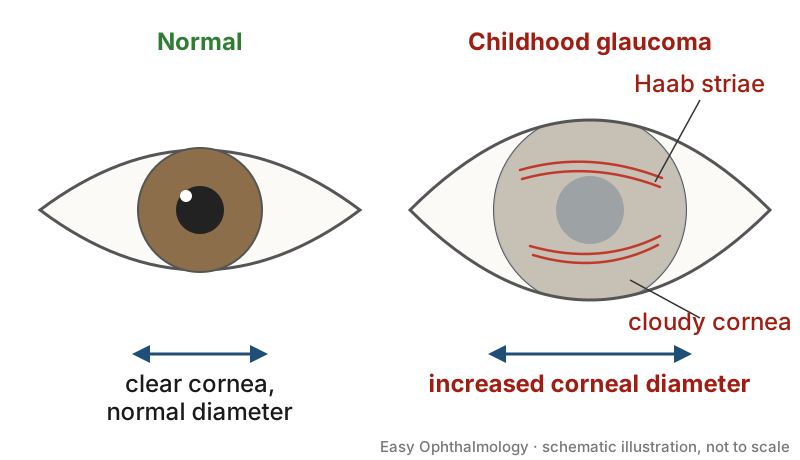
- Examination findings to record: IOP, corneal diameter and clarity, Haab striae, refraction, cup-disc ratio and asymmetry of at least 0.2 [S9].
- Genetic testing practices vary and there are no widely accepted testing guidelines [S6].
Manage it
Before acting on this section, check the national and local guidelines, product information and regulatory approvals that apply where you practise. See the medical disclaimer.
Tier A (primary care / no specialist)
- Recognise the signs above and refer the child the same day [EIC expert opinion].
- Avoid prolonged topical steroid use without eye review in at-risk children [S10].
Tier B (general eye clinic)
- Confirm raised IOP and corneal signs and refer to a paediatric glaucoma surgeon [S9] [EIC expert opinion].
- Medication is often used before surgery [S9]; one guideline listed topical beta-blockers or carbonic anhydrase inhibitors, on low to moderate quality evidence or expert opinion [S4]. Dosing for children is not covered by these sources; follow paediatric formularies.
- Correct refractive error and treat amblyopia after surgery; optical correction was needed in 66% of PCG eyes long term [S3].
Tier C (specialist centre)
- Angle surgery. Goniotomy and trabeculotomy are first-line operations [S9] [S12]. Microcatheter-assisted 360-degree trabeculotomy gave lower IOP at 12 months (MD -1.77 mmHg) and higher success (RR 1.54) than conventional trabeculotomy [S2].
- Combined trabeculotomy-trabeculectomy (CTT). CTT and trabeculotomy showed little to no difference in IOP or success at 1 year (very low certainty) [S2], but CTT is described as showing superior long-term success in Indian children (narrative review) [S12]. Caregiver quality of life improved after CTT [S5].
- Cyclophotocoagulation. Transscleral and endoscopic cyclophotocoagulation both lowered IOP (from 31.2 to 20.8 mmHg and from 32.9 to 22.6 mmHg), with multiple sessions often needed [S7].
- Netarsudil may be an adjunct in refractory cases on maximal drops, with careful corneal examination; evidence is retrospective [S8].
- Optical rehabilitation. Rigid gas-permeable lenses gave 0.19 logMAR more improvement than spectacles at 1 year, and better stereoacuity [S11].
- Long-term care. Lifelong monitoring is needed because surgical success can decline over time [S12]. Surgical success was associated with better final acuity and stereoacuity [S3].
Refer when
| Situation | Urgency |
|---|---|
| Infant with cloudy or enlarged cornea | Same-day referral to a paediatric eye service [EIC expert opinion] |
| Child with confirmed raised IOP or suspected glaucoma | Within days to a paediatric glaucoma surgeon [EIC expert opinion] |
| Child on long-term topical steroids with risk factors | Urgent for IOP check [S10]; timing per your local service or specialist advice |
Pitfalls
- Treating only the IOP and neglecting refraction and amblyopia [S3] [S11].
- Losing children to follow-up: inadequate follow-up worsens outcomes in developing countries [S1].
- Ignoring caregiver burden, which is high and worse with longer and more severe disease [S5].
- Missing steroid-induced pressure rise in children [S10].
Evidence notes
| Source | Date | Design |
|---|---|---|
| [S1] | 2013 | Narrative review (developing world) |
| [S2] | 2020 | Cochrane review, 16 trials, 587 eyes, mostly Egypt and the Middle East |
| [S3] | 2020 | Cohort study of long-term PCG outcomes |
| [S4] | 2022 | Systematic review of guidelines |
| [S5] | 2022 | Systematic review, 8 studies |
| [S6] | 2024 | Systematic review, 196 genetic studies |
| [S7] | 2024 | Meta-analysis, 17 observational studies |
| [S8] | 2025 | Systematic review, 8 publications (retrospective and case reports) |
| [S9] | 2025 | Narrative review |
| [S10] | 2025 | Narrative review |
| [S11] | 2025 | RCT (CLEVR-PCG), 56 children, China |
| [S12] | 2026 | Narrative review with literature search (India) |
- Thin evidence. The search sheet held mostly narrative reviews; trials are few and small, and no high-quality guideline exists [S2] [S4]. Clinical signs and the treatment sequence rest on narrative reviews [S9] [S12].
- The Cochrane finding of no difference between CTT and trabeculotomy conflicts with the Indian review's preference for CTT [S2] [S12].
- Not covered by these sources: examination under anaesthesia technique, drug doses for children, drainage device outcomes in children, and glaucoma after childhood cataract surgery.
Related articles
References
See the numbered source list below. Each marker [S#] links to its PubMed and DOI record.
Sources
- [S1] Moore DB, Tomkins O, Ben-Zion I A review of primary congenital glaucoma in the developing world. Survey of ophthalmology. (2013). PubMed 23465868 · doi:10.1016/j.survophthal.2012.11.003
- [S2] Gagrani M, Garg I, Ghate D Surgical interventions for primary congenital glaucoma. The Cochrane database of systematic reviews. (2020). PubMed 32816311 · doi:10.1002/14651858.cd008213.pub3
- [S3] Esfandiari H, Prager A, Hassanpour K, Kurup SP, Mets-Halgrimson R, Yoon H, et al. The Long-term Visual Outcomes of Primary Congenital Glaucoma. Journal of ophthalmic & vision research. (2020). PubMed 32864063 · doi:10.18502/jovr.v15i3.7451
- [S4] Lingham G, Thakur S, Safi S, Gordon I, Evans JR, Keel S A systematic review of clinical practice guidelines for childhood glaucoma. BMJ open ophthalmology. (2022). PubMed 35136841 · doi:10.1136/bmjophth-2021-000933
- [S5] Basilious A, Villani S, Jang H, Kaberi KM, Malvankar-Mehta MS Quality of life and caregiver burden in pediatric glaucoma: A systematic review. PloS one. (2022). PubMed 36288373 · doi:10.1371/journal.pone.0276881
- [S6] Kumar A, Han Y, Oatts JT Genetic changes and testing associated with childhood glaucoma: A systematic review. PloS one. (2024). PubMed 38386645 · doi:10.1371/journal.pone.0298883
- [S7] Elhusseiny AM, Hassan AK, Elsaman AS, Azhari JO, VanderVeen DK, Abdelnaem S, et al. Continuous Wave Transscleral Cyclophotocoagulation and Endoscopic Cyclophotocoagulation in Childhood Glaucoma: A Meta-Analysis. Journal of glaucoma. (2024). PubMed 38506746 · doi:10.1097/ijg.0000000000002365
- [S8] Shaikh O, Kuziez L, Saeedi OJ, Abbasian J, Elhusseiny AM Topical Netarsudil in Childhood Glaucoma: A Systematic Review. Current eye research. (2025). PubMed 39749726 · doi:10.1080/02713683.2024.2445622
- [S9] Coviltir V, Marinescu MC, Urse BM, Burcel MG Primary Congenital and Childhood Glaucoma-A Complex Clinical Picture and Surgical Management. Diagnostics (Basel, Switzerland). (2025). PubMed 39941238 · doi:10.3390/diagnostics15030308
- [S10] Lacau S, Marin A, Bitrian E Steroid-Induced Ocular Hypertension in Children: A Review on Risk Factors. Journal of ocular pharmacology and therapeutics : the official journal of the Association for Ocular Pharmacology and Therapeutics. (2025). PubMed 40359125 · doi:10.1089/jop.2025.0024
- [S11] Jiang J, Hu Y, Zhu Y, Zhong Y, Xiang C, Chen S, et al. Visual Outcomes of Children With Primary Congenital Glaucoma Receiving Different Refractive Corrections: The CLEVR-PCG Randomized Clinical Trial. JAMA ophthalmology. (2025). PubMed 41196588 · doi:10.1001/jamaophthalmol.2025.3976
- [S12] Tripathi M, Gupta V, Gupta S Management of primary congenital glaucoma in the Indian population. Indian journal of ophthalmology. (2026). PubMed 41739114 · doi:10.4103/ijo.ijo_290_25