Educational content only. Not personalised medical advice. Clinical decisions remain the responsibility of the treating clinician.
Glaucoma Drainage Devices
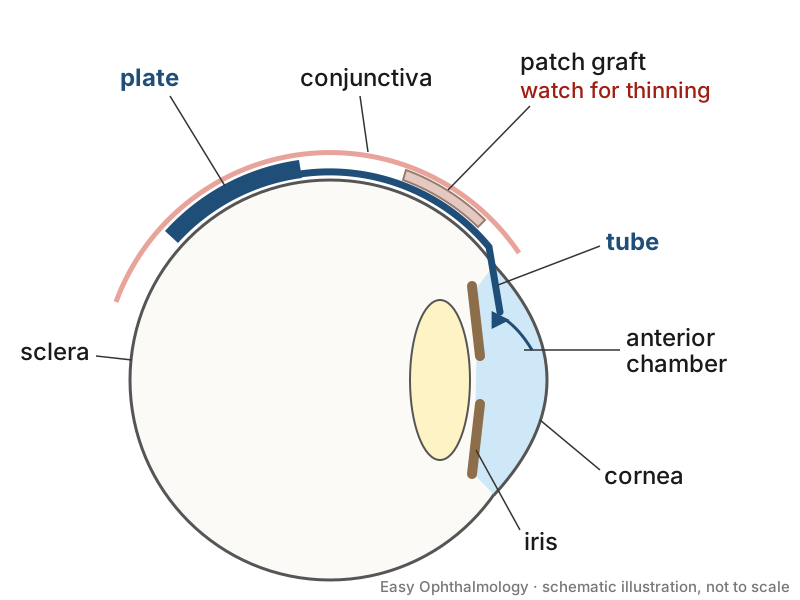
Glaucoma drainage devices (tube shunts) are used for refractory glaucoma and, increasingly, as a primary operation [S1] [S7]. Valved (Ahmed) and non-valved (Baerveldt, Paul, Aurolab) implants trade safety against pressure lowering [S2] [S11] [S12], and a low-cost non-valved implant compared well with the Ahmed valve [S8].
Key points - In eyes with previous trabeculectomy or cataract surgery, a Baerveldt tube had lower 5-year failure than trabeculectomy with MMC (29.8% vs 46.9%) [S1]. - In eyes with no previous incisional surgery, tube and trabeculectomy had similar IOP and failure at 5 years, but tubes needed more medications (2.2 vs 1.3) [S7]. - The Baerveldt implant lowered IOP more and needed fewer reoperations than the Ahmed valve, but failed more often for safety reasons (persistent hypotony, explantation, loss of light perception) [S2]; the Ahmed valve had less persistent hypotony and choroidal effusion [S11]. - The Aurolab aqueous drainage implant (AADI) achieved higher complete success than the Ahmed valve (OR 3.64) with similar adverse events [S8]. - Lower preoperative IOP, neovascular glaucoma, Ahmed implantation and younger age predicted tube failure [S6].
Evidence last checked: 2026-10-17 (PubMed abstracts).
Red flags
- Tube exposure: the most common late complication after Baerveldt surgery in neovascular glaucoma [S5]; Baerveldt implants had more tube erosion than trabeculectomy [S10].
- Hypotony and choroidal effusion: persistent hypotony occurred in 4.4% after Baerveldt vs 0.6% after Ahmed in RCTs [S11].
- Diplopia or strabismus: more frequent after Baerveldt than trabeculectomy [S10].
- Vision loss: occurred in 18.9% after Baerveldt vs 9% after Ahmed in pooled data [S11].
Recognise it: who needs a tube
- Uncontrolled glaucoma after previous trabeculectomy or cataract extraction [S1].
- Refractory glaucoma or previous intraocular surgery [S2] [S8] [S12].
- Medically uncontrolled glaucoma without previous surgery, as an alternative to trabeculectomy [S7].
- Neovascular glaucoma, where tube failure risk is higher (HR 1.79) [S6]; a Japanese RCT found trabeculectomy and Baerveldt implant similarly successful, with fewer late complications after trabeculectomy [S5].
Confirm it: judging outcome
- Trials defined failure as IOP above 21 mmHg or reduced less than 20% from baseline, IOP of 5 mmHg or less, reoperation for glaucoma, or loss of light perception [S1].
- Mean 5-year IOP was 12.7 to 14.7 mmHg across tube trials [S1] [S2] [S7].
- Anterior segment OCT was used to monitor patch graft thinning over the tube [S4].
Manage it
Before acting on this section, check the national and local guidelines, product information and regulatory approvals that apply where you practise. See the medical disclaimer.
Tier A (primary care / no specialist)
- No tube management at this level. Patients with a tube who develop a red, painful eye, an exposed tube or reduced vision need the eye unit the same day.
Tier B (general eye clinic)
- Examine the conjunctiva over the tube for thinning or exposure [S4] [S5], and check for double vision [S10].
- Expect patients to need some drops after a tube: mean 1.4 to 2.2 medications at 5 years [S1] [S2] [S7].
Tier C (specialist centre)
- Tube or trabeculectomy. A meta-analysis of 49 studies found the Ahmed valve similar to trabeculectomy for IOP with fewer adverse events, and the Baerveldt implant less effective for IOP but with fewer bleb leaks, hyphaema and hypotony maculopathy [S10]. Cochrane found the IOP difference between shunts and trabeculectomy at 1 year uncertain (very low certainty) [S3].
- Choosing a device. Ahmed had higher IOP at 1 year (MD 2.60 mmHg) and more reoperations than Baerveldt (moderate certainty) [S3]. Ahmed has a safer hypotony profile [S11]. Choose by patient risk [S11].
- Low-cost devices. The AADI lowered IOP more and needed fewer medications than the Ahmed valve in 6 studies of 825 eyes [S8], relevant where device cost limits access.
- Newer implants. The Paul implant reduced IOP by 14.8 to 19.1 mmHg with complete success of 38.4% to 75%; evidence is mostly uncontrolled with short follow-up [S12].
- Covering the tube. Amniotic membrane-umbilical cord grafts thinned less than pericardium (early thinning 12% vs 43%), with similar exposure rates [S4].
- Neovascular glaucoma. Intravitreal bevacizumab with Ahmed valve and panretinal photocoagulation was studied in RCTs; anti-VEGF improved IOP control at 1 month (RR 1.32, low certainty) [S9].
Refer when
| Situation | Urgency |
|---|---|
| Exposed tube, or red painful eye with a tube | Immediate, same-day |
| Very low IOP, shallow chamber or choroidal effusion after tube surgery | Within hours to the surgeon [S11] [EIC expert opinion] |
| Uncontrolled IOP after failed trabeculectomy | Urgent to a glaucoma surgeon [S1]; timing per your local service or specialist advice |
Pitfalls
- Assuming all tubes behave alike: valved and non-valved devices differ in IOP and safety [S2] [S11].
- Missing early conjunctival thinning over the tube [S4].
- Expecting drop-free control after a tube [S7].
- Using the higher-cost device by default where a low-cost implant performs at least as well [S8].
Evidence notes
| Source | Date | Design |
|---|---|---|
| [S1] | 2012 | Multicentre RCT (TVT), 212 eyes, 5 years |
| [S2] | 2015 | RCT (ABC study), 5 years |
| [S3] | 2017 | Cochrane review, 27 trials |
| [S4] | 2019 | RCT, 81 eyes |
| [S5] | 2021 | RCT, 50 patients, Japan |
| [S6] | 2022 | Pooled analysis of prospective trial data |
| [S7] | 2022 | Multicentre RCT (PTVT), 242 eyes, 5 years |
| [S8] | 2023 | Meta-analysis, 6 studies |
| [S9] | 2023 | Cochrane review, 5 RCTs |
| [S10] | 2023 | Meta-analysis, 49 studies |
| [S11] | 2025 | Meta-analysis, 4 RCTs and 9 non-randomised studies |
| [S12] | 2025 | Systematic review, 18 studies, mostly uncontrolled |
- TVT and PTVT enrolled different populations (previous surgery vs none), which explains different conclusions [S1] [S7].
- The AADI meta-analysis included non-randomised studies; design details are not given in the abstract [S8].
- Not covered by these sources: surgical technique, tube position choice, management of tube exposure, childhood and uveitic glaucoma tubes, and device cost figures.
Related articles
References
See the numbered source list below. Each marker [S#] links to its PubMed and DOI record.
Sources
- [S1] Gedde SJ, Schiffman JC, Feuer WJ, Herndon LW, Brandt JD, Budenz DL, et al. Treatment outcomes in the Tube Versus Trabeculectomy (TVT) study after five years of follow-up. American journal of ophthalmology. (2012). PubMed 22245458 · doi:10.1016/j.ajo.2011.10.026
- [S2] Budenz DL, Barton K, Gedde SJ, Feuer WJ, Schiffman J, Costa VP, et al. Five-year treatment outcomes in the Ahmed Baerveldt comparison study. Ophthalmology. (2015). PubMed 25439606 · doi:10.1016/j.ophtha.2014.08.043
- [S3] Tseng VL, Coleman AL, Chang MY, Caprioli J Aqueous shunts for glaucoma. The Cochrane database of systematic reviews. (2017). PubMed 28750481 · doi:10.1002/14651858.cd004918.pub3
- [S4] Sheha H, Tello C, Al-Aswad LA, Sayed MS, Lee RK Outcomes of the Shunt Tube Exposure Prevention Study: A Randomized Clinical Trial. Ophthalmology. Glaucoma. (2019). PubMed 32672570 · doi:10.1016/j.ogla.2019.08.003
- [S5] Tokumo K, Komatsu K, Yuasa Y, Murakami Y, Okumichi H, Hirooka K, et al. Treatment outcomes in the neovascular glaucoma tube versus trabeculectomy study. Graefe's archive for clinical and experimental ophthalmology = Albrecht von Graefes Archiv fur klinische und experimentelle Ophthalmologie. (2021). PubMed 34125289 · doi:10.1007/s00417-021-05257-2
- [S6] Bowden EC, Choudhury A, Gedde SJ, Feuer WJ, Christakis PG, Savatovsky E, et al. Risk Factors for Failure of Tube Shunt Surgery: A Pooled Data Analysis. American journal of ophthalmology. (2022). PubMed 35288073 · doi:10.1016/j.ajo.2022.02.027
- [S7] Gedde SJ, Feuer WJ, Lim KS, Barton K, Goyal S, Ahmed II, et al. Treatment Outcomes in the Primary Tube Versus Trabeculectomy Study after 5 Years of Follow-up. Ophthalmology. (2022). PubMed 35835337 · doi:10.1016/j.ophtha.2022.07.003
- [S8] Hong M, Peng Y, Lai Y, Zheng Q, Hong C Comparison of Aurolab Aqueous Drainage Implant with Ahmed Glaucoma Valve for Refractory Glaucoma: A Meta-Analysis. Ophthalmic research. (2023). PubMed 36646045 · doi:10.1159/000529039
- [S9] Rittiphairoj T, Roberti G, Michelessi M Anti-vascular endothelial growth factor for neovascular glaucoma. The Cochrane database of systematic reviews. (2023). PubMed 37010901 · doi:10.1002/14651858.cd007920.pub4
- [S10] Luo N, Liu M, Hao M, Xu R, Wang F, Zhang W Comparison of tube shunt implantation and trabeculectomy for glaucoma: a systematic review and meta-analysis. BMJ open. (2023). PubMed 37080625 · doi:10.1136/bmjopen-2022-065921
- [S11] Matarazzo F, Passaro ML, Rinaldi M, Afflitto GG, Aiello F, Avolio FC, et al. Ahmed and baerveldt in glaucoma surgery: what is the safest choice? - a systematic review and meta-analysis. Graefe's archive for clinical and experimental ophthalmology = Albrecht von Graefes Archiv fur klinische und experimentelle Ophthalmologie. (2025). PubMed 40164796 · doi:10.1007/s00417-025-06794-w
- [S12] Carlà MM, Gambini G, Boselli F, Hu L, Perugini AM, Crincoli E, et al. The Paul Glaucoma Implant: a systematic review of safety, efficacy, and emerging applications. Graefe's archive for clinical and experimental ophthalmology = Albrecht von Graefes Archiv fur klinische und experimentelle Ophthalmologie. (2025). PubMed 40434721 · doi:10.1007/s00417-025-06861-2