Educational content only. Not personalised medical advice. Clinical decisions remain the responsibility of the treating clinician.
Uveal melanoma: diagnosis and primary treatment
Uveal melanoma is the most common primary intraocular tumour in adults [S9]. Untreated choroidal and ciliary body melanoma metastasises in most reported patients, and delay in treatment carries a measurable risk that rises with tumour size [S6] [S11]. Eye-conserving radiotherapy gives survival similar to enucleation in randomised evidence [S1].
Key points - In the COMS randomised trial, survival after iodine-125 brachytherapy did not differ from enucleation, with little difference in quality of life [S1] [S3]. - Each month a melanoma stays untreated is estimated to add 0.3, 1.8 and 4.0 percentage points to the 10-year risk of metastatic death for small, medium and large tumours [S11]. - Charged-particle therapy gives lower local recurrence than brachytherapy, with a possible higher risk of secondary glaucoma; mortality does not differ [S9]. - Surveillance for metastases can be tailored to each patient's prognostic group [S10].
Evidence last checked: 2026-10-17 (PubMed abstracts).
Red flags
- Delay in definitive treatment. Larger melanomas have shorter volume doubling times (717, 421 and 307 days for small, medium and large tumours), so delay matters most for large tumours [S11].
- Untreated melanoma. In the rare published untreated patients, 15 of 17 with choroidal or ciliary body melanoma developed metastases, and disease-specific survival was 29% at 10 years [S6].
- Toxic tumour syndrome after radiotherapy. This aggressive secondary vasculopathy from persisting necrotic tumour usually ends in enucleation if untreated [S4].
Recognise it
- Clinical presentation and the features that separate a melanoma from a naevus are not described in these abstracts (see the choroidal naevus article).
- Growing naevi have a mean volume doubling time of 6392 days, far longer than melanomas (360 days on average) [S11].
Confirm it
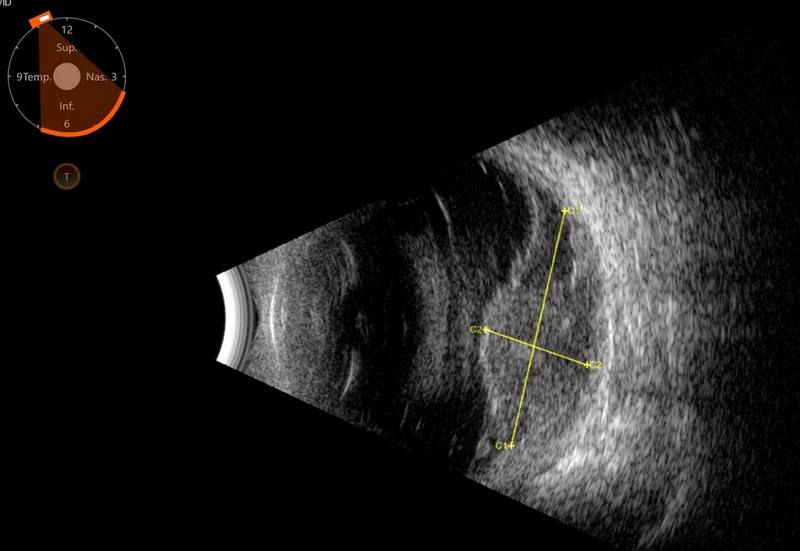
- In the COMS, tumours were followed with ophthalmic ultrasound and fundus photography [S3].
- Prognostic biopsy with gene expression profiling (GEP) is used at primary treatment; in a cohort of 347 patients the observed 5-year metastasis-free survival for class 2 tumours (47%) was better than the GEP-predicted 28%, and larger tumour size independently raised metastatic risk [S7].
- The Alberta guideline gives recommendations on genetic prognostic testing and imaging to detect metastases [S8].
Manage it
Before acting on this section, check the national and local guidelines, product information and regulatory approvals that apply where you practise. See the medical disclaimer.
Tier A (primary care / no specialist)
- Refer any suspected intraocular tumour to an eye service (see Refer when). Treatment is not possible at this level.
Tier B (general eye clinic)
- Document the lesion and arrange prompt ocular oncology referral; the cost of delay rises with tumour size [S11].
- Where no ocular oncology service exists, note that enucleation and brachytherapy gave similar survival in the COMS [S1].
Tier C (specialist centre)
- Plaque brachytherapy. In the COMS (tumours 2.5 to 10.0 mm thick and up to 16.0 mm basal diameter), the 5-year risk of enucleation after iodine-125 brachytherapy was 12.5% and of local treatment failure 10.3% [S3]. Thicker tumours and those close to the fovea had higher risk [S3]. A pooled analysis of 103 studies (21,263 patients) found ruthenium-106 plaques gave high local control while minimising complications, and use of a treatment planning system most influenced outcomes [S5].
- Charged-particle therapy. A 2024 meta-analysis (2 RCTs, 5 controlled cohorts, 143 case series) found lower local recurrence than brachytherapy (OR 0.38) and no difference in mortality, enucleation or cataract [S9]. The only randomised comparison (184 patients) reported 5-year local control of 100% with helium ions versus 84% with iodine-125 plaque, and 5-year enucleation of 11% versus 22% [S2].
- Proton beam therapy. Pooled case series (1059 patients) reported 5-year overall survival of 73% and 5-year local control of 94%; glaucoma, optic neuropathy and cataract were the commonest adverse effects [S12].
- Toxic tumour syndrome. A systematic review suggests endoresection within 3 months of radiotherapy for tumours thicker than 7 mm with basal diameter 8 to 15 mm and post-equatorial location, and endodrainage for eyes with macula-off detachment, diameter above 15 mm or ciliary body involvement [S4].
- Radiation retinopathy. The Alberta guideline includes recommendations on intravitreal anti-VEGF agents for radiation retinopathy [S8] (see the radiation retinopathy article).
- Surveillance. Under a "number needed to scan 20" model, patients with disomy 3 tumours need about two examinations while GEP class 2 PRAME-positive patients need up to 17 [S10]. Regimens and intervals are otherwise not detailed in these abstracts.
Refer when
| Situation | Urgency |
|---|---|
| Suspected choroidal or ciliary body melanoma | Urgent to ocular oncology; timing per your local service or specialist advice (delay risk rises with size [S11]) |
| Large tumour, painful eye or secondary glaucoma | Urgent; timing per your local service or specialist advice |
| Treated patient with new systemic symptoms | Urgent, oncology review; timing per your local service or specialist advice |
Pitfalls
- Assuming a "watch and wait" delay is harmless for a confirmed medium or large melanoma [S11].
- Telling patients that enucleation improves survival over brachytherapy: the COMS showed no difference [S1].
- Taking a GEP-predicted prognosis as exact: observed survival in class 2 tumours was better than predicted [S7].
- Applying one fixed surveillance schedule to every patient [S10].
Evidence notes
| Source | Date | Design |
|---|---|---|
| [S1] | 2011 | COMS multicentre RCT, brachytherapy vs enucleation (overview) |
| [S2] | 2015 | RCT, helium ion vs iodine-125, 184 patients |
| [S3] | 2020 | Case series within the COMS RCT, 650 patients |
| [S4] | 2021 | Systematic review |
| [S5] | 2022 | Systematic review and pooled analysis, 103 studies |
| [S6] | 2022 | Systematic review, 19 untreated patients |
| [S7] | 2022 | Cohort with meta-analysis of published series |
| [S8] | 2023 | Clinical practice guideline (Alberta, Canada) |
| [S9] | 2024 | Systematic review and meta-analysis |
| [S10] | 2025 | Modelling study from systematic review data |
| [S11] | 2025 | Systematic review and meta-analysis, 5 studies |
| [S12] | 2025 | Meta-analysis of 6 case series |
- Most comparative radiotherapy evidence is observational; the level of evidence is limited [S9].
- The doubling-time estimates [S11] and untreated-tumour survival [S6] rest on few patients and modelling.
- The proton beam meta-analysis has no comparator arm [S12].
- Not covered by these sources: symptoms and signs, imaging criteria for diagnosis, radiation doses, enucleation technique, adjuvant therapy, and costs or access in low-resource settings. The Alberta guideline abstract [S8] lists topics but not its recommendations.
Related articles
- Choroidal naevus versus small melanoma
- Metastatic uveal melanoma and tebentafusp
- Radiation retinopathy
References
See the numbered source list below. Each marker [S#] links to its PubMed and DOI record.
Sources
- [S1] Hawkins BS Collaborative ocular melanoma study randomized trial of I-125 brachytherapy. Clinical trials (London, England). (2011). PubMed 22013172 · doi:10.1177/1740774511419684
- [S2] Mishra KK, Quivey JM, Daftari IK, Weinberg V, Cole TB, Patel K, et al. Long-term Results of the UCSF-LBNL Randomized Trial: Charged Particle With Helium Ion Versus Iodine-125 Plaque Therapy for Choroidal and Ciliary Body Melanoma. International journal of radiation oncology, biology, physics. (2015). PubMed 25841624 · doi:10.1016/j.ijrobp.2015.01.029
- [S3] Jampol LM, Moy CS, Murray TG, Reynolds SM, Albert DM, Schachat AP, et al. The COMS Randomized Trial of Iodine 125 Brachytherapy for Choroidal Melanoma: IV. Local Treatment Failure and Enucleation in the First 5 Years after Brachytherapy. COMS Report No. 19. Ophthalmology. (2020). PubMed 32200815 · doi:10.1016/j.ophtha.2020.01.032
- [S4] Romano MR, Catania F, Confalonieri F, Zollet P, Allegrini D, Sergenti J, et al. Vitreoretinal Surgery in the Prevention and Treatment of Toxic Tumour Syndrome in Uveal Melanoma: A Systematic Review. International journal of molecular sciences. (2021). PubMed 34576231 · doi:10.3390/ijms221810066
- [S5] Buonanno F, Conson M, de Almeida Ribeiro C, Oliviero C, Itta F, Liuzzi R, et al. Local tumor control and treatment related toxicity after plaque brachytherapy for uveal melanoma: A systematic review and a data pooled analysis. Radiotherapy and oncology : journal of the European Society for Therapeutic Radiology and Oncology. (2022). PubMed 34774654 · doi:10.1016/j.radonc.2021.11.007
- [S6] Stålhammar G, Gill VT The long-term prognosis of patients with untreated primary uveal melanoma: A systematic review and meta-analysis. Critical reviews in oncology/hematology. (2022). PubMed 35304261 · doi:10.1016/j.critrevonc.2022.103652
- [S7] Singh AD, Binkley EM, Wrenn JM, Bena JF, Hinz C, Boldt HC Predicted vs Observed Metastasis-Free Survival in Individuals With Uveal Melanoma. JAMA ophthalmology. (2022). PubMed 35862032 · doi:10.1001/jamaophthalmol.2022.2623
- [S8] Weis E, Surgeoner B, Salopek TG, Cheng T, Hyrcza M, Kostaras X, et al. Management of Uveal Melanoma: Updated Cancer Care Alberta Clinical Practice Guideline. Current oncology (Toronto, Ont.). (2023). PubMed 38275828 · doi:10.3390/curroncol31010002
- [S9] Tseng YH, Hsu CA, Chou YB Comparing efficacy of charged-particle therapy with brachytherapy in treatment of uveal melanoma. Eye (London, England). (2024). PubMed 38565600 · doi:10.1038/s41433-024-03035-y
- [S10] Hagström A, Witzenhausen H, Stålhammar G Tailoring surveillance imaging in uveal melanoma based on individual metastatic risk. Canadian journal of ophthalmology. Journal canadien d'ophtalmologie. (2025). PubMed 39151896 · doi:10.1016/j.jcjo.2024.07.014
- [S11] Stålhammar G, Hagström A, Ermedahl Conradi M, Williams PA Choroidal nevi and melanoma doubling times and implications for delays in treatment: A systematic review and meta-analysis. Survey of ophthalmology. (2025). PubMed 39343315 · doi:10.1016/j.survophthal.2024.09.004
- [S12] Miao Y, Zheng T, Zhang Q, Li M, Lei Q, Liu Q, et al. Efficacy and safety of proton radiotherapy in treating choroidal melanoma: a systematic review and meta-analysis. Radiation oncology (London, England). (2025). PubMed 39799332 · doi:10.1186/s13014-024-02580-w