Educational content only. Not personalised medical advice. Clinical decisions remain the responsibility of the treating clinician.
Radiation retinopathy
Radiation retinopathy and radiation maculopathy are common, vision-threatening complications of ocular and periocular radiotherapy, particularly after treatment of uveal melanoma [S12]. They result from progressive occlusive microangiopathy causing retinal ischaemia, macular oedema and visual decline [S12]. Intravitreal anti-VEGF therapy is the current standard of care and can also be used to prevent maculopathy in high-risk eyes [S10] [S12].
Key points - After iodine-125 brachytherapy in the COMS, 91.2% of patients had at least one posterior pole abnormality at 5 years, and optic neuropathy was present in 27.4% [S2]. - Risk rises with diabetes, hypertension, radiation dose and fractionation, and tumour location near the optic nerve and fovea [S2] [S11]. - In a meta-analysis, prophylactic anti-VEGF reduced radiation maculopathy (OR 0.40) and treatment of established maculopathy improved visual acuity [S10]. - Monthly ranibizumab gave better vision than as-needed dosing in a phase IIb RCT; adding targeted laser gave no benefit [S6]. - Intravitreal dexamethasone is an option for suboptimal response to, or contraindications for, anti-VEGF [S7].
Evidence last checked: 2026-10-17 (PubMed abstracts).
Red flags
- Vision loss after ocular radiotherapy. Retinopathy and optic neuropathy increase in amount and severity through 8 years after brachytherapy [S2].
- Iris neovascularisation or neovascular glaucoma. At 4 years after plaque radiotherapy with prophylactic bevacizumab, these developed in 13% and 12% of large melanomas [S5].
- Diabetes. Diabetes was a prognostic factor for more severe posterior pole abnormalities [S2].
- Stopping treatment. The benefit of ranibizumab over laser disappeared after injections were stopped [S4].
Recognise it
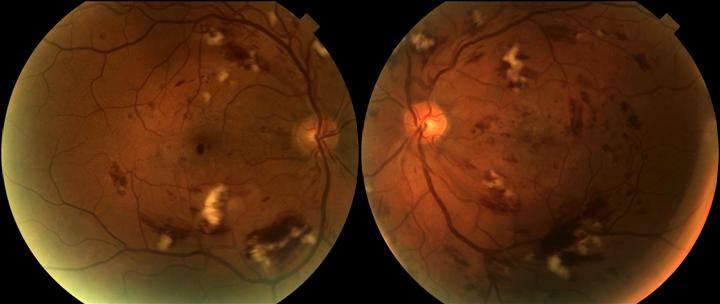
- Clinical signs include macular oedema, retinal haemorrhages, cotton-wool spots, capillary dropout and neovascularisation [S1] [S9].
- The commonest findings in the COMS were macular microaneurysms (75.6% of examinations), macular angiographic leakage (75.1%) and optic disc hyperfluorescence (62.8%) [S2].
- Neovascularisation of the disc was present in 5.2% at 5 years [S2].
- Large tumours had a higher 4-year risk of cystoid macular oedema (63%) and earlier onset (19 months) than small or medium tumours [S5].
Confirm it
- OCT and OCT angiography detect subclinical oedema and microvascular ischaemia before changes are visible on fundoscopy [S12]; radiation vasculopathy appears on OCT-A before clinical signs or symptoms [S9].
- Ultra-widefield fluorescein angiography helps early detection [S11].
- Classification systems combining fundus, angiographic and OCT features allow standardised grading [S12].
Manage it
Before acting on this section, check the national and local guidelines, product information and regulatory approvals that apply where you practise. See the medical disclaimer.
Tier A (primary care / no specialist)
- Anyone who has had radiotherapy to or near the eye and reports reduced vision needs an eye examination (see Refer when) [S2] [S12].
- Optimise control of diabetes and hypertension, which are risk factors [S11] [S12].
Tier B (general eye clinic)
- Examine with OCT where available; it shows oedema before fundus changes [S12].
- Check the iris and intraocular pressure for neovascularisation, especially after treatment of large tumours [S5].
- Coordinate with the treating ocular oncology service; intravitreal therapy can be given where injection services exist [S7].
Tier C (specialist centre)
- Anti-VEGF for established maculopathy. Anti-VEGF agents have the strongest evidence for reducing oedema and preserving vision, though no agent is clearly superior and most data are non-comparative [S12]. In a meta-analysis of 4 trials (189 eyes), anti-VEGF improved acuity and reduced central macular thickness over 6 months [S10].
- Regimen. In a phase IIb RCT of 40 eyes, monthly ranibizumab 0.5 mg (as reported in [S6]) gained 4.0 letters at 1 year versus 0.9 with as-needed dosing plus laser [S6]. After switching to treat-and-extend in year 2, the gains were not maintained, although 90% kept 20/200 or better [S8]. Ranibizumab was superior to focal and panretinal laser at 6 months in a small RCT, but the effect disappeared by 52 weeks after treatment stopped [S4].
- Bevacizumab. In an early series of 21 patients, bevacizumab 1.25 mg every 6-12 weeks, as reported in [S1], reduced haemorrhage, exudation and oedema, with acuity stable or improved in 86% [S1].
- Prophylaxis. In 4 trials (2226 eyes), preventive anti-VEGF reduced radiation maculopathy over 24 months [S10]. In a pilot study of 40 patients after proton beam therapy, ranibizumab every 2 months kept 97% at 20/200 or better versus 45% of historical controls [S3]. Earlier anti-VEGF intervention typically preserved more macular anatomy and vision [S9].
- Corticosteroids. Intravitreal dexamethasone implant is an option for suboptimal response or contraindications to anti-VEGF [S7]. A trial of prophylactic faricimab or fluocinolone acetonide implant versus observation is under way [S11].
- Laser. Retinal laser alone gave poor outcomes historically [S7]; targeted laser added nothing to ranibizumab [S6].
Refer when
| Situation | Urgency |
|---|---|
| Reduced vision after ocular or periocular radiotherapy | Urgent to the treating ocular oncology or retina service; timing per your local service or specialist advice |
| Iris neovascularisation or raised pressure after radiotherapy | Urgent; timing per your local service or specialist advice |
Pitfalls
- Waiting for vision loss before treating high-risk eyes: earlier treatment preserves more vision [S9].
- Extending injection intervals too fast: gains fell after switching to treat-and-extend [S8] [S10].
- Relying on fundoscopy alone: OCT detects subclinical disease [S12].
- Assuming laser is an adequate substitute for anti-VEGF [S4] [S7].
Evidence notes
| Source | Date | Design |
|---|---|---|
| [S1] | 2008 | Prospective case series, 21 patients |
| [S2] | 2009 | Observational series within the COMS RCT, 650 patients |
| [S3] | 2016 | Phase 1 pilot study with historical controls |
| [S4] | 2020 | Phase II RCT, 31 patients |
| [S5] | 2020 | Retrospective series, 1131 eyes |
| [S6] | 2020 | Phase IIb RCT, 40 eyes, 1-year results |
| [S7] | 2021 | Systematic review |
| [S8] | 2022 | Phase IIb RCT, 2-year results |
| [S9] | 2023 | Narrative review |
| [S10] | 2024 | Systematic review and meta-analysis, 11 trials |
| [S11] | 2025 | Narrative review |
| [S12] | 2026 | Narrative review |
- Most treatment evidence is from small or retrospective studies [S7] [S12]; the RCTs are small phase II trials [S4] [S6].
- The prophylaxis pilot used historical controls [S3].
- [S1] and [S9] are from the same research group that first described anti-VEGF for this condition.
- Not covered by these sources: aflibercept and faricimab dosing, treatment of radiation optic neuropathy in detail, and evidence-based referral timings.
Related articles
References
See the numbered source list below. Each marker [S#] links to its PubMed and DOI record.
Sources
- [S1] Finger PT Radiation retinopathy is treatable with anti-vascular endothelial growth factor bevacizumab (Avastin). International journal of radiation oncology, biology, physics. (2008). PubMed 18313522 · doi:10.1016/j.ijrobp.2007.11.045
- [S2] Boldt HC, Melia BM, Liu JC, Reynolds SM, Collaborative Ocular Melanoma Study Group I-125 brachytherapy for choroidal melanoma photographic and angiographic abnormalities: the Collaborative Ocular Melanoma Study: COMS Report No. 30. Ophthalmology. (2009). PubMed 19118701 · doi:10.1016/j.ophtha.2008.10.013
- [S3] Kim IK, Lane AM, Jain P, Awh C, Gragoudas ES Ranibizumab for the Prevention of Radiation Complications in Patients Treated With Proton Beam Irradiation for Choroidal Melanoma. Transactions of the American Ophthalmological Society. (2016). PubMed 27630373
- [S4] Seibel I, Vollhardt D, Riechardt AI, Rehak M, Schmied S, Schiller P, et al. Influence of Ranibizumab versus laser photocoagulation on radiation retinopathy (RadiRet) - a prospective randomized controlled trial. Graefe's archive for clinical and experimental ophthalmology = Albrecht von Graefes Archiv fur klinische und experimentelle Ophthalmologie. (2020). PubMed 32112140 · doi:10.1007/s00417-020-04618-7
- [S5] Yang X, Dalvin LA, Mazloumi M, Chang M, Shields JA, Mashayekhi A, et al. Impact of uveal melanoma thickness on post-plaque radiotherapy outcomes in the prophylactic anti-vascular endothelial growth factor era in 1131 patients. Clinical & experimental ophthalmology. (2020). PubMed 32277560 · doi:10.1111/ceo.13758
- [S6] Schefler AC, Fuller D, Anand R, Fuller T, Moore C, Munoz J, et al. Randomized Trial of Monthly Versus As-Needed Intravitreal Ranibizumab for Radiation Retinopathy-Related Macular Edema: 1-Year Outcomes. American journal of ophthalmology. (2020). PubMed 32278771 · doi:10.1016/j.ajo.2020.03.045
- [S7] Fallico M, Chronopoulos A, Schutz JS, Reibaldi M Treatment of radiation maculopathy and radiation-induced macular edema: A systematic review. Survey of ophthalmology. (2021). PubMed 32918934 · doi:10.1016/j.survophthal.2020.08.007
- [S8] Yu HJ, Fuller D, Anand R, Fuller T, Munoz J, Moore C, et al. Two-year results for ranibizumab for radiation retinopathy (RRR): a randomized, prospective trial. Graefe's archive for clinical and experimental ophthalmology = Albrecht von Graefes Archiv fur klinische und experimentelle Ophthalmologie. (2022). PubMed 34463842 · doi:10.1007/s00417-021-05281-2
- [S9] Powell BE, Chin KJ, Finger PT Early anti-VEGF treatment for radiation maculopathy and optic neuropathy: lessons learned. Eye (London, England). (2023). PubMed 35974178 · doi:10.1038/s41433-022-02200-5
- [S10] Chi SC, Chang HH THE EFFICACY OF INTRAVITREAL ANTI-VASCULAR ENDOTHELIAL GROWTH FACTOR FOR RADIATION MACULOPATHY: A Systematic Review and Meta-Analysis. Retina (Philadelphia, Pa.). (2024). PubMed 39173177 · doi:10.1097/iae.0000000000004255
- [S11] Lovett EA, Fan J, Williams BK, Di Nicola M Update on diagnosis and management of radiation retinopathy. Current opinion in ophthalmology. (2025). PubMed 39927566 · doi:10.1097/icu.0000000000001126
- [S12] Khodor A, Colorado-Zavala MF, Ruiz-Lozano RE, Quiroga-Garza ME, Ramos-Dávila EM, Mendivil-Aguayo P, et al. Radiation retinopathy: a review. International ophthalmology. (2026). PubMed 42521880 · doi:10.1007/s10792-026-04132-5