Educational content only. Not personalised medical advice. Clinical decisions remain the responsibility of the treating clinician.
Open-globe injury
Open-globe injury (OGI) is a vision-threatening injury with significant global morbidity [S12]. Surgery is the mainstay of management, and the timing of repair may affect the risk of blinding complications such as endophthalmitis [S8].
Key points - Primary repair within 24 hours of injury was associated with lower odds of endophthalmitis than later repair (low-certainty, retrospective evidence) [S8]. - A normal CT scan does not rule out an open globe or an intraocular foreign body (IOFB); CT cannot replace examination by an ophthalmologist [S10]. - When systemic antibiotic prophylaxis is used, oral antibiotics appear non-inferior to intravenous ones (moderate evidence) [S6]. - Intraocular antibiotics at primary repair reduced endophthalmitis, mainly in eyes with a retained IOFB [S1] [S3]. - Sympathetic ophthalmia after OGI is rare (about 0.19%), and there is no evidence that primary eye removal lowers its risk [S4] [S7].
Evidence last checked: 2026-10-17 (PubMed abstracts).
Red flags
- Any suspected open globe after trauma, even with a reassuring scan: CT was only 74% sensitive for OGI [S10].
- A possible retained IOFB. In one RCT, 7 of 25 control eyes with an IOFB developed endophthalmitis, compared with 1 of 142 control eyes without one [S1]. A negative CT does not exclude an IOFB [S10].
- Delay to surgery. Repair later than 24 hours was associated with more endophthalmitis [S8].
- Blast or conflict injuries, often seen where specialist care is scarce [S11].
- No light perception (NLP). NLP predicts a poor prognosis, but outcomes of NLP eyes have improved with exploratory vitreoretinal surgery, so NLP alone should not end the assessment [S5].
Recognise it
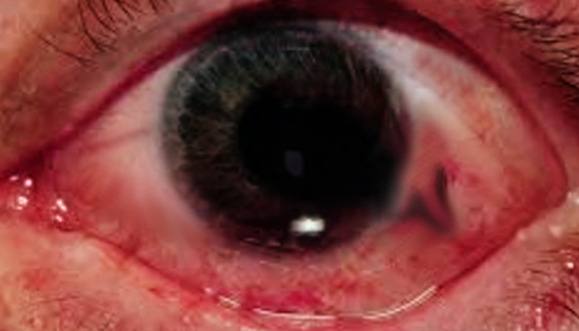
- In a meta-analysis of 47 studies (12,515 patients), males made up 83% of paediatric and 69% of adult cohorts [S12].
- Globe rupture was the most common injury in children (23%), and IOFB-related injuries in adults (29%) [S12].
- Zone I injuries predominated (more than 50%), and traumatic cataract was the leading complication [S12].
- Penetrating and IOFB injuries were the most common injury types in the timing meta-analysis [S8].
Confirm it
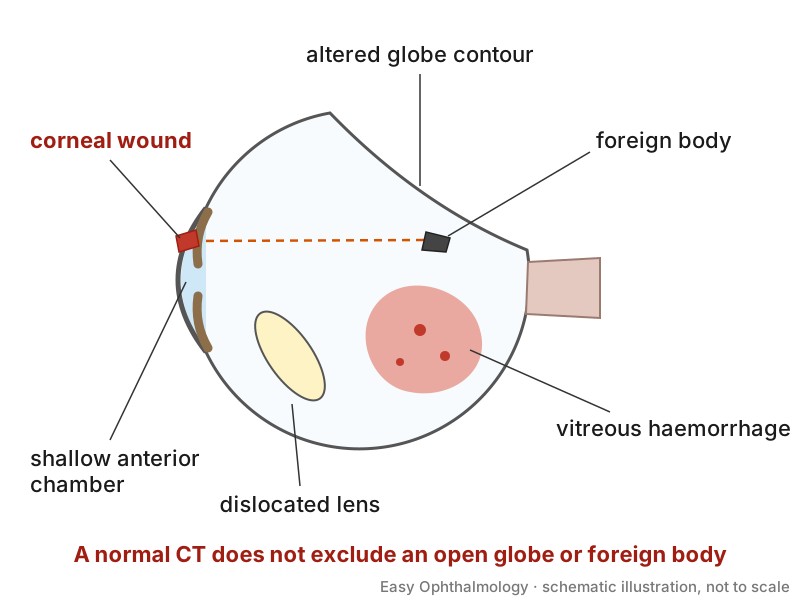
- Clinical examination by an ophthalmologist is the reference standard. In one systematic review (11 studies, 1126 patients), CT was 74% sensitive and 93% specific for OGI compared with clinical diagnosis [S10]. A second meta-analysis (12 studies, 937 patients) found a pooled sensitivity of 75% and specificity of 83% [S9].
- CT signs suggesting OGI: change in globe contour, scleral deformity or injury, corneal injury, altered or shallow anterior chamber depth, lens abnormality or dislocation, and vitreous haemorrhage [S9] [S10]. Shallow anterior chamber and lens dislocation or destruction had the highest sensitivity; lens dislocation and IOFB had the highest specificity [S9].
- IOFB: CT was 69% sensitive for IOFB against intraoperative findings [S10]. B-scan ultrasound was 86% sensitive for IOFB against CT, but its safety with respect to pressure on the globe extruding intraocular contents was not studied [S10].
- Prognosis: the Ocular Trauma Score (OTS) and Paediatric OTS correlate with final vision, but agreement between predicted and observed categories was only moderate (Cohen's κ 0.48), so use them cautiously when counselling [S12].
Manage it
Before acting on this section, check the national and local guidelines, product information and regulatory approvals that apply where you practise. See the medical disclaimer.
Tier A (primary care / no specialist)
- A resource-adapted guideline (EXTRACCT, 2026, expert consensus) gives frontline workers recommendations for assessing, classifying and managing major ocular injuries without specialist expertise or equipment, including dosing; consult the full guideline [S11].
- Protect the eye, avoid any pressure on the globe and arrange immediate transfer to an eye surgeon.
- Do not delay transfer to obtain imaging: CT cannot confirm or exclude an OGI on its own [S10].
Tier B (general eye clinic)
- Systemic prophylaxis. In a meta-analysis of 2 RCTs (1555 patients), endophthalmitis occurred in 2.26% with oral and 2.11% with IV (± oral) antibiotics, with no significant difference; high-risk cases were excluded [S6]. In a South African RCT, 3 days of IV cefazolin plus oral ciprofloxacin, or oral ciprofloxacin plus oral cefuroxime, from admission gave endophthalmitis rates of 2.0% and 2.7% (not significant), as reported in [S2]. The oral-only regimen shortened hospital stay and reduced costs [S2]. Doses are not stated in these abstracts; follow local formularies.
- Timing. Aim for primary repair as early as possible: repair within 24 hours was associated with an odds ratio of 0.39 for endophthalmitis versus later repair, with no significant difference in visual outcome [S8].
Tier C (specialist centre)
- Intraocular antibiotics. A meta-analysis of 3 trials found that intravitreal or intracameral antibiotics reduced endophthalmitis (RR 0.19) without improving visual acuity [S3]. In the largest RCT (346 eyes), 40 µg gentamicin and 45 µg clindamycin given after primary repair reduced endophthalmitis from 2.3% to 0.3%, as reported in [S1]. The benefit was concentrated in eyes with an IOFB, and intravitreal injection was superior to intracameral [S1].
- Primary eye removal. Pooled sympathetic ophthalmia rates were 0.05% after primary enucleation or evisceration and 0.15% after primary repair, a non-significant difference; there is no evidence that primary removal reduces the risk [S7].
- NLP eyes. A 2022 consensus guideline gives 16 recommendations on the determination, surgical indication and timing of vitrectomy in NLP eyes after mechanical trauma [S5].
Refer when
| Situation | Urgency |
|---|---|
| Suspected or confirmed open globe, with or without a scan | Immediate transfer to an eye surgeon |
| Suspected retained IOFB | Immediate, same-day specialist referral; higher endophthalmitis risk [S1] |
| Pain or worsening vision after repair (possible endophthalmitis) | Immediate, same-day [G1] |
| Inflammation in the uninjured eye after OGI (possible sympathetic ophthalmia) | Urgent; timing per your local service or specialist advice |
Pitfalls
- Treating a negative CT as proof that the globe is intact or that there is no IOFB [S10].
- Pressing on a possibly open globe for B-scan; this safety question was not studied [S10].
- Deferring repair for logistics; delay beyond 24 hours was associated with more endophthalmitis [S8].
- Assuming IV prophylaxis is required; oral regimens performed similarly in trials that excluded high-risk cases [S2] [S6].
- Removing an eye mainly to prevent sympathetic ophthalmia; evidence does not show this lowers the risk [S7].
- Over-relying on trauma scores for an individual patient [S12].
Evidence notes
| Source | Date | Design |
|---|---|---|
| [S1] | 2007 | Multicentre double-masked RCT, 346 eyes |
| [S2] | 2017 | Non-inferiority RCT, 300 patients, South Africa |
| [S3] | 2017 | Meta-analysis of 3 trials |
| [S4] | 2022 | Meta-analysis of 24 population-based studies |
| [S5] | 2022 | Consensus guideline (NLP eyes) |
| [S6] | 2023 | Meta-analysis (2 RCTs, 1 prospective study) |
| [S7] | 2024 | Meta-analysis of 8 observational studies |
| [S8] | 2025 | Meta-analysis of 15 retrospective studies, 8497 eyes |
| [S9] | 2025 | Diagnostic meta-analysis, 12 studies |
| [S10] | 2026 | Diagnostic systematic review, 11 studies |
| [S11] | 2026 | Expert-consensus practice guideline (blast trauma, low-resource) |
| [S12] | 2026 | Systematic review and meta-analysis, 47 studies |
- The timing evidence is retrospective and non-randomised, with low GRADE certainty and very high heterogeneity (I² = 95%) [S8].
- The antibiotic trials excluded high-risk cases, so their low endophthalmitis rates may not apply to contaminated or IOFB injuries [S2] [S6].
- The two CT meta-analyses differ in specificity (93% vs 83%) [S9] [S10].
- The sympathetic ophthalmia evidence is observational and low certainty [S7]. The intraocular antibiotic meta-analysis included only 3 trials [S3].
- The EXTRACCT guideline and the NLP guideline are expert consensus; their specific recommendations are not given in the abstracts [S5] [S11].
- Not covered by these sources: shield and analgesia protocols, tetanus prophylaxis, antiemetics, specific surgical techniques and doses of systemic antibiotics.
Related articles
- Intraocular foreign body
- Blunt eye injury and traumatic hyphaema
- Post-operative endophthalmitis
- Eyelid and Canalicular Lacerations
References
See the numbered source list below. Each marker [S#] links to its PubMed and DOI record.
Sources
- [S1] Soheilian M, Rafati N, Mohebbi MR, Yazdani S, Habibabadi HF, Feghhi M, et al. Prophylaxis of acute posttraumatic bacterial endophthalmitis: a multicenter, randomized clinical trial of intraocular antibiotic injection, report 2. Archives of ophthalmology (Chicago, Ill. : 1960). (2007). PubMed 17420365 · doi:10.1001/archopht.125.4.460
- [S2] Du Toit N, Mustak S, Cook C Randomised controlled trial of prophylactic antibiotic treatment for the prevention of endophthalmitis after open globe injury at Groote Schuur Hospital. The British journal of ophthalmology. (2017). PubMed 27793818 · doi:10.1136/bjophthalmol-2016-309736
- [S3] Thevi T, Abas AL Role of intravitreal/intracameral antibiotics to prevent traumatic endophthalmitis - Meta-analysis. Indian journal of ophthalmology. (2017). PubMed 29044054 · doi:10.4103/ijo.ijo_512_17
- [S4] He B, Tanya SM, Wang C, Kezouh A, Torun N, Ing E The Incidence of Sympathetic Ophthalmia After Trauma: A Meta-analysis. American journal of ophthalmology. (2022). PubMed 34283983 · doi:10.1016/j.ajo.2021.06.036
- [S5] Yan H, Yang K, Ma Z, Kuhn F, Zhang W, Wang Z, et al. Guideline for the treatment of no light perception eyes induced by mechanical ocular trauma. Journal of evidence-based medicine. (2022). PubMed 36151612 · doi:10.1111/jebm.12496
- [S6] Patterson TJ, McKinney D, Ritson J, McLean C, Gu W, Colyer M, et al. The Use of Preoperative Prophylactic Systemic Antibiotics for the Prevention of Endopthalmitis in Open Globe Injuries: A Meta-Analysis. Ophthalmology. Retina. (2023). PubMed 37406735 · doi:10.1016/j.oret.2023.06.022
- [S7] Patterson TJ, Kedzierski A, McKinney D, Ritson J, McLean C, Gu W, et al. The Risk of Sympathetic Ophthalmia Associated with Open-Globe Injury Management Strategies: A Meta-analysis. Ophthalmology. (2024). PubMed 38086434 · doi:10.1016/j.ophtha.2023.12.006
- [S8] McMaster D, Bapty J, Bush L, Serra G, Kempapidis T, McClellan SF, et al. Early versus Delayed Timing of Primary Repair after Open-Globe Injury: A Systematic Review and Meta-analysis. Ophthalmology. (2025). PubMed 39218161 · doi:10.1016/j.ophtha.2024.08.030
- [S9] Foroughi E, Fathi M, Pourazizi M, Radmard M, Sadeghi Z, Tafazolimoghadam A, et al. Diagnostic assessment of computed tomography (CT) in open globe injuries: a systematic review and meta-analysis. Emergency radiology. (2025). PubMed 40694213 · doi:10.1007/s10140-025-02368-9
- [S10] Mair J, Bush L, Halliday S, McMaster D, Sellon E, Colyer MH, et al. Use of preoperative imaging in open globe injury management: a systematic review. The British journal of ophthalmology. (2026). PubMed 41423323 · doi:10.1136/bjo-2025-327387
- [S11] Butterfield E, Bolt A, Clare G, Mattia J, Tin-U AM, Ndyabawe I, et al. Explosive Weapons Trauma Care Collective (EXTRACCT) Blast Injury Clinical Practice Guideline: Ocular Trauma. World journal of surgery. (2026). PubMed 41454569 · doi:10.1002/wjs.70204
- [S12] Rezaei K, Mejía-Salgado G, Abboud I, El Sayed MG, Bahn J, Parker K, et al. How Well Do Ocular Trauma Scores Predict Vision after Open-Globe Injury?: A Systematic Review and Meta-Analysis. Ophthalmology. (2026). PubMed 41655813 · doi:10.1016/j.ophtha.2026.01.031
Guidelines
- [G1] NHS Scotland (Community Eyecare Guidelines, eyes.nhs.scot). 7.4 Endophthalmitis, Post-Operative, (Exogenous Endophthalmitis) (2026). https://www.eyes.nhs.scot/eyecare-guidelines/section-7-uvea/74-endophthalmitis-post-operative-exogenous-endophthalmitis/