Educational content only. Not personalised medical advice. Clinical decisions remain the responsibility of the treating clinician.
Cerebral visual impairment in children
Cerebral visual impairment (CVI) is visual dysfunction caused by brain damage [S2]. A proposed definition is a verifiable visual dysfunction that cannot be attributed to disorders of the anterior visual pathways or any co-occurring ocular impairment [S2] [S10]. CVI is the most frequent cause of paediatric visual impairment in developed countries and is increasing in prevalence in developing nations [S4], yet it is often unrecognised [S3].
Key points - CVI usually occurs with a neurodevelopmental condition or multiple disabilities, but also in children with apparently typical development; high-contrast acuity can be normal [S8]. - The most common cause is hypoxic-ischaemic encephalopathy, particularly in premature children; others include seizures, hydrocephalus, trauma and infection [S4]. - Diagnosis is still mostly one of exclusion and there are no agreed clinical guidelines [S5]; Dutton's CVI questionnaire-based tools were the most relevant assessment tools in a recent review [S10]. - No standard therapy exists; intervention research is in its infancy and mostly low-level evidence [S4] [S7]. - Management focuses on adapting the child's environment with families and teachers, and treating co-existing eye problems [S4].
Evidence last checked: 2026-10-17 (PubMed abstracts).
Red flags
- Treatable eye disease alongside CVI: comorbid ocular disorders are common and should be managed [S4]. In children with cerebral palsy, refractive error (52%), strabismus (48%) and nystagmus (11%) were the most frequent abnormalities [S6].
- A normal acuity does not exclude CVI: identification requires assessment beyond high-contrast acuity, and visual function may fluctuate [S8].
- Preterm children in mainstream school with unexplained learning or visual difficulties: 33% of a preterm cohort showed behaviours of cerebral visual dysfunction [S1].
Recognise it: who is at risk
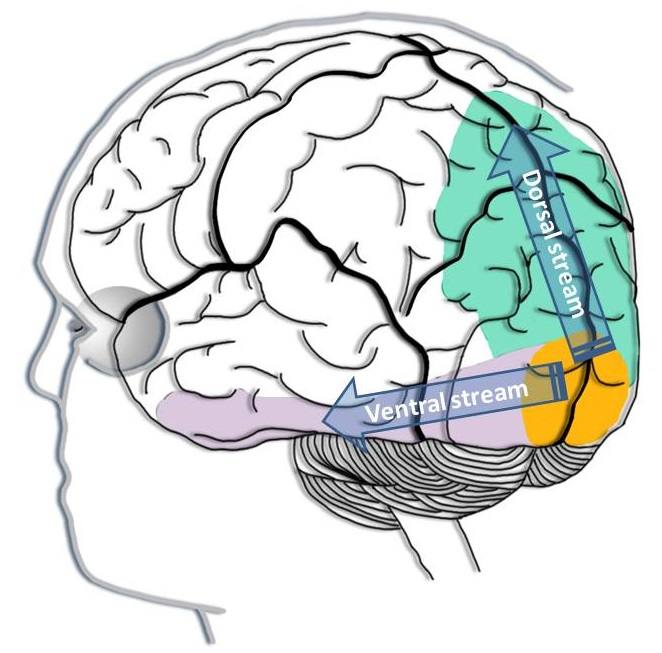
- Children born preterm, particularly with hypoxic-ischaemic encephalopathy [S4] [S1].
- Children with cerebral palsy: periventricular leucomalacia on MRI was strongly associated with CVI in all 30 studies of one review [S3]. Ocular abnormalities affected 34% to 100% of children with cerebral palsy [S6].
- Children with seizures, hydrocephalus, head trauma or brain infection [S4].
- Genetic conditions: up to 40% of CVI patients showed chromosomal abnormalities and 26.9% had pathogenic variants linked to seizures, developmental delay, intellectual disability or birth complications [S11].
- In preterm children, the pattern resembled "dorsal stream dysfunction" [S1].
Confirm it
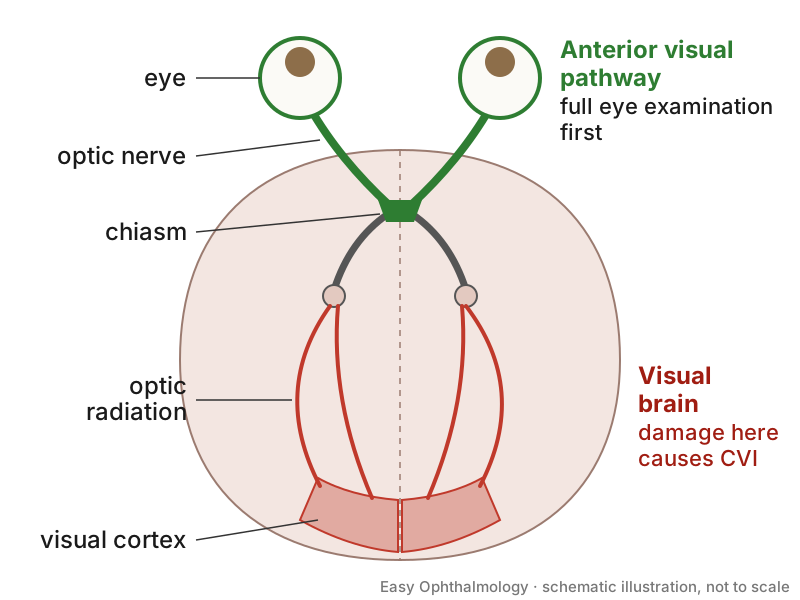
- A full eye examination first, to exclude or treat anterior visual pathway disease: CVI is most often diagnosed when visual dysfunction cannot be explained by anterior pathway abnormalities [S5].
- Structured history and questionnaires: caregiver questionnaires help assess visual functioning [S4]; ten of 17 questionnaires or screening tools have been validated [S11]. A structured CVI question inventory identified affected preterm children [S1].
- Other assessments used: visual behaviour observation, visual perception tests, ocular movement assessment, neuroimaging, electrophysiology and neurodevelopmental tests [S5]; visual evoked potentials and eye tracking can help [S11].
- MRI can be valuable but is optional and not sufficient on its own for diagnosis [S10].
- Multidisciplinary diagnosis: diagnosis should be established by a multidisciplinary team after cognitive assessment, with tests of visual and visuospatial perception and input from caregivers and teachers [S10]. In the UK, diagnosis rests on professional clinical judgement and practice varies [S8].
- Genetic testing can help once the main causes have been excluded [S11].
Manage it
Before acting on this section, check the national and local guidelines, product information and regulatory approvals that apply where you practise. See the medical disclaimer.
Tier A (primary care / community / school)
- Ask parents and teachers about how the child uses vision; caregiver questionnaires support assessment [S4].
- Refer at-risk children (preterm birth, cerebral palsy, seizures, developmental delay) for an eye examination; early ocular assessment in cerebral palsy is essential [S6].
- Work with teachers to adapt the environment [S4].
Tier B (general eye clinic)
- Examine for and correct refractive error, strabismus and other ocular disease [S4] [S6].
- Use a structured history or validated questionnaire [S1] [S11], and assess visual performance beyond acuity [S8].
- Coordinate with education and rehabilitation services: fragmented services hinder care, and collaboration across settings supports families [S12].
Tier C (specialist centre)
- Multidisciplinary diagnosis with neuropsychological assessment, and neuroimaging or electrophysiology where available [S10] [S11].
- Interventions: visual stimulation, task and environmental adaptations, vision training, acupuncture, stem cell transplantation and transcranial electrical stimulation have been studied, mostly in small, low-level studies [S7]. Controlled trials are needed to show whether visual stimulation or stem cells are better than observation [S4].
- Game-based rehabilitation: in a triple-blind RCT of 73 children, both the adaptive individualised and non-adaptive versions of iVision improved visual perception, with no difference between groups [S9].
Refer when
| Situation | Urgency |
|---|---|
| New loss of visual behaviour in a child with seizures, shunted hydrocephalus or head injury | Medical emergency: paediatrics and ophthalmology; follow your national protocol [EIC expert opinion] |
| Child at risk of CVI (preterm birth, cerebral palsy, developmental delay) not yet examined | Routine, within months, for eye examination [S6] |
| Suspected CVI after a normal eye examination | Routine, within months, for multidisciplinary assessment [S10] |
Pitfalls
- Dismissing CVI because acuity is normal [S8].
- Missing correctable refractive error or strabismus in children with cerebral palsy [S6].
- Relying on MRI alone to diagnose or exclude CVI [S10].
- Promising benefit from unproven interventions such as stem cells [S4] [S7].
- Working in isolation from schools and families [S12].
Evidence notes
| Source | Date | Design |
|---|---|---|
| [S1] | 2013 | Prospective controlled study, 46 preterm and 130 term children |
| [S2] | 2018 | Systematic review of definitions, 51 studies |
| [S3] | 2020 | Systematic review of 30 observational studies |
| [S4] | 2020 | Narrative review |
| [S5] | 2021 | Systematic review of assessment methods, 45 articles |
| [S6] | 2022 | Systematic review, 17 studies, 1734 patients |
| [S7] | 2023 | Scoping review of interventions, 23 studies |
| [S8] | 2023 | Consensus practice guide (UK) |
| [S9] | 2025 | Triple-blind RCT, 73 children |
| [S10] | 2025 | Scoping review of consensus |
| [S11] | 2026 | Scoping review of clinical and genetic diagnosis |
| [S12] | 2026 | Mixed-methods systematic review, 23 studies |
- There is no internationally accepted definition [S2] and no agreed diagnostic guideline [S5]; [S10] reports emerging consensus.
- The evidence base for intervention is small and low level [S7]; the one RCT found no advantage of the individualised version [S9].
- Evidence on the link between brain lesions and CVI patterns was of low level [S3].
- Most sources come from high-income settings; the burden in developing nations is reported as increasing [S4].
- Not covered by these sources: specific environmental adaptation strategies, low vision aids, and prevalence figures for low-income countries.
Related articles
References
See the numbered source list below. Each marker [S#] links to its PubMed and DOI record.
Sources
- [S1] Macintyre-Béon C, Young D, Dutton GN, Mitchell K, Simpson J, Loffler G, et al. Cerebral visual dysfunction in prematurely born children attending mainstream school. Documenta ophthalmologica. Advances in ophthalmology. (2013). PubMed 23996515 · doi:10.1007/s10633-013-9405-y
- [S2] Sakki HEA, Dale NJ, Sargent J, Perez-Roche T, Bowman R Is there consensus in defining childhood cerebral visual impairment? A systematic review of terminology and definitions. The British journal of ophthalmology. (2018). PubMed 29146757 · doi:10.1136/bjophthalmol-2017-310694
- [S3] Philip SS, Guzzetta A, Chorna O, Gole G, Boyd RN Relationship between brain structure and Cerebral Visual Impairment in children with Cerebral Palsy: A systematic review. Research in developmental disabilities. (2020). PubMed 32004872 · doi:10.1016/j.ridd.2020.103580
- [S4] Chang MY, Borchert MS Advances in the evaluation and management of cortical/cerebral visual impairment in children. Survey of ophthalmology. (2020). PubMed 32199940 · doi:10.1016/j.survophthal.2020.03.001
- [S5] McConnell EL, Saunders KJ, Little JA What assessments are currently used to investigate and diagnose cerebral visual impairment (CVI) in children? A systematic review. Ophthalmic & physiological optics : the journal of the British College of Ophthalmic Opticians (Optometrists). (2021). PubMed 33368471 · doi:10.1111/opo.12776
- [S6] Heydarian S, Abbasabadi MM, Khabazkhoob M, Hoseini-Yazdi H, Gharib M Vision Abnormalities in Children and Young Adults With Cerebral Palsy; A Systematic Review. Seminars in ophthalmology. (2022). PubMed 34978933 · doi:10.1080/08820538.2021.2021248
- [S7] Delay A, Rice M, Bush E, Harpster K Interventions for children with cerebral visual impairment: A scoping review. Developmental medicine and child neurology. (2023). PubMed 36217216 · doi:10.1111/dmcn.15431
- [S8] Pilling RF, Allen L, Bowman R, Ravenscroft J, Saunders KJ, Williams C Clinical assessment, investigation, diagnosis and initial management of cerebral visual impairment: a consensus practice guide. Eye (London, England). (2023). PubMed 36258009 · doi:10.1038/s41433-022-02261-6
- [S9] Ben Itzhak N, Stijnen L, Kostkova K, Laenen A, Jansen B, Ortibus E The effectiveness of an individualised and adaptive game-based rehabilitation, iVision, on visual perception in cerebral visual impairment: A triple-blind randomised controlled trial. Research in developmental disabilities. (2025). PubMed 39719804 · doi:10.1016/j.ridd.2024.104899
- [S10] Lindquist B, Westerberg C Closing in on a Consensus in Identifying, Assessing and Diagnosing Children With Cerebral Visual Impairment. Acta paediatrica (Oslo, Norway : 1992). (2025). PubMed 40558005 · doi:10.1111/apa.70200
- [S11] Albertos-Arranz H, Juvier-Riesgo T, Sainfort F, Jayakar A, Alfonso EC, Jacko VA, et al. A scoping review on clinical and genetic diagnostic approaches for cerebral visual impairment. Survey of ophthalmology. (2026). PubMed 40967510 · doi:10.1016/j.survophthal.2025.09.010
- [S12] Hepworth LR, Labinjo T, Riley A, Williams C, Ravenscroft J, Helliwell B, et al. Care and services for children with cerebral visual impairment - barriers, facilitators and experiences: a mixed-methods systematic review. Disability and rehabilitation. (2026). PubMed 42746998 · doi:10.1080/09638288.2026.2731077