Educational content only. Not personalised medical advice. Clinical decisions remain the responsibility of the treating clinician.
Visual acuity testing: charts, apps and children
Visual acuity (VA) is the simplest and most used assessment of visual function, and chart design and testing procedure affect how reliable and valid the result is [S12]. Measurement variability in adults is larger than often assumed [S10], and smartphone, web and printed home tests now extend testing beyond the clinic, with uneven validation [S3] [S9] [S11].
Key points - Distance VA in adults varies by about ±0.20 logMAR between measurements (very low certainty evidence), wider than the commonly quoted ±0.15 logMAR [S10]. - Charts based on Bailey-Lovie design principles used with standardised protocols may reduce test-retest variability [S12]. - In children aged 3 to 4 years, Lea symbols gave better acuity than a tumbling E chart and are preferred for this age group [S1]; grating acuity tests serve infants and people who cannot respond verbally [S8]. - Mobile app VA tests showed pooled sensitivity of 0.85 to 0.87 against clinical tests across age groups in a meta-analysis [S5], but few apps have been clinically validated [S4] [S11]. - Peek Acuity had the strongest supporting evidence among home tests in one systematic review [S3]; another found most remote self-tests less accurate than clinic assessment [S9].
Evidence last checked: 2026-10-17 (PubMed abstracts).
Red flags: results that need action now
- A drop of 2 lines or more from a previous reliable measurement. One validation study treated a change of 0.2 logMAR or more as significant [S6]; because test-retest variability is about ±0.20 logMAR [S10], repeat the test carefully, then act on a confirmed drop.
- Sudden painless or painful loss of vision in one eye. Needs same-day eye assessment.
- A young child who cannot fixate or follow, or has unequal acuity between the eyes. Use an age-appropriate test [S1] [S8] and refer (see below).
- A normal high-contrast acuity in an older patient with visual complaints. Standard VA does not assess low-contrast vision, which matters for mobility in the elderly [S12].
Recognise it: what acuity tells you
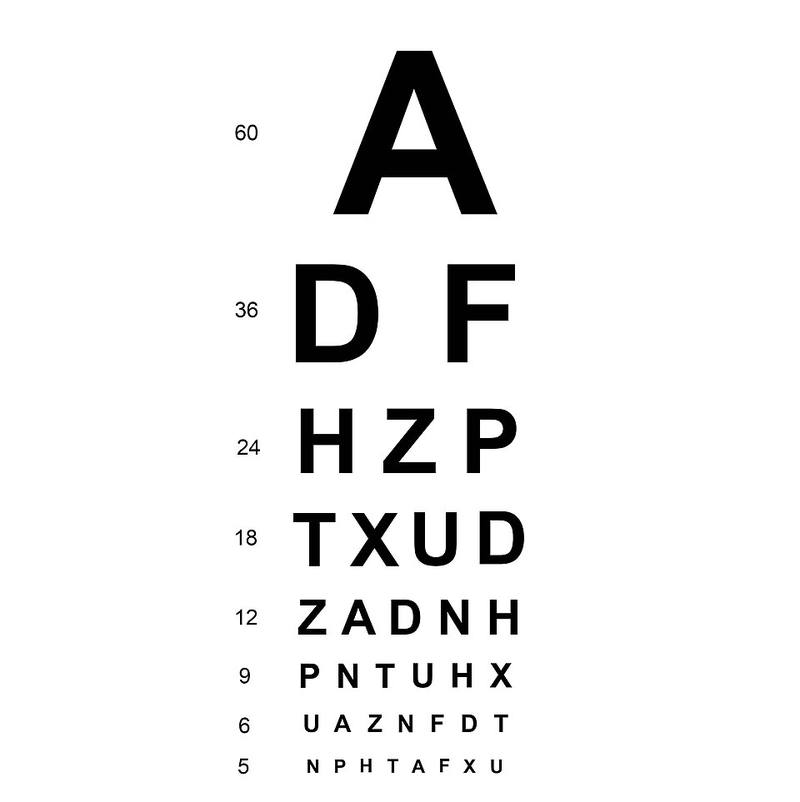
- Reduced acuity may come from optical blur or from disease of the macula and visual pathways [S12].
- Acuity improves rapidly in the first year of life and reaches adult levels at about 4 to 6 years or later; in healthy eyes it then typically stays stable until the eighth decade [S12].
- Hyperacuity measures show promise for assessing macular function [S12].
Confirm it: getting a reliable measurement
- Adults. Use a logMAR-type chart with a standard protocol where available [S12]. Treat changes within about ±0.20 logMAR as possibly within measurement noise [S10].
- Preschool children. In 47 children aged 3 to 6 years, mean logMAR was 0.17 with Lea symbols and 0.22 with the Bailey-Lovie tumbling E; the difference was significant at 3 to 4 years but not at 5 to 6 years [S1].
- Infants, young children and people with disabilities. A review identified eight grating acuity tests (six paper-based, two app-based); repeatability data existed for only four [S8].
- Screening context. In preschool screening studies, inability to cooperate may limit some tests below age 3, and with low prevalence (<10%) false-positive rates were high (usually >75%) [S2].
Manage it: testing at each resource tier
Before acting on this section, check the national and local guidelines, product information and regulatory approvals that apply where you practise. See the medical disclaimer.
Tier A (primary care / no specialist)
- A printed chart or a validated smartphone app is a practical option. In 22 studies of tablet or smartphone apps, a meta-analysis of 6 studies (24,284 participants) found pooled sensitivity of 0.87 and specificity of 0.78 in children aged 3 to 5 years, and 0.86 and 0.91 in those aged 6 to 22 years [S5].
- Non-professional examiners achieved high accuracy with apps (AUC 0.93 vs 0.87 for professionals) [S5], which supports task-sharing with trained lay workers.
- Choose a validated app. Of 24 free apps surveyed in 2021, only 5 calibrated optotype size and 3 had evidence of clinical validation [S4]. A 2025 review of 44 apps found few clinically validated and a mean quality score of about 3 out of 5 [S11].
- Peek Acuity on a smartphone showed a mean difference of 0.055 logMAR from ETDRS for home testing, with test-retest variability of ±0.029 logMAR [S3].
Tier B (general eye clinic)
- Measure with a standard chart under a consistent protocol and record logMAR where possible [S12].
- For telehealth follow-up, home tests can be useful. In a randomised validation study of 121 adults, printed chart, phone app and website results were within 1 line of clinic Snellen acuity, with mean differences of -0.07, -0.12 and -0.13 logMAR; the printed chart correlated best (r = 0.72) [S6]. Older participants were more likely to have limited access to digital tools [S6].
- For children, the Smart Optometry app had 89.3% sensitivity for subnormal VA and good caregiver-clinician agreement, but lower sensitivity for amblyopia [S7].
Tier C (specialist centre)
- Use standardised logMAR protocols for monitoring and research, recognising that published variability limits rest on very low certainty evidence [S10].
- Consider additional tests (contrast, hyperacuity) when standard acuity does not explain symptoms [S12].
- Remote self-tests are promising for triage and long-term monitoring but need further pragmatic trials before wide deployment [S9].
Refer when
| Situation | Urgency |
|---|---|
| Sudden loss of vision in one or both eyes | Same-day to an eye service |
| Confirmed drop of 0.2 logMAR or more from baseline in a patient under treatment [S6] [S10] | Urgent, sooner if symptomatic; timing per your local service or specialist advice |
| Child failing an age-appropriate acuity screen or with unequal acuity [S2] | Routine; timing per your local service or specialist advice |
Pitfalls
- Treating a one-line change as real progression: variability is about ±0.20 logMAR [S10].
- Using a directional E test in 3 to 4 year olds instead of picture symbols [S1].
- Trusting any app: most are unvalidated and many lack size calibration [S4] [S11].
- Over-referring from low-prevalence screening: false-positive rates can exceed 75% [S2].
- Assuming normal acuity means normal function in the elderly [S12].
- Relying on app tests to detect amblyopia [S7].
Evidence notes
| Source | Date | Design |
|---|---|---|
| [S1] | 2013 | Comparative study, 47 preschool children |
| [S2] | 2017 | Systematic review for the USPSTF, 40 studies |
| [S3] | 2023 | Systematic review, 14 studies |
| [S4] | 2021 | Review of app stores, 24 apps |
| [S5] | 2022 | Systematic review and meta-analysis, 22 studies |
| [S6] | 2022 | Randomised validation study, 121 participants |
| [S7] | 2022 | Randomised-order validation study, 100 children |
| [S8] | 2023 | Narrative review of grating acuity tests |
| [S9] | 2023 | Systematic review of pragmatic trials, 10 studies |
| [S10] | 2025 | Systematic review, 18 studies, GRADE very low |
| [S11] | 2025 | Systematic review of 44 apps (quality rating) |
| [S12] | 2026 | Narrative review |
- The variability estimate rests on studies with high or unclear risk of bias [S10].
- Reviews of home testing conflict: one favours Peek Acuity [S3], another found conflicting results for Peek Acuity and iSight Professional in a pooled study [S9].
- The USPSTF review found no RCT comparing screening with no screening [S2].
- App reviews are snapshots of app stores and age quickly [S4] [S11].
- Not covered by these sources: near acuity standards, low-vision acuity charts, test distance and lighting standards, and acuity notation conversion tables.
Related articles
References
See the numbered source list below. Each marker [S#] links to its PubMed and DOI record.
Sources
- [S1] Sanker N, Dhirani S, Bhakat P Comparison of visual acuity results in preschool children with lea symbols and Bailey-Lovie E chart. Middle East African journal of ophthalmology. (2013). PubMed 24339687 · doi:10.4103/0974-9233.120020
- [S2] Jonas DE, Amick HR, Wallace IF, Feltner C, Vander Schaaf EB, Brown CL, et al. Vision Screening in Children Aged 6 Months to 5 Years: Evidence Report and Systematic Review for the US Preventive Services Task Force. JAMA. (2017). PubMed 28873167 · doi:10.1001/jama.2017.9900
- [S3] Samanta A, Mauntana S, Barsi Z, Yarlagadda B, Nelson PC Is your vision blurry? A systematic review of home-based visual acuity for telemedicine. Journal of telemedicine and telecare. (2023). PubMed 33222600 · doi:10.1177/1357633x20970398
- [S4] Kawamoto K, Stanojcic N, Li JO, Thomas PBM Visual Acuity Apps for Rapid Integration in Teleconsultation Services in all Resource Settings: A Review. Asia-Pacific journal of ophthalmology (Philadelphia, Pa.). (2021). PubMed 33606386 · doi:10.1097/apo.0000000000000384
- [S5] Suo L, Ke X, Zhang D, Qin X, Chen X, Hong Y, et al. Use of Mobile Apps for Visual Acuity Assessment: Systematic Review and Meta-analysis. JMIR mHealth and uHealth. (2022). PubMed 35156935 · doi:10.2196/26275
- [S6] Bellsmith KN, Gale MJ, Yang S, Nguyen IB, Prentiss CJ, Nguyen LT, et al. Validation of Home Visual Acuity Tests for Telehealth in the COVID-19 Era. JAMA ophthalmology. (2022). PubMed 35357405 · doi:10.1001/jamaophthalmol.2022.0396
- [S7] Raffa LH, Balbaid NT, Ageel MM "Smart Optometry" phone-based application as a visual acuity testing tool among pediatric population. Saudi medical journal. (2022). PubMed 35964961 · doi:10.15537/smj.2022.43.8.20220374
- [S8] Sumalini R, Satgunam P Grating acuity tests for infants, young children and individuals with disabilities: A review of recent advances. Seminars in ophthalmology. (2023). PubMed 36073743 · doi:10.1080/08820538.2022.2116987
- [S9] Thirunavukarasu AJ, Hassan R, Limonard A, Savant SV Accuracy and reliability of self-administered visual acuity tests: Systematic review of pragmatic trials. PloS one. (2023). PubMed 37347757 · doi:10.1371/journal.pone.0281847
- [S10] van der Zee C, Muijzer MB, Claessens JLJ, Wisse RPL Determining the Variability Associated with Visual Acuity and Refractive Error Measurements: A Systematic Review. Ophthalmology. (2025). PubMed 40288446 · doi:10.1016/j.ophtha.2025.04.021
- [S11] Lentz PC, Dorairaj E, Vasu P, Wagner I, Jeffery J, Deceus F, et al. Evaluating the Quality and Features of Visual Acuity Apps Using the Mobile App Rating Scale: Systematic Review. JMIR mHealth and uHealth. (2025). PubMed 41385727 · doi:10.2196/65997
- [S12] Schwartz SH Visual acuity. Handbook of clinical neurology. (2026). PubMed 42106186 · doi:10.1016/b978-0-443-22193-4.00010-x