Educational content only. Not personalised medical advice. Clinical decisions remain the responsibility of the treating clinician.
Traumatic optic neuropathy
Traumatic optic neuropathy (TON) is an important cause of severe visual loss after blunt or penetrating head trauma [S2]. It mainly affects men (84%), road traffic accidents are the leading cause (67%), and 46% of patients have no light perception (NLP) after the injury [S11]. Spontaneous recovery is relatively common, and no treatment has consistently been shown to beat observation [S2] [S3] [S7].
Key points - Test vision and look for a relative afferent pupillary defect (RAPD) in every patient with head or facial trauma who can cooperate; TON is often associated with craniofacial fractures (70%) [S11]. - First exclude orbital compartment syndrome, a separate entity that needs urgent surgical and medical treatment [S9]. - High-dose corticosteroids have not been shown to improve vision over placebo, and megadose IV methylprednisolone increased mortality in large head-injury studies [S1] [S2] [S9]. - Evidence on optic canal decompression conflicts: observational meta-analyses favour it, especially early, while RCT-based reviews find no proven benefit and it carries risks of CSF leak and meningitis [S3] [S6] [S12]. - Initial NLP and delayed treatment predict a worse visual outcome [S4] [S10].
Evidence last checked: 2026-10-17 (PubMed abstracts).
Red flags
- Reduced vision or an RAPD after head or facial trauma: TON may be present even when the eye looks normal [S11].
- Suspected orbital compartment syndrome (acute optic nerve compression and ischaemia) needs urgent surgical and medical intervention to lower the intraocular pressure and reduce the risk of permanent optic nerve dysfunction [S9].
- Unconscious or head-injured patients: at least half of patients with moderate to severe traumatic brain injury show visual field defects or optic atrophy on more sensitive testing [S9].
- Planning megadose steroids in a patient with traumatic brain injury: strong evidence of increased mortality [S9].
Recognise it
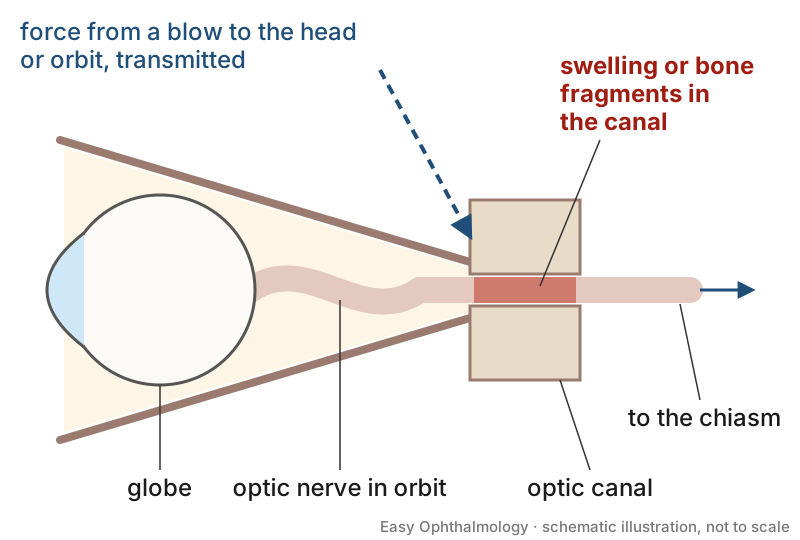
- Mechanism: direct TON follows sharp trauma to the nerve; indirect TON follows transmitted forces from a concussive blow to the head or orbit [S5].
- TON is classically described in up to 8% of patients with traumatic brain injury, but subclinical damage is much more common [S9].
- Optic nerve swelling within the canal, or compression by bone fragments, is thought to cause secondary retinal ganglion cell loss [S2] [S3].
Confirm it
- Measure best-corrected visual acuity, colour vision and the RAPD; trials used these as outcomes [S4] [S10].
- CT: fine-cut facial CT was used to exclude retrobulbar haematoma before treatment in an RCT [S5]. CT detected optic canal fractures in 34% of cases, compared with 47% found at surgery [S11].
- Posterior orbital fractures were associated with worse visual recovery [S10].
Manage it
Before acting on this section, check the national and local guidelines, product information and regulatory approvals that apply where you practise. See the medical disclaimer.
Tier A (primary care / no specialist)
- Record visual acuity and the pupil reactions in both eyes as soon as the patient can cooperate [S11].
- Consider orbital compartment syndrome first; it needs urgent treatment [S9].
- Do not start megadose steroids, particularly with a head injury [S9].
- Refer to an eye or neurosurgical service (see table), as an emergency [EIC expert opinion].
Tier B (general eye clinic)
- Observation is a valid option. Vision improved significantly in the observation, steroid and erythropoietin arms of a multicentre trial, without significant differences between them [S4]. In a placebo-controlled RCT (31 eyes), vision improved in 53.3% given placebo and 68.8% given steroids, a non-significant difference [S1].
- Corticosteroids: in that RCT, 250 mg IV methylprednisolone every 6 hours for 3 days, then 1 mg/kg oral prednisolone for 14 days, gave no significant benefit, as reported in [S1]. A Cochrane review found no convincing evidence of benefit and possible harm [S2]. If considered, decide case by case with informed consent [S2].
- Erythropoietin (EPO): TONTT found significant colour vision improvement with EPO but no difference in acuity versus steroids or observation [S4]. In TONTT-2 (93 patients), weight-adjusted IV EPO at 900, 1800 or 3600 IU/kg in total gave similar improvements, so higher doses gave no added benefit, as reported in [S10]. A pooled analysis reported a 61% improvement rate with EPO [S11]. The American Academy of Ophthalmology review judged that direct comparison failed to confirm EPO's usefulness [S7].
Tier C (specialist centre)
- Optic canal decompression: meta-analyses of mostly observational studies reported more improvement with decompression than conservative care (55% vs 40%) [S6] or corticosteroids (62% vs 37%; OR 2.35) [S12], especially when surgery was within 7 days and in indirect TON [S12]. Another meta-analysis of 16 studies found no difference between surgery and steroids [S8]. The 2026 pooled analysis found decompression better than steroid pulse therapy when an optic canal fracture was present (53% vs 24%) but similar without one [S11].
- In a small RCT (30 patients), patients with NLP or light perception had a higher chance of benefiting from surgery than from steroids, as reported with a steroid regimen of 30 mg/kg then 15 mg/kg every 6 hours for 3 days [S5].
- The Cochrane review found no RCTs of surgery and noted definite risks such as CSF leak and meningitis [S3]. Decompression carried risks of haemorrhage and CSF leakage in the AAO review [S7].
- Treatment should be individualised; no consensus on a preferred treatment exists [S7].
Refer when
| Situation | Urgency |
|---|---|
| Suspected orbital compartment syndrome | Immediate [S9] |
| Reduced vision or RAPD after head or facial trauma | Same-day eye or neurosurgical assessment; outcomes of intervention were better within 7 days [S11] [S12] |
| Optic canal fracture on CT with reduced vision | Emergency referral, within hours, to a centre offering decompression [S11] [EIC expert opinion] |
| Stable TON already assessed | Routine follow-up; timing per your local service or specialist advice |
Pitfalls
- Missing orbital compartment syndrome, which is treatable, while focusing on TON [S9].
- Giving megadose steroids to a patient with traumatic brain injury [S9].
- Attributing spontaneous recovery to treatment; recovery occurred in placebo and observation arms [S1] [S4].
- Assuming a normal CT excludes an optic canal fracture [S11].
Evidence notes
| Source | Date | Design |
|---|---|---|
| [S1] | 2007 | Double-masked placebo-controlled RCT, 31 eyes |
| [S2] | 2013 | Cochrane review (steroids), 1 RCT |
| [S3] | 2013 | Cochrane review (surgery), no eligible RCTs |
| [S4] | 2018 | Multicentre phase 3 semi-experimental trial, 100 patients |
| [S5] | 2020 | RCT, 30 patients |
| [S6] | 2021 | Meta-analysis, 9 studies, 766 patients |
| [S7] | 2021 | Systematic review (American Academy of Ophthalmology), 32 studies |
| [S8] | 2023 | Meta-analysis, 16 studies, 1046 patients |
| [S9] | 2024 | Systematic review, 3 RCTs |
| [S10] | 2025 | Multicentre double-blind dose-finding RCT, 93 patients |
| [S11] | 2026 | Systematic review and meta-analysis, 109 studies, 6068 patients |
| [S12] | 2026 | Meta-analysis, 34 studies, 1046 patients |
- Major conflict: RCT-based reviews find no proven benefit of any treatment [S2] [S3] [S9], while meta-analyses dominated by observational studies favour early decompression [S6] [S12]. The observational data carry surgical selection and publication bias [S6] and heterogeneous definitions [S11].
- No study in the AAO review met criteria for level I evidence [S7].
- Most trials were small; the EPO trials had no placebo arm in TONTT-2 [S10].
- Not covered by these sources: levodopa-carbidopa dosing, decompression technique and paediatric management.
Related articles
- Orbital compartment syndrome and retrobulbar haemorrhage
- Blunt eye injury and traumatic hyphaema
- Pupil Abnormalities: Anisocoria and Horner Syndrome
References
See the numbered source list below. Each marker [S#] links to its PubMed and DOI record.
Sources
- [S1] Entezari M, Rajavi Z, Sedighi N, Daftarian N, Sanagoo M High-dose intravenous methylprednisolone in recent traumatic optic neuropathy; a randomized double-masked placebo-controlled clinical trial. Graefe's archive for clinical and experimental ophthalmology = Albrecht von Graefes Archiv fur klinische und experimentelle Ophthalmologie. (2007). PubMed 17265030 · doi:10.1007/s00417-006-0441-0
- [S2] Yu-Wai-Man P, Griffiths PG Steroids for traumatic optic neuropathy. The Cochrane database of systematic reviews. (2013). PubMed 23771729 · doi:10.1002/14651858.cd006032.pub4
- [S3] Yu-Wai-Man P, Griffiths PG Surgery for traumatic optic neuropathy. The Cochrane database of systematic reviews. (2013). PubMed 23780732 · doi:10.1002/14651858.cd005024.pub3
- [S4] Kashkouli MB, Yousefi S, Nojomi M, Sanjari MS, Pakdel F, Entezari M, et al. Traumatic optic neuropathy treatment trial (TONTT): open label, phase 3, multicenter, semi-experimental trial. Graefe's archive for clinical and experimental ophthalmology = Albrecht von Graefes Archiv fur klinische und experimentelle Ophthalmologie. (2018). PubMed 28986670 · doi:10.1007/s00417-017-3816-5
- [S5] Chen HH, Lee MC, Tsai CH, Pan CH, Lin YT, Chen CT Surgical Decompression or Corticosteroid Treatment of Indirect Traumatic Optic Neuropathy: A Randomized Controlled Trial. Annals of plastic surgery. (2020). PubMed 31800551 · doi:10.1097/sap.0000000000002186
- [S6] Martinez-Perez R, Albonette-Felicio T, Hardesty DA, Carrau RL, Prevedello DM Outcome of the surgical decompression for traumatic optic neuropathy: a systematic review and meta-analysis. Neurosurgical review. (2021). PubMed 32088777 · doi:10.1007/s10143-020-01260-z
- [S7] Wladis EJ, Aakalu VK, Sobel RK, McCulley TJ, Foster JA, Tao JP, et al. Interventions for Indirect Traumatic Optic Neuropathy: A Report by the American Academy of Ophthalmology. Ophthalmology. (2021). PubMed 33161071 · doi:10.1016/j.ophtha.2020.10.038
- [S8] Pandey S, Reddy GS, Chug A, Dixit A, Raja BS Comparison of Surgical Decompression and Steroid Therapy for the Management of Traumatic Optic Neuropathy: A Systematic Review and Meta-Analysis. Craniomaxillofacial trauma & reconstruction. (2023). PubMed 38047144 · doi:10.1177/19433875221142682
- [S9] Blanch RJ, Joseph IJ, Cockerham K Traumatic optic neuropathy management: a systematic review. Eye (London, England). (2024). PubMed 38862644 · doi:10.1038/s41433-024-03129-7
- [S10] Abdolalizadeh P, Kashkouli MB, Ghazizadeh M, Pakdel F, Etezad Razavi M, Nojomi M, et al. Traumatic Optic Neuropathy Treatment Trial 2 (TONTT-2): evaluating the efficacy of different doses of erythropoietin - a multicentre, randomised, double-blind clinical trial. The British journal of ophthalmology. (2025). PubMed 39461733 · doi:10.1136/bjo-2024-325828
- [S11] He M, Yang Z, Shi Z, Chen Y, Zhao X Clinical features, management, and prognosis factors of traumatic optic neuropathy. Survey of ophthalmology. (2026). PubMed 40749877 · doi:10.1016/j.survophthal.2025.07.012
- [S12] Huang C, Xu Y, Wu X, Tang S Traumatic Optic Neuropathy After Head Trauma: Pathophysiology, Interventions, and Evidence From Meta-Analysis. ANZ journal of surgery. (2026). PubMed 41467484 · doi:10.1111/ans.70454