Educational content only. Not personalised medical advice. Clinical decisions remain the responsibility of the treating clinician.
Orbital compartment syndrome and retrobulbar haemorrhage
Orbital compartment syndrome (OCS) is an ophthalmic surgical emergency caused by an acute rise in orbital pressure; without prompt treatment it can cause irreversible blindness [S1]. It is most commonly due to orbital haemorrhage after trauma or surgery [S6]. The diagnosis is clinical, and emergency decompression by lateral canthotomy and inferior cantholysis, even before imaging, is the mainstay of treatment [S1].
Key points - Do not wait for a scan: decompression should be done even before imaging [S1], and CT should preferably follow canthotomy [S8]. - Aim to decompress within 2 hours of injury; better visual outcomes are reported with intervention in the first 2 hours [S4] [S6]. - Lateral canthotomy with cantholysis is a simple procedure that non-specialists can be trained to perform where specialists are not available [S2]. - Consider decompression even when presentation is delayed; visual recovery after delay has been reported [S6]. - A displaced orbital fracture does not exclude OCS [S7].
Evidence last checked: 2026-10-17 (PubMed abstracts).
Red flags
- Proptosis with visual symptoms after facial or head trauma [S12].
- Pupillary abnormalities or reduced visual acuity with an orbital haematoma [S8].
- Anticoagulation or a bleeding tendency: 7 of 9 patients in one case series had a hypocoagulable state [S8], and coagulopathy was documented in 11 of 126 children [S12].
- Severe burns with large-volume resuscitation: OCS in burns occurred most often within 24 hours, with a mean burn area of 58.7% and periorbital burns in 86.5% [S10].
- Raised intraocular pressure: in burns, IOP above 30 to 40 mmHg warrants intervention [S10].
- Recent orbital, sinus or eyelid surgery [S5] [S6].
Recognise it
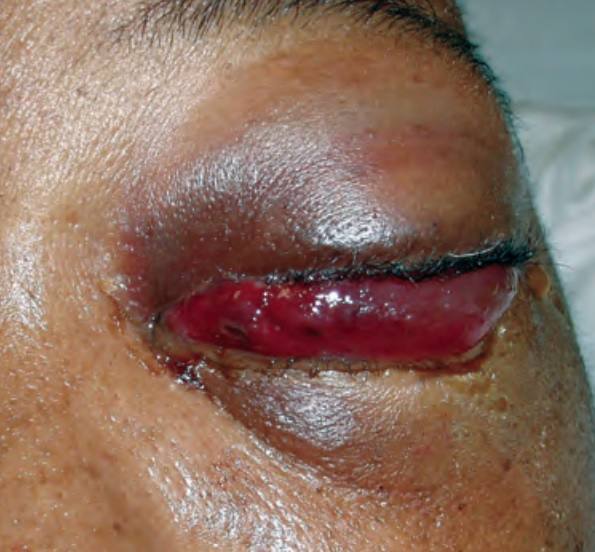
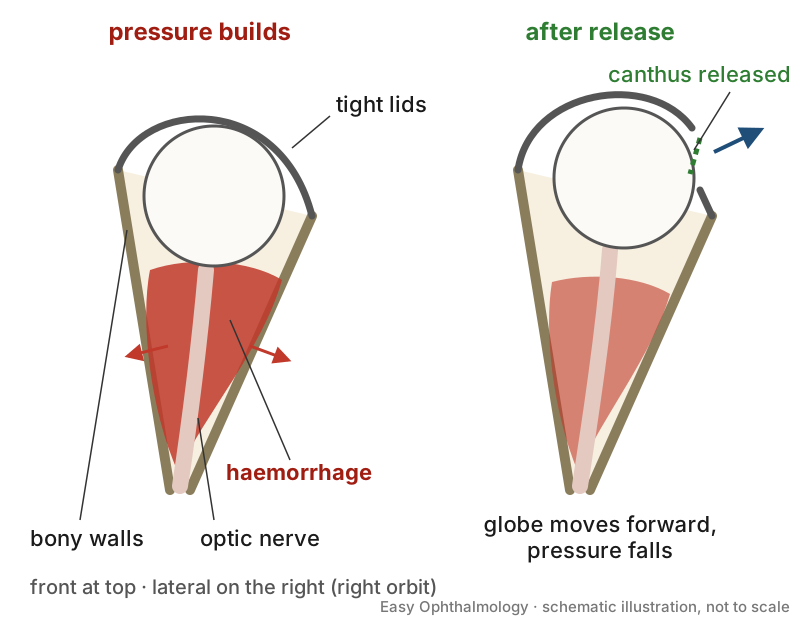
- Retrobulbar haemorrhage is a known complication of trauma, facial fracture reduction, sinus surgery and blepharoplasty [S5]. In a systematic review, 74% of retrobulbar haematomas followed trauma and 26% surgery [S5].
- Its incidence is cited as lower than 1% of midface trauma [S3]; OCS from orbital haematoma occurred in 0.26% of 3514 craniomaxillofacial injuries in one centre [S8].
- The haemorrhage can rapidly fill the orbit and cut off perfusion to ocular structures, leading to permanent visual loss [S2]. The orbital fat is divided into compartments by fibrous septa, which may explain why OCS can occur even with a fracture [S7].
- Children: mean age 10 years, mostly after falls and direct head trauma; subperiosteal haematoma was the main cause, and onset was either immediate or delayed by 4 to 7 days [S12].
Confirm it
- The diagnosis is clinical [S1]. Check vision, pupils and IOP, but do not delay decompression for tests in a sight-threatening case [S1] [S8].
- CT helps the differential diagnosis of acute traumatic proptosis but should preferably follow decompression [S8].
- Diagnosis in children is harder because of limited cooperation [S12].
Manage it
Before acting on this section, check the national and local guidelines, product information and regulatory approvals that apply where you practise. See the medical disclaimer.
Tier A (primary care / no specialist)
- Lateral canthotomy and cantholysis can be performed by trained non-specialist personnel when specialist care is not immediately available, as recommended for military medics in remote settings [S2]. Train staff in advance where possible [S2] [S8].
- If you cannot perform it, arrange immediate transfer to the nearest person who can.
Tier B (general eye clinic)
- Decompress immediately. Lateral canthotomy with inferior cantholysis is the most frequently used technique [S4]. In burns, decompression starts with canthotomy, and cantholysis is added when pressure does not fall immediately [S10].
- Timing. Decompress as an emergency, ideally within 2 hours of trauma [S4]. In a review of 93 retrobulbar haematomas, surgical decompression and shorter time to treatment each predicted full recovery; 51% recovered completely and 22% became blind [S5].
- Medical adjuncts. Acetazolamide, mannitol and corticosteroids should not delay surgery, and postoperative corticosteroids are not indicated, especially with severe head trauma [S4]. Steroid use was not significantly related to outcome [S5]. Doses are not covered; follow local formularies.
- Monitoring without decompression. For orbital haematomas without pupil or acuity changes, close monitoring is recommended for patients who are anticoagulated, hypertensive, head-injured, with reduced consciousness, elderly with dementia or without rapid access to follow-up [S8].
Tier C (specialist centre)
- Septolysis and careful dissection in the inferotemporal quadrant may be added [S8]. More extensive septal incision or bony orbital decompression may be needed in unresponsive cases [S1] [S6].
- In children, 103 of 126 had surgery, and earlier surgery was consistently linked to better vision (very low certainty) [S12].
- Treat the underlying cause [S6].
Refer when
| Situation | Urgency |
|---|---|
| Suspected OCS with visual loss or pupil abnormality | Immediate decompression on site, ideally within 2 hours of injury, then transfer [S4] [S6] |
| Orbital haematoma without visual change in a high-risk patient (anticoagulated, head-injured, elderly) | Within hours: close monitoring allowing timely intervention [S8] |
| Severe burns with periorbital involvement | Urgent: monitor IOP, as OCS occurs most often within 24 hours of the burn [S10] |
| After canthotomy and cantholysis | Same-day transfer to an ophthalmic or orbital surgeon |
Pitfalls
- Sending the patient for CT before decompression [S1] [S8].
- Assuming a displaced fracture has decompressed the orbit [S7].
- Relying on acetazolamide, mannitol or steroids instead of surgery [S4].
- Giving up because presentation is late [S6].
- Missing delayed OCS in children, which can appear 4 to 7 days after trauma [S12].
Evidence notes
| Source | Date | Design |
|---|---|---|
| [S1] | 2009 | Narrative review |
| [S2] | 2009 | Narrative review (military, remote settings) |
| [S3] | 2014 | Retrospective institutional review |
| [S4] | 2015 | Literature review, 89 surgically treated patients |
| [S5] | 2018 | Systematic review, 16 studies, 93 cases |
| [S6] | 2019 | Narrative review |
| [S7] | 2022 | Case-based systematic review, 18 cases |
| [S8] | 2023 | Case series (9 patients) with literature review |
| [S9] | 2019 | Narrative review |
| [S10] | 2024 | Systematic review, 8 retrospective studies (burns) |
| [S11] | 2024 | Systematic review (traumatic optic neuropathy) |
| [S12] | 2026 | Systematic review of case reports and series, 126 children |
- Very low-certainty evidence: all sources are reviews, case series or case reports, with no controlled studies. The 2-hour target comes from literature reviews [S4] [S6].
- OCS is a separate entity from traumatic optic neuropathy and requires medical and surgical intervention [S11]. It is a true ophthalmological emergency requiring immediate management [S9].
- The IOP threshold of 30 to 40 mmHg comes from burn studies and is conflicted [S10].
- Not covered by these sources: step-by-step canthotomy technique, anaesthesia, instruments and drug doses.
Related articles
References
See the numbered source list below. Each marker [S#] links to its PubMed and DOI record.
Sources
- [S1] Lima V, Burt B, Leibovitch I, Prabhakaran V, Goldberg RA, Selva D Orbital compartment syndrome: the ophthalmic surgical emergency. Survey of ophthalmology. (2009). PubMed 19539832 · doi:10.1016/j.survophthal.2009.04.005
- [S2] Ballard SR, Enzenauer RW, O'Donnell T, Fleming JC, Risk G, Waite AN Emergency lateral canthotomy and cantholysis: a simple procedure to preserve vision from sight threatening orbital hemorrhage. Journal of special operations medicine : a peer reviewed journal for SOF medical professionals. (2009). PubMed 19739474 · doi:10.55460/1cld-xjuv
- [S3] Fattahi T, Brewer K, Retana A, Ogledzki M Incidence of retrobulbar hemorrhage in the emergency department. Journal of oral and maxillofacial surgery : official journal of the American Association of Oral and Maxillofacial Surgeons. (2014). PubMed 25249171 · doi:10.1016/j.joms.2014.06.457
- [S4] Soare S, Foletti JM, Gallucci A, Collet C, Guyot L, Chossegros C Update on orbital decompression as emergency treatment of traumatic blindness. Journal of cranio-maxillo-facial surgery : official publication of the European Association for Cranio-Maxillo-Facial Surgery. (2015). PubMed 26116304 · doi:10.1016/j.jcms.2015.05.003
- [S5] Christie B, Block L, Ma Y, Wick A, Afifi A Retrobulbar hematoma: A systematic review of factors related to outcomes. Journal of plastic, reconstructive & aesthetic surgery : JPRAS. (2018). PubMed 29239798 · doi:10.1016/j.bjps.2017.10.025
- [S6] McCallum E, Keren S, Lapira M, Norris JH Orbital Compartment Syndrome: An Update With Review Of The Literature. Clinical ophthalmology (Auckland, N.Z.). (2019). PubMed 31806931 · doi:10.2147/opth.s180058
- [S7] Zogheib S, Sukkarieh G, Mjaess G, Zeid SA Displaced Orbital Fractures with Concurrent Orbital Compartment Syndrome: A Case-Based Systematic Review. Facial plastic surgery : FPS. (2022). PubMed 34905802 · doi:10.1055/s-0041-1740290
- [S8] Papadiochos I, Petsinis V, Sarivalasis SE, Strantzias P, Bourazani M, Goutzanis L, et al. Acute orbital compartment syndrome due to traumatic hemorrhage: 4-year case series and relevant literature review with emphasis on its management. Oral and maxillofacial surgery. (2023). PubMed 35083570 · doi:10.1007/s10006-021-01036-9
- [S9] Turgut B, Karanfil FC, Turgut FA Orbital Compartment Syndrome. Beyoglu eye journal. (2019). PubMed 35187423
- [S10] Makarewicz N, Perrault D, Cevallos P, Sheckter CC Diagnosis and Management of Orbital Compartment Syndrome in Burn Patients-A Systematic Review. Journal of burn care & research : official publication of the American Burn Association. (2024). PubMed 38808731 · doi:10.1093/jbcr/irae096
- [S11] Blanch RJ, Joseph IJ, Cockerham K Traumatic optic neuropathy management: a systematic review. Eye (London, England). (2024). PubMed 38862644 · doi:10.1038/s41433-024-03129-7
- [S12] Jhala T, Berger L, Aichner J, Lehner M, Lieber J, Fuchs J Traumatic Orbital Compartment Syndrome in Children-Systematic Review and Descriptive Summary. Children (Basel, Switzerland). (2026). PubMed 42650322 · doi:10.3390/children13080982