Educational content only. Not personalised medical advice. Clinical decisions remain the responsibility of the treating clinician.
School eye health programmes
Uncorrected refractive error is the leading cause of vision impairment in children, and spectacles correct the large majority of it [S9]. School-based screening is one of the most effective and cost-efficient ways to reach children over five years old [S8]. Programmes succeed only when screening is linked to spectacles, referral follow-up and continued spectacle wear [S9] [S12].
Key points - Trained teachers screen vision with pooled sensitivity 76.8% and specificity 93.6% [S11]; involving all class teachers was more accurate and cheaper than using a few selected teachers in a Nepal RCT [S10]. - Referral compliance after school screening is poor (median 43.1%); on-site spectacle provision achieved the highest compliance [S12]. - Smartphone-based screening with sight-simulation cards and SMS reminders raised hospital attendance from 22% to 54% in a Kenyan cluster RCT [S3]. - Ready-made spectacles were non-inferior to custom-made ones for wear at 3 to 4 months in eligible Indian children [S2] and cut cost per child needing spectacles by 58.6% [S6]. - Integrating eye health into an existing school programme performed better than a stand-alone model, but both stopped when funding ended [S7].
Evidence last checked: 2026-10-17 (PubMed abstracts).
Red flags: signs that need urgent action
- In a child: vision not improved by spectacles, which may mean amblyopia, strabismus or other eye disease needing referral [S9].
- In a child: an obvious ocular abnormality found by the teacher [S10].
- In a programme: referral attendance below half of children referred [S3] [S12].
- In a programme: low spectacle wear, recorded in both models in Zanzibar [S7].
- In a programme: dependence on short-term external funding [S7].
Recognise it: who to target
- School-aged children, particularly those over five years old [S8].
- An estimated 13 million children aged 5 to 15 years were visually impaired from uncorrected refractive error [S1].
- Need varies with local prevalence of refractive error, competing conditions and school attendance [S1].
- In India the prevalence of uncorrected refractive error among screened children aged 11 to 15 years was 2.23% [S6].
Confirm it: screening and refraction
- Who screens: trained teachers, where eye-care specialists are too few, provide good-quality and cost-effective screening [S4].
- Threshold: studies using a 6/12 cut-off showed more consistent performance [S11]; the Nepal trial referred children with 6/9 or worse in either eye [S10]; the Kenyan trial referred those with less than 6/12 [S3].
- Age matters: teacher screening sensitivity was 89.29% in younger children but 45.45% in adolescents [S11].
- Tools: Peek Acuity had similar sensitivity to a Snellen Tumbling-E card (77% vs 75%) but lower specificity (91% vs 97.4%) [S3].
- Refraction: studies specifying a cycloplegia protocol in the reference examination reported better screening performance [S11].
- Eligibility for ready-made spectacles in the Indian trial included anisometropia under 1.0 dioptre and acuity with spherical equivalent within 1 line of full correction [S2].
Manage it: running a programme at each resource tier
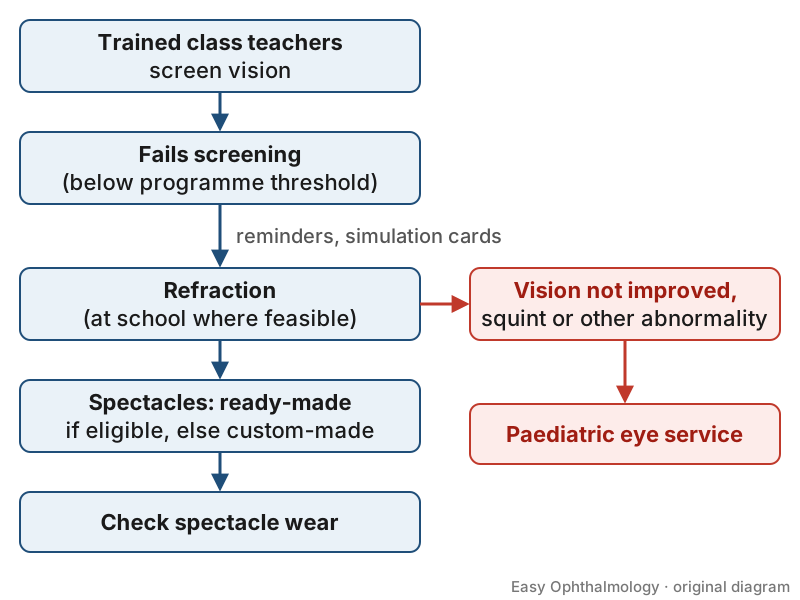
Before acting on this section, check the national and local guidelines, product information and regulatory approvals that apply where you practise. See the medical disclaimer.
Tier A (school and primary care)
- Train all class teachers and repeat training; success depends on solid practical training and teacher motivation [S10] [S11].
- Secure time in the school schedule and the support of principals, staff and parents [S4].
- Address parents' misconceptions, poor literacy and lack of eye health knowledge [S4], including the belief that glasses harm children's eyes [S1].
- Use reminders and simulation cards to push referral attendance [S3].
Tier B (general eye clinic, optometrist or refraction team)
- Provide refraction and spectacles at school where feasible (compliance 51.8% to 96.0%) [S12].
- Otherwise set up a clear referral pathway (25.0% to 65.7%); health education alone was insufficient (21.3% to 24.5%) [S12].
- Use ready-made spectacles for eligible children and custom-made for the rest [S2] [S6].
- Check spectacle wear; more severe refractive error and worse uncorrected acuity predict higher wear, and girls were more likely to wear spectacles in quantitative studies [S5].
Tier C (specialist centre and planners)
- Signpost children with amblyopia, strabismus and other eye disease to treatment [S9].
- Build government-owned, intersectoral programmes with long-term financing, integrated into school health [S7] [S8].
- Standardise protocols and the measurement of spectacle compliance [S5] [S8].
Refer when
| Situation | Urgency |
|---|---|
| Sudden vision loss, painful red eye, eye injury or white pupil in a child | Same-day to an eye service |
| Failed screening (below the programme threshold) | Urgent to a few weeks, for refraction and examination; timing per your local service or specialist advice |
| Vision not improved with spectacles, squint or other abnormality | Urgent to a few weeks, to a paediatric eye service; timing per your local service or specialist advice |
Pitfalls
- Screening without a plan for spectacles and follow-up [S9] [S12].
- Relying on health education alone to drive referral uptake [S12].
- Assuming teacher screening performs as well in adolescents [S11].
- Ignoring spectacle wear after dispensing [S5] [S7].
- Running a vertical programme that ends with donor funding [S7].
Evidence notes
| Source | Date | Design |
|---|---|---|
| [S1] | 2012 | Narrative review |
| [S2] | 2017 | Non-inferiority RCT, 460 children, India |
| [S3] | 2018 | Cluster RCT, 50 schools, Kenya |
| [S4] | 2018 | Systematic review, 48 articles, 13 LMICs |
| [S5] | 2019 | Literature review, 25 studies |
| [S6] | 2021 | Cost-minimisation analysis alongside an RCT |
| [S7] | 2023 | Non-randomised comparative implementation study, Zanzibar |
| [S8] | 2024 | Scoping review, 95 articles, LMICs |
| [S9] | 2025 | Narrative review |
| [S10] | 2025 | Cluster randomised study, 9 schools, Nepal |
| [S11] | 2026 | Diagnostic accuracy meta-analysis, 19 articles |
| [S12] | 2026 | Systematic review, 30 articles, narrative synthesis |
- The Nepal trial randomised only nine schools [S10]; the ready-made spectacle trial followed children for only 3 to 4 months [S2].
- Diagnostic accuracy of teacher screening depends on the rigour of the reference standard and on teacher training [S11].
- Definitions of spectacle compliance varied widely between studies [S5].
- Not covered by these sources: myopia control in schools, screening of preschool children, and near-vision screening.
Related articles
- Refractive error in children and spectacle provision
- Ready-made spectacles and near-vision correction
- Vision screening in children
References
See the numbered source list below. Each marker [S#] links to its PubMed and DOI record.
Sources
- [S1] Sharma A, Congdon N, Patel M, Gilbert C School-based approaches to the correction of refractive error in children. Survey of ophthalmology. (2012). PubMed 22398336 · doi:10.1016/j.survophthal.2011.11.002
- [S2] Morjaria P, Evans J, Murali K, Gilbert C Spectacle Wear Among Children in a School-Based Program for Ready-Made vs Custom-Made Spectacles in India: A Randomized Clinical Trial. JAMA ophthalmology. (2017). PubMed 28426857 · doi:10.1001/jamaophthalmol.2017.0641
- [S3] Rono HK, Bastawrous A, Macleod D, Wanjala E, Di Tanna GL, Weiss HA, et al. Smartphone-based screening for visual impairment in Kenyan school children: a cluster randomised controlled trial. The Lancet. Global health. (2018). PubMed 30012273 · doi:10.1016/s2214-109x(18)30244-4
- [S4] Burnett AM, Yashadhana A, Lee L, Serova N, Brain D, Naidoo K Interventions to improve school-based eye-care services in low- and middle-income countries: a systematic review. Bulletin of the World Health Organization. (2018). PubMed 30455516 · doi:10.2471/blt.18.212332
- [S5] Morjaria P, McCormick I, Gilbert C Compliance and Predictors of Spectacle Wear in Schoolchildren and Reasons for Non-Wear: A Review of the Literature. Ophthalmic epidemiology. (2019). PubMed 31181970 · doi:10.1080/09286586.2019.1628282
- [S6] Minakaran N, Morjaria P, Frick KD, Gilbert C Cost-minimisation Analysis from a Non-inferiority Trial of Ready-Made versus Custom-Made Spectacles for School Children in India. Ophthalmic epidemiology. (2021). PubMed 33256485 · doi:10.1080/09286586.2020.1851728
- [S7] Chan VF, Yard E, Mashayo E, Mulewa D, Drake L, Price-Sanchez C, et al. Does an integrated school eye health delivery model perform better than a vertical model in a real-world setting? A non-randomised interventional comparative implementation study in Zanzibar. The British journal of ophthalmology. (2023). PubMed 36376063 · doi:10.1136/bjo-2022-321752
- [S8] Harvey AA, Morjaria P, Tousignant B Priorities in school eye health in low and middle-income countries a scoping review. Eye (London, England). (2024). PubMed 38565599 · doi:10.1038/s41433-024-03032-1
- [S9] Little JA, Chan VF, Saw SM, Tham YC, Chew L, Foo LL, et al. Current status of school vision screening-rationale, models, impact and challenges: a review. The British journal of ophthalmology. (2025). PubMed 40562460 · doi:10.1136/bjo-2024-326726
- [S10] Awasthi S, Reddy PA, Bassett KL Visual Acuity Screening By by School Teachers in Far West Nepal: A randomized trial of alternate screening models. Kathmandu University medical journal (KUMJ). (2025). PubMed 42023574
- [S11] Cunha M, Nunes AF, Miguel M, Ferreira D, Lanca C Diagnostic Accuracy of Teacher-Administered School Vision Screening: A Systematic Review and Meta-Analysis. Ophthalmic & physiological optics : the journal of the British College of Ophthalmic Opticians (Optometrists). (2026). PubMed 42557529 · doi:10.1007/s44402-026-00145-w
- [S12] Cui J, Zhuo S, Qin Y, Wang J, Chen R, Huang W, et al. Compliance with post-school vision screening referral: a systematic review. BMJ open ophthalmology. (2026). PubMed 42838618 · doi:10.1136/bmjophth-2026-002876