Educational content only. Not personalised medical advice. Clinical decisions remain the responsibility of the treating clinician.
Refractive error in children and spectacle provision
Uncorrected refractive error is the main cause of poor vision in school children; in China it causes 90% of poor vision among children [S5]. The problem is rarely the prescription itself: fewer than half of children who are prescribed spectacles wear them [S8]. This article covers detection, spectacle provision and wear; myopia control is covered in separate articles.
Key points - Pooled spectacle compliance in children was 40.14% across 20 cross-sectional studies [S8] and 53.11% across trials that provided free spectacles [S10]. - Screening plus free spectacles increased spectacle wear compared with a prescription only (RR 1.60, high-certainty Cochrane evidence) and may improve school results [S4]. - Ready-made spectacles performed as well as custom-made ones in eligible children and are cheaper for lower-income settings [S4]. - Health education alone did not improve spectacle wear or purchase [S4] [S1] [S12]; teachers' attitudes did influence it [S5]. - Uncorrected hyperopia is associated with poorer educational performance and reading skills [S9].
Evidence last checked: 2026-10-17 (PubMed abstracts).
Red flags
- Reduced vision that does not improve with correction: it is not simple refractive error. In amblyopia, glasses alone still improve acuity, but further treatment may be needed [S3] [S11].
- Poor adherence in the children most at risk: after infant cataract surgery, children with vision worse than 20/40 had the worst spectacle adherence, though they most needed eye protection [S7].
- Children who do not buy or wear glasses despite poor vision: among children not purchasing glasses in one trial, 21.7% had better-eye acuity worse than 6/18 [S1].
Recognise it
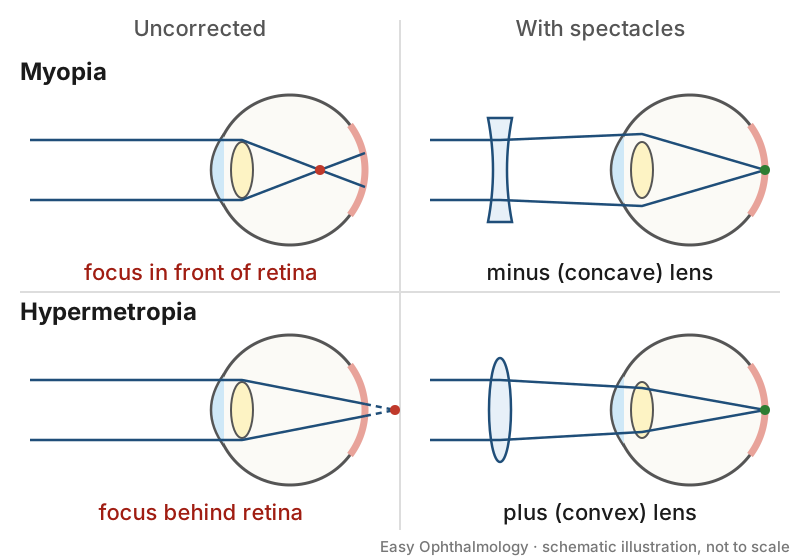
- School screening programmes identify correctable visual acuity deficits due to refractive error [S4]; a common referral threshold in trials was uncorrected acuity of 6/12 or worse in either eye [S5] [S1].
- Hyperopia: uncorrected hyperopia had a small adverse effect on educational performance (SMD -0.18) and a moderate effect on reading skills (SMD -0.46) compared with emmetropia [S9].
- Who buys glasses: girls, children with worse uncorrected acuity and those with higher refractive error were more likely to buy spectacles [S1].
Confirm it
- Use cycloplegic refraction: in one trial, spectacles were recommended when acuity worse than 6/12 improved by more than 2 lines with cycloplegic refraction [S1].
- Check acuity in each eye with the new correction, and check for amblyogenic factors such as anisometropia, astigmatism and hypermetropia [S11].
Manage it: spectacle provision and wear
Before acting on this section, check the national and local guidelines, product information and regulatory approvals that apply where you practise. See the medical disclaimer.
Tier A (primary care / school / community)
- Screen and refer children with reduced vision; trained teachers can provide a good-quality, cost-effective service where eye-care specialists are few [S6].
- Enlist teachers. Teachers who advised children to obtain glasses increased acceptance of free glasses (RR 2.74) and wear (RR 2.93); teachers who believed glasses harm vision reduced purchase [S5]. In that study, 20.4% of teachers believed glasses worsened vision [S5].
- Address misconceptions: barriers include cost, poor literacy, misconceptions and lack of eye health knowledge among parents [S6].
Tier B (refraction service / outreach team)
- Provide free spectacles where possible. About 400 per 1000 children wore spectacles after screening with free spectacles vs 250 per 1000 with a prescription only [S4]. Free spectacles increased compliance in a meta-analysis of trials (OR 2.45), though the effect fell with longer follow-up [S10].
- Consider ready-made spectacles. They gave no important difference in spectacle wear (RR 0.98) or quality of life compared with custom-made spectacles [S4]. Eligibility criteria for ready-made spectacles are not given in these abstracts.
- Dispense on site. Providing prescriptions for eyeglasses at school gave referral compliance of 51.8-96.0%, compared with 21.3-24.5% for education alone [S12].
- Plan for replacement: reasons for non-wear were broken or lost spectacles, forgetfulness and parental disapproval [S8].
- Do not rely on education campaigns alone. A carefully piloted lecture, video and demonstration did not increase purchase or wear in rural China [S1].
Tier C (paediatric eye clinic)
- Amblyopia: optical treatment alone had a large effect on acuity in a meta-analysis [S3]. In a trial run-in, 16 weeks of spectacles improved amblyopic eye acuity by 0.20 logMAR, and 37% of children no longer met amblyopia criteria; compliance measured electronically averaged 73% of waking time [S11].
- Hyperopia without strabismus: whether spectacles prevent strabismus in hyperopic infants is uncertain (Cochrane, very low-quality evidence), and one trial suggested spectacles impede emmetropisation [S2].
- Aphakia after infant cataract surgery: high spectacle adherence is achievable at age 4 years; adherence correlated with patching [S7].
Refer when
| Situation | Urgency |
|---|---|
| Sudden loss of vision, a white pupil or a painful red eye in a child seen for glasses | Urgent, same-day, to an eye specialist |
| Vision does not improve to normal with correction | Routine to an eye clinic; timing per your local service or specialist advice [S3] |
| Child fails school screening | Routine, ideally refracted on site at the next school visit [S12] |
| Young child with high hyperopia or anisometropia | Routine, at the next available paediatric eye clinic, for cycloplegic refraction and amblyopia assessment [S11] |
Pitfalls
- Measuring success by spectacles dispensed rather than spectacles worn [S8] [S10].
- Issuing a prescription without spectacles [S4].
- Ignoring teachers' beliefs [S5].
- Assuming education materials will change behaviour [S1] [S4].
- Forgetting that compliance falls over time [S10].
Evidence notes
| Source | Date | Design |
|---|---|---|
| [S1] | 2011 | Cluster RCT, rural China, 11,423 children examined |
| [S2] | 2014 | Cochrane systematic review, 3 trials (UK) |
| [S3] | 2018 | Systematic review and meta-analysis, 29 papers |
| [S4] | 2018 | Cochrane systematic review, 7 RCTs (China, India, Tanzania) |
| [S5] | 2019 | Cohort study, 882 children, 276 teachers (China) |
| [S6] | 2018 | Systematic review, 48 articles, 13 low- and middle-income countries |
| [S7] | 2019 | Cohort analysis of RCT data, 114 children |
| [S8] | 2020 | Meta-analysis of 20 cross-sectional studies |
| [S9] | 2022 | Systematic review and meta-analysis, 25 studies |
| [S10] | 2023 | Meta-analysis of 11 RCTs |
| [S11] | 2024 | Optical treatment run-in of an RCT, 65 children |
| [S12] | 2026 | Systematic review, 30 articles |
- Conflict: one meta-analysis recommends free spectacles combined with education [S10], while the Cochrane review found education adds little [S4].
- Most trial evidence comes from China and other Asian settings [S1] [S4] [S5]; the Cochrane review included one study in Tanzania [S4].
- The hyperopia evidence is mostly observational; no full-scale randomised trials were identified [S9].
- Not covered by these sources: prescribing thresholds by age, ready-made spectacle eligibility (anisometropia and astigmatism limits), frame fitting, and myopia control (see separate articles).
Related articles
- Low-dose atropine for myopia control
- Optical myopia control: spectacle lenses, contact lenses and orthokeratology
- School eye health programmes
References
See the numbered source list below. Each marker [S#] links to its PubMed and DOI record.
Sources
- [S1] Congdon N, Li L, Zhang M, Yang A, Gao Y, Griffiths S, et al. Randomized, controlled trial of an educational intervention to promote spectacle use in rural China: the see well to learn well study. Ophthalmology. (2011). PubMed 21889800 · doi:10.1016/j.ophtha.2011.06.016
- [S2] Jones-Jordan L, Wang X, Scherer RW, Mutti DO Spectacle correction versus no spectacles for prevention of strabismus in hyperopic children. The Cochrane database of systematic reviews. (2014). PubMed 25133974 · doi:10.1002/14651858.cd007738.pub2
- [S3] Asper L, Watt K, Khuu S Optical treatment of amblyopia: a systematic review and meta-analysis. Clinical & experimental optometry. (2018). PubMed 29392811 · doi:10.1111/cxo.12657
- [S4] Evans JR, Morjaria P, Powell C Vision screening for correctable visual acuity deficits in school-age children and adolescents. The Cochrane database of systematic reviews. (2018). PubMed 29446439 · doi:10.1002/14651858.cd005023.pub3
- [S5] Wang X, Ma Y, Hu M, Jin L, Xiao B, Ni M, et al. Teachers' influence on purchase and wear of children's glasses in rural China: The PRICE study. Clinical & experimental ophthalmology. (2019). PubMed 30117241 · doi:10.1111/ceo.13376
- [S6] Burnett AM, Yashadhana A, Lee L, Serova N, Brain D, Naidoo K Interventions to improve school-based eye-care services in low- and middle-income countries: a systematic review. Bulletin of the World Health Organization. (2018). PubMed 30455516 · doi:10.2471/blt.18.212332
- [S7] Lambert SR, DuBois L, Cotsonis G, Hartmann EE, Drews-Botsch C, Infant Aphakia Treatment Study Group Spectacle Adherence Among Four-Year-Old Children in the Infant Aphakia Treatment Study. American journal of ophthalmology. (2019). PubMed 30633891 · doi:10.1016/j.ajo.2018.12.017
- [S8] Dhirar N, Dudeja S, Duggal M, Gupta PC, Jaiswal N, Singh M, et al. Compliance to spectacle use in children with refractive errors- a systematic review and meta-analysis. BMC ophthalmology. (2020). PubMed 32093669 · doi:10.1186/s12886-020-01345-9
- [S9] Mavi S, Chan VF, Virgili G, Biagini I, Congdon N, Piyasena P, et al. The Impact of Hyperopia on Academic Performance Among Children: A Systematic Review. Asia-Pacific journal of ophthalmology (Philadelphia, Pa.). (2022). PubMed 35066525 · doi:10.1097/apo.0000000000000492
- [S10] Wu L, Feng J, Zhang M Implementing interventions to promote spectacle wearing among children with refractive errors: A systematic review and meta-analysis. Frontiers in public health. (2023). PubMed 36969641 · doi:10.3389/fpubh.2023.1053206
- [S11] Kadhum A, Tan ETC, Wenner Y, Joosse MV, Loudon SE Effectiveness of optical treatment in amblyopia and validation of measuring spectacle compliance with the ODM. Ophthalmic & physiological optics : the journal of the British College of Ophthalmic Opticians (Optometrists). (2024). PubMed 38757545 · doi:10.1111/opo.13322
- [S12] Cui J, Zhuo S, Qin Y, Wang J, Chen R, Huang W, et al. Compliance with post-school vision screening referral: a systematic review. BMJ open ophthalmology. (2026). PubMed 42838618 · doi:10.1136/bmjophth-2026-002876