Educational content only. Not personalised medical advice. Clinical decisions remain the responsibility of the treating clinician.
Low-dose atropine for myopia control
Atropine eye drops slow myopia progression in children, with a concentration-dependent effect in randomised trials [S2] [S3]. Low concentrations have few side effects, but the effect of 0.01% is modest and the certainty of evidence for low-dose atropine is very low in the 2025 Cochrane review [S10]. Treatment lasts years, and progression can rebound after stopping [S7] [S8].
Key points - In the LAMP trial (2019), 0.05%, 0.025% and 0.01% atropine reduced progression in a concentration-dependent way; 0.05% was most effective over 1 year [S2]. - A 2022 network meta-analysis ranked 0.05% atropine close to high-dose atropine (1% and 0.5%) for efficacy, while pupil and accommodation effects rose with dose [S3]. - 0.01% atropine reduced progression versus placebo in a UK multicentre RCT (mean difference 0.33 D over 2 years) [S12], but did not prevent myopia onset in non-myopic children in LAMP2 [S5]. - Photophobia and blurred near vision are the most common adverse events; severe adverse events were 0.0% in a pooled analysis [S6]. - Stopping causes rebound, greater in younger children and after shorter treatment [S7]; tapering produced less progression than abrupt stopping [S11].
Evidence last checked: 2026-10-17 (PubMed abstracts).
Red flags
- Fast progression despite treatment. A guideline defines progression as more than 0.50 D per year in spherical equivalent, or axial elongation of more than 0.3 mm (until age 10) or 0.2 mm (above 11) [S9]; combinations may be needed for uncontrolled cases [S9].
- Abrupt cessation in a young child. Rebound is greater in younger children and after shorter treatment [S7].
- Allergic reaction to the drops. Allergic conjunctivitis and dermatitis occurred with 0.1% and 0.5% atropine but not with 0.01% in ATOM2 [S1].
Recognise it: who may benefit
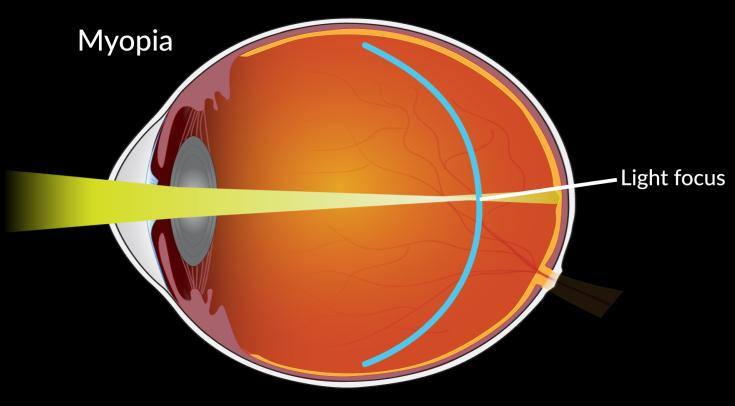
- Trials enrolled children aged 4 to 12 years with myopia of at least -1.0 D (LAMP) [S2], 6 to 12 years with at least -2.0 D (ATOM2) [S1], and 6 to 12 years with -0.50 to -10.0 D (CHAMP-UK) [S12].
- In a trial from India, children aged 5 to 15 years with myopia over 2 D were treated with 0.01% atropine at night [S4].
- Most trials in the Cochrane review were conducted in China or other Asian countries (66.3%) [S10]; the UK trial found no subgroup differences by age, ethnicity, sex or severity [S12].
Confirm it: baseline and monitoring
- The Brazilian guideline recommends corneal topography, cycloplegic refraction every 6 months and annual optical biometry, with 6-monthly biometry for fast progressors [S9].
- Trials measured cycloplegic refraction and axial length as outcomes [S2] [S12].
Manage it
Before acting on this section, check the national and local guidelines, product information and regulatory approvals that apply where you practise. See the medical disclaimer.
Tier A (primary care / no specialist)
- Refer children with myopia for a cycloplegic refraction and discussion of myopia control where available [S9].
- Atropine is one of several options alongside environmental measures, defocus spectacles, contact lenses and orthokeratology [S9].
Tier B (general eye clinic)
- Choice of concentration. Doses below are as reported in the trials, not a prescription; follow local formularies and product availability. - 0.05% nightly: mean SE change -0.27 D vs -0.81 D with placebo at 1 year, as reported in [S2]. - 0.01% nightly: -0.59 D vs -0.81 D at 1 year in LAMP [S2]; mean difference 0.33 D vs placebo at 2 years in CHAMP-UK [S12]; -0.30 D vs -0.88 D at 2 years in the Indian RCT [S4]. - In ATOM2, 0.5%, 0.1% and 0.01% gave -0.30, -0.38 and -0.49 D over 2 years; the authors judged the differences clinically insignificant, with fewer side effects at 0.01% [S1].
- Pooled estimates. The Cochrane review (very low-certainty evidence) gave a 1-year mean difference of 0.25 D and -0.10 mm for low-dose atropine (<0.1%), 0.55 D for medium dose (0.1% to <0.5%) and 0.90 D for high dose (≥0.5%, moderate certainty) [S10].
- Duration. The guideline advises treatment for at least 2 years [S9]. Over 5 years in LAMP, continued treatment groups that started on 0.05%, 0.025% and 0.01% progressed -1.34 D, -1.97 D and -2.34 D [S8].
- Side effects to explain. Pooled incidence of adverse events was 5.9%: photophobia 9.1%, blurred near vision 2.9% [S6]. Lower doses had fewer adverse events [S6]. In LAMP, 0.05% reduced accommodation by 1.98 D and increased photopic pupil size by 1.03 mm; visual acuity and quality of life were not affected [S2].
Tier C (specialist centre)
- Combination with orthokeratology. Ortho-K plus low-dose atropine probably reduces axial elongation more than ortho-K alone (MD -0.12 mm, moderate certainty) [S10].
- Prevention in pre-myopes. In LAMP2, 0.05% nightly reduced 2-year myopia incidence (28.4% vs 53.0% placebo); 0.01% did not differ from placebo [S5]. The authors call for replication and longer-term safety data [S5].
- Stopping. In LAMP, 87.9% of children who stopped at year 3 needed re-treatment; restarting 0.05% achieved similar efficacy to continued treatment [S8]. Tapering (0.05% then 0.025% for 6 months each) before stopping gave less progression over 3 years than stopping from 0.05% (-0.54 D vs -0.78 D), though the clinical relevance of the 0.24 D difference is unclear [S11].
Refer when
| Situation | Urgency |
|---|---|
| Child with new or progressing myopia and no access to myopia control | Routine; timing per your local service or specialist advice |
| Progression above 0.50 D per year on atropine | Routine, for review of combined treatment [S9]; timing per your local service or specialist advice |
| Red, painful eye, rash or marked photophobia on drops | Urgent; timing per your local service or specialist advice |
Pitfalls
- Expecting 0.01% atropine to prevent myopia onset: LAMP2 found no difference from placebo [S5].
- Assuming all concentrations work equally: effect was concentration-dependent in LAMP [S2] [S3].
- Stopping early without follow-up: rebound is greatest in the first 6 months after cessation [S7].
- Overstating certainty: low-dose atropine evidence is very low certainty and heterogeneous [S10].
Evidence notes
| Source | Date | Design |
|---|---|---|
| [S1] | 2012 | RCT, 400 children, no placebo arm (ATOM2) |
| [S2] | 2019 | RCT, placebo-controlled, 438 children (LAMP) |
| [S3] | 2022 | Network meta-analysis, 16 RCTs |
| [S4] | 2022 | Single-blind RCT, India |
| [S5] | 2023 | RCT, 474 non-myopic children (LAMP2) |
| [S6] | 2023 | Meta-analysis of adverse events, 31 articles |
| [S7] | 2024 | Systematic review and meta-analysis, 13 studies |
| [S8] | 2024 | Extended RCT, 5 years (LAMP phase 4) |
| [S9] | 2024 | National guideline (Brazil), expert consensus |
| [S10] | 2025 | Cochrane living systematic review and NMA, 104 RCTs |
| [S11] | 2026 | RCT of discontinuation, 8 years (LAMP) |
| [S12] | 2026 | Multicentre placebo-controlled RCT, UK |
- The Cochrane networks were poorly connected, and estimates rely mainly on direct comparisons; adverse events and adherence were inconsistently reported [S10].
- LAMP-series trials come from one centre in Hong Kong [S2] [S5]; the UK trial adds evidence from a mainly white population [S12].
- ATOM2 compared against historical placebo data from ATOM1, not a concurrent placebo [S1].
- Rebound evidence comes partly from interventional, non-randomised studies [S7].
- Not covered by these sources: cost, compounded versus commercial preparations, and treatment in adults.
Related articles
- Optical myopia control: spectacle lenses, contact lenses and orthokeratology
- Outdoor time and the prevention of myopia
- Repeated low-level red-light therapy for myopia
References
See the numbered source list below. Each marker [S#] links to its PubMed and DOI record.
Sources
- [S1] Chia A, Chua WH, Cheung YB, Wong WL, Lingham A, Fong A, et al. Atropine for the treatment of childhood myopia: safety and efficacy of 0.5%, 0.1%, and 0.01% doses (Atropine for the Treatment of Myopia 2). Ophthalmology. (2012). PubMed 21963266 · doi:10.1016/j.ophtha.2011.07.031
- [S2] Yam JC, Jiang Y, Tang SM, Law AKP, Chan JJ, Wong E, et al. Low-Concentration Atropine for Myopia Progression (LAMP) Study: A Randomized, Double-Blinded, Placebo-Controlled Trial of 0.05%, 0.025%, and 0.01% Atropine Eye Drops in Myopia Control. Ophthalmology. (2019). PubMed 30514630 · doi:10.1016/j.ophtha.2018.05.029
- [S3] Ha A, Kim SJ, Shim SR, Kim YK, Jung JH Efficacy and Safety of 8 Atropine Concentrations for Myopia Control in Children: A Network Meta-Analysis. Ophthalmology. (2022). PubMed 34688698 · doi:10.1016/j.ophtha.2021.10.016
- [S4] Sen S, Yadav H, Jain A, Verma S, Gupta P Effect of atropine 0.01% on progression of myopia. Indian journal of ophthalmology. (2022). PubMed 36018124 · doi:10.4103/ijo.ijo_256_22
- [S5] Yam JC, Zhang XJ, Zhang Y, Yip BHK, Tang F, Wong ES, et al. Effect of Low-Concentration Atropine Eyedrops vs Placebo on Myopia Incidence in Children: The LAMP2 Randomized Clinical Trial. JAMA. (2023). PubMed 36786791 · doi:10.1001/jama.2022.24162
- [S6] Sun H, Bu F, Xin X, Yan J Incidence of Adverse Events Induced by Atropine in Myopic Children: A Meta-Analysis. Journal of clinical pharmacology. (2023). PubMed 37492894 · doi:10.1002/jcph.2320
- [S7] Lee SH, Tsai PC, Chiu YC, Wang JH, Chiu CJ Myopia progression after cessation of atropine in children: a systematic review and meta-analysis. Frontiers in pharmacology. (2024). PubMed 38318144 · doi:10.3389/fphar.2024.1343698
- [S8] Zhang XJ, Zhang Y, Yip BHK, Kam KW, Tang F, Ling X, et al. Five-Year Clinical Trial of the Low-Concentration Atropine for Myopia Progression (LAMP) Study: Phase 4 Report. Ophthalmology. (2024). PubMed 38494130 · doi:10.1016/j.ophtha.2024.03.013
- [S9] Ejzenbaum F, Schaefer TMC, Cunha C, Rossetto JD, Godinho IF, Nakanami CR, et al. Guidelines for preventing and slowing myopia progression in Brazilian children. Arquivos brasileiros de oftalmologia. (2024). PubMed 39109702 · doi:10.5935/0004-2749.2023-0009
- [S10] Lawrenson JG, Huntjens B, Virgili G, Ng S, Dhakal R, Downie LE, et al. Interventions for myopia control in children: a living systematic review and network meta-analysis. The Cochrane database of systematic reviews. (2025). PubMed 39945354 · doi:10.1002/14651858.cd014758.pub3
- [S11] Zhang Y, Zhang XJ, Zaabaar E, Yim CC, Yip BHK, Kam KW, et al. Discontinuation Approach and Follow-Up of Low-Concentration Atropine for Myopia Progression: Eight-Year Results of the LAMP Randomized Clinical Trial. JAMA ophthalmology. (2026). PubMed 41885837 · doi:10.1001/jamaophthalmol.2026.0436
- [S12] Azuara-Blanco A, Logan NS, McConnell E, Kearney S, Kirk G, Jones S, et al. Low concentration atropine eye drops and progression of myopia in children: multicentre placebo controlled, double masked, randomised trial in the UK (CHAMP-UK). BMJ (Clinical research ed.). (2026). PubMed 42276557 · doi:10.1136/bmj-2025-086698