Educational content only. Not personalised medical advice. Clinical decisions remain the responsibility of the treating clinician.
Outdoor time and the prevention of myopia
More time outdoors is associated with a lower risk of myopia in children, and per additional hour outdoors per week is one of the best-supported risk factors in an umbrella review [S7]. School-based randomised trials show that adding outdoor time reduces myopia onset, but the effect on progression in children who are already myopic is small and less certain [S8]. It is a low-cost measure suited to schools and families in any setting [S1] [S6].
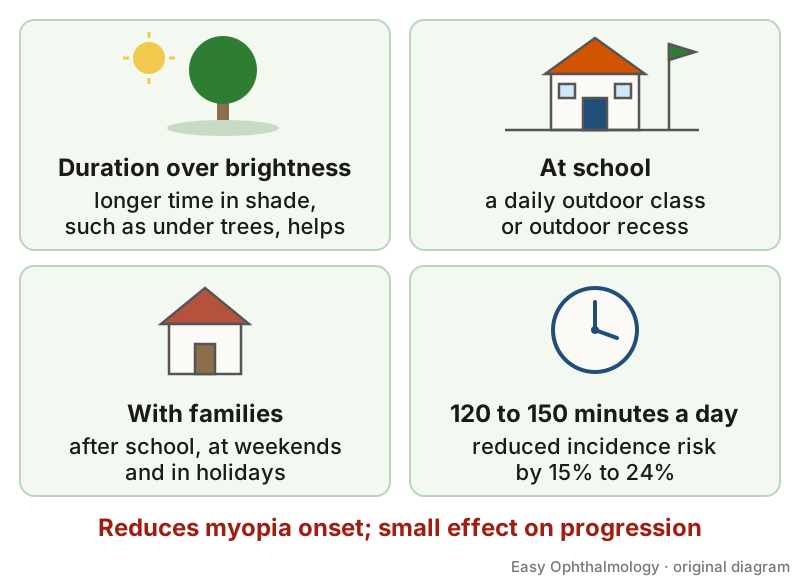
Key points - A Cochrane review (2024) of 5 RCTs and 10,733 children found lower myopia incidence at 2 years (22.5% vs 26.7%, moderate certainty), with small effects on refraction and axial length [S8]. - In Guangzhou, one extra 40-minute outdoor class per school day reduced 3-year myopia incidence from 39.5% to 30.4% [S1]. - Duration matters more than bright sunlight: longer time at moderate light (such as under trees) also protected [S2]; about 120 to 150 minutes a day reduced incidence risk by 15% to 24% [S5]. - Protection may be weaker in premyopic children than in hyperopic children [S11]. - Simple behavioural tools, such as text messages to parents, increased outdoor time and reduced axial elongation [S6].
Evidence last checked: 2026-10-17 (PubMed abstracts).
Red flags
This is a prevention topic. Outdoor time does not treat established progressive myopia: all interventions had a limited effect on progression in a review of national recommendations in China [S4]. A child with fast-progressing myopia needs a refraction and an eye examination, not only advice on outdoor time.
Recognise it: who is at risk
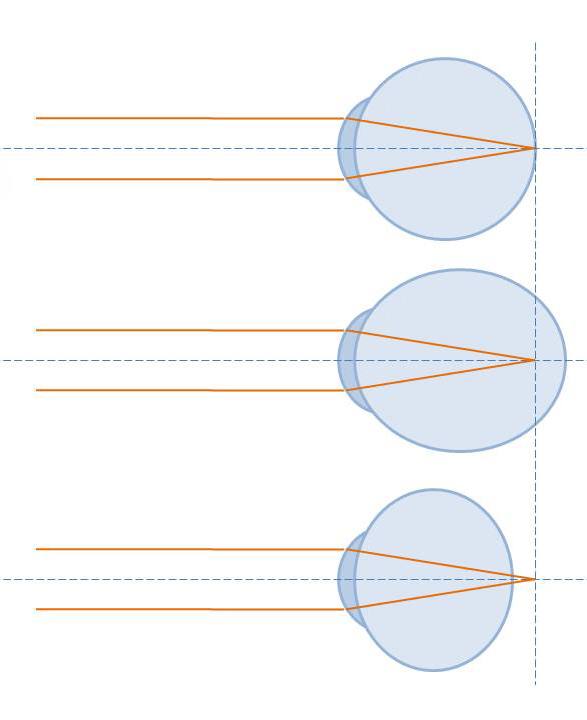
- Parental myopia and less time outdoors per week were rated as highly suggestive evidence, and near work as suggestive evidence, in an umbrella review [S7].
- Most trial participants were primary school children aged 6 to 9 years [S8].
- Children with premyopia showed a limited benefit from outdoor time in a post hoc analysis of a Shanghai trial; myopic shift fell with more outdoor time in hyperopic children, plateauing at about 120 minutes a day [S11].
Confirm it: measuring outdoor exposure
- Trials measured outdoor time and light with wrist-worn devices or light meters [S2] [S5] [S6].
- The dose-response between 40 and 80 extra minutes was not seen in Shanghai because the test groups achieved similar outdoor time, so compliance monitoring is important [S5].
Manage it: running an outdoor-time programme
Before acting on this section, check the national and local guidelines, product information and regulatory approvals that apply where you practise. See the medical disclaimer.
Tier A (primary care / no specialist)
- Families. Encourage children to spend more time outdoors after school, at weekends and in holidays, as in the Guangzhou trial [S1].
- Reminders. Text messages to parents twice daily for 1 year increased weekend outdoor time and reduced axial elongation over 3 years [S6]. Myopia prevalence at year 3 was 46.6% vs 65.4% in controls [S6].
- Shade is acceptable. Outdoor activity with lower light intensity but longer duration, such as in hallways or under trees, can be considered [S2].
Tier B (general eye clinic and school health services)
- School programmes. Add a daily outdoor class (40 minutes in [S1]; 40 or 80 minutes in [S5]) or move recess outdoors. The Taiwan recess programme encouraged up to 11 hours a week and reduced myopic shift (0.35 D vs 0.47 D) in both non-myopic and myopic children [S2].
- Target dose. Daily outdoor time of 120 to 150 minutes at 5000 lux, or cumulative exposure of 600 000 to 750 000 lux, reduced incidence risk by 15% to 24% [S5]. A meta-analysis reported benefits with 40 to 120 minutes daily [S10].
- Near-work feedback. Wearable eye-use reminders with feedback reduced 49-week myopia incidence (13.3% vs 27.8%), but differences diminished by 98 weeks once stopped [S9].
Tier C (specialist centre and policy)
- Combine with active treatment for progressing myopia. Outdoor time alone has limited effect on progression [S4].
- Other activities. A 2026 network meta-analysis ranked racket sports highest for slowing axial elongation (MD -0.30 mm), followed by increased outdoor time (MD -0.08 mm) [S12]. This is a ranking signal from 16 RCTs, not confirmed by head-to-head trials [S12].
Refer when
| Situation | Urgency |
|---|---|
| Child with sudden loss of vision, eye pain or a white pupil reflex | Same-day |
| Child with reduced distance vision at school screening | Routine, for refraction; timing per your local service or specialist advice |
| Child with known myopia that is getting worse despite outdoor time | Routine, for myopia control assessment [S4]; timing per your local service or specialist advice |
Pitfalls
- Presenting outdoor time as a treatment for established myopia [S4] [S8].
- Assuming strong sunlight is required: longer time at lower intensity also helped [S2].
- Prescribing time without checking it: insufficient achieved outdoor time removed the expected dose-response [S5].
- Stopping a programme early: benefits of behavioural tools faded after the intervention ended [S9].
Evidence notes
| Source | Date | Design |
|---|---|---|
| [S1] | 2015 | Cluster RCT, 12 schools, Guangzhou |
| [S2] | 2018 | Cluster RCT, 16 schools, Taiwan |
| [S3] | 2020 | Meta-analysis of 5 RCTs |
| [S4] | 2023 | Systematic review of national recommendations, China |
| [S5] | 2022 | Cluster RCT, 24 schools, Shanghai |
| [S6] | 2022 | RCT, text messages to parents |
| [S7] | 2024 | Umbrella review of meta-analyses |
| [S8] | 2024 | Cochrane systematic review, 5 RCTs |
| [S9] | 2025 | Cluster RCT, wearable eye-use monitoring |
| [S10] | 2025 | Meta-analysis, 9 RCTs and 6 observational studies |
| [S11] | 2026 | Post hoc analysis of a cluster RCT |
| [S12] | 2026 | Network meta-analysis, 16 RCTs |
- Estimates differ: a 2020 meta-analysis of 5 RCTs reported a risk ratio of 0.76 for new myopia and an axial length difference of -0.03 mm [S3]; Cochrane found effects at 1 and 3 years with confidence intervals that included no benefit [S8].
- The 2025 meta-analysis rated its certainty as low due to suspected publication bias [S10].
- Almost all trials are from China and Taiwan [S1] [S2] [S5]; generalisability to other settings is uncertain [S1].
- The Taiwan trial lost 8 of 24 randomised schools before enrolment [S2].
- No adverse events were reported in the Cochrane review [S8].
- Not covered by these sources: sun protection, effects in adolescents and data from Africa or South Asia.
Related articles
References
See the numbered source list below. Each marker [S#] links to its PubMed and DOI record.
Sources
- [S1] He M, Xiang F, Zeng Y, Mai J, Chen Q, Zhang J, et al. Effect of Time Spent Outdoors at School on the Development of Myopia Among Children in China: A Randomized Clinical Trial. JAMA. (2015). PubMed 26372583 · doi:10.1001/jama.2015.10803
- [S2] Wu PC, Chen CT, Lin KK, Sun CC, Kuo CN, Huang HM, et al. Myopia Prevention and Outdoor Light Intensity in a School-Based Cluster Randomized Trial. Ophthalmology. (2018). PubMed 29371008 · doi:10.1016/j.ophtha.2017.12.011
- [S3] Cao K, Wan Y, Yusufu M, Wang N Significance of Outdoor Time for Myopia Prevention: A Systematic Review and Meta-Analysis Based on Randomized Controlled Trials. Ophthalmic research. (2020). PubMed 31430758 · doi:10.1159/000501937
- [S4] Zhu Z, Chen Y, Tan Z, Xiong R, McGuinness MB, Müller A Interventions recommended for myopia prevention and control among children and adolescents in China: a systematic review. The British journal of ophthalmology. (2023). PubMed 34844916 · doi:10.1136/bjophthalmol-2021-319306
- [S5] He X, Sankaridurg P, Wang J, Chen J, Naduvilath T, He M, et al. Time Outdoors in Reducing Myopia: A School-Based Cluster Randomized Trial with Objective Monitoring of Outdoor Time and Light Intensity. Ophthalmology. (2022). PubMed 35779695 · doi:10.1016/j.ophtha.2022.06.024
- [S6] Li SM, Ran AR, Kang MT, Yang X, Ren MY, Wei SF, et al. Effect of Text Messaging Parents of School-Aged Children on Outdoor Time to Control Myopia: A Randomized Clinical Trial. JAMA pediatrics. (2022). PubMed 36155742 · doi:10.1001/jamapediatrics.2022.3542
- [S7] Ying ZQ, Li DL, Zheng XY, Zhang XF, Pan CW Risk factors for myopia among children and adolescents: an umbrella review of published meta-analyses and systematic reviews. The British journal of ophthalmology. (2024). PubMed 36754586 · doi:10.1136/bjo-2022-322773
- [S8] Kido A, Miyake M, Watanabe N Interventions to increase time spent outdoors for preventing incidence and progression of myopia in children. The Cochrane database of systematic reviews. (2024). PubMed 38864362 · doi:10.1002/14651858.cd013549.pub2
- [S9] Hu Y, Yu M, Han X, Congdon N, Wu Z, Liu J, et al. Behavioral Intervention with Eye-Use Monitoring to Delay Myopia Onset and Progression in Children: A Cluster Randomized Trial. Ophthalmology. (2025). PubMed 39793658 · doi:10.1016/j.ophtha.2025.01.003
- [S10] Martinez-Perez C, Sanchez-Tena MA, Sánchez-González JM, Villa-Collar C, Alvarez-Peregrina C Influence of outdoor time on the spherical equivalent and axial length in childhood myopia: A meta-analysis. Acta ophthalmologica. (2025). PubMed 40066935 · doi:10.1111/aos.17478
- [S11] Chen J, Qi Z, Morgan I, Rose K, Zhu Z, Ding X, et al. Time outdoors prevents myopia in hyperopic children, but protection is weaker in premyopic children: a post-hoc analysis of a cluster-randomised trial. The British journal of ophthalmology. (2026). PubMed 41062253 · doi:10.1136/bjo-2025-327768
- [S12] Weng X, Yang Y, Zhou S, Yuan L Comparative effectiveness of outdoor and exercise interventions for myopia control in children and adolescents: a systematic review and network meta-analysis of randomized clinical trials. Frontiers in public health. (2026). PubMed 42494903 · doi:10.3389/fpubh.2026.1833405