Educational content only. Not personalised medical advice. Clinical decisions remain the responsibility of the treating clinician.
Ophthalmia neonatorum
Ophthalmia neonatorum is an infection of the eyes in newborns that can lead to blindness, particularly when caused by Neisseria gonorrhoeae [S7]. Gonococcal infection can cause corneal scarring, ocular perforation and blindness as early as 24 hours after birth [S6], and it remains a major cause of ocular morbidity, blindness and even death among neonates in developing countries [S11]. Chlamydia trachomatis is the other key pathogen, and current prophylaxis does not reliably prevent it [S8] [S10].
Key points - The USPSTF recommends topical ocular prophylaxis for all newborns to prevent gonococcal ophthalmia neonatorum (grade A) [S6]. - A Cochrane review (30 trials, 79,198 neonates) found that prophylaxis probably reduces conjunctivitis of any cause, but evidence for gonococcal and chlamydial conjunctivitis specifically was uncertain, and no agent was consistently superior [S7]. - Erythromycin or tetracycline ointment does not reduce chlamydial conjunctivitis in infants of infected mothers compared with silver nitrate [S8]; screening and treating chlamydia in pregnancy is recommended where feasible [S10]. - Treatment of gonococcal ophthalmia with single low-dose ceftriaxone is supported only by a small series of 21 babies [S1].
Evidence last checked: 2026-10-17 (PubMed abstracts).
Red flags
- Purulent discharge within the first days of life: gonococcal infection can damage the cornea as early as 24 hours after birth [S6].
- Corneal haze, ulcer or perforation [S6].
- Signs of systemic infection: N. gonorrhoeae can cause systemic neonatal infection [S5]; chlamydial infection can cause pneumonia [S8] [S10].
- Mother with known or suspected gonorrhoea or chlamydia: without prophylaxis, gonococcal transmission from mother to newborn is 30% to 50% [S6].
- Drug-resistant gonorrhoea: N. gonorrhoeae is developing resistance to most antibiotics currently prescribed [S11].
Recognise it
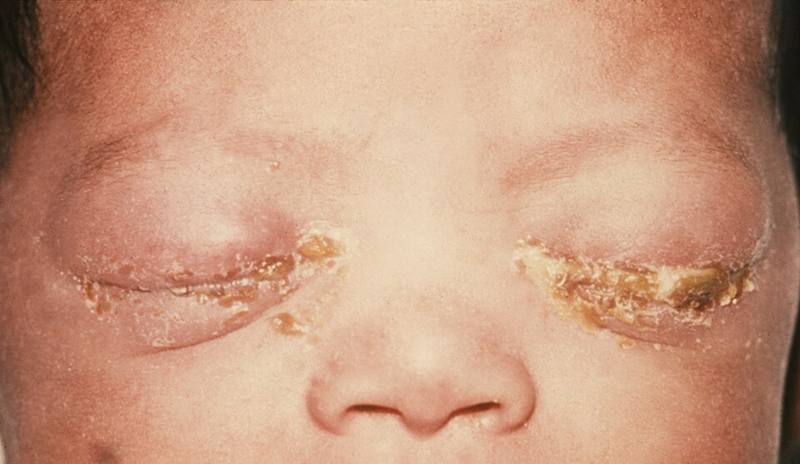
- Neonatal conjunctivitis has infectious and non-infectious origins; recognising causes that threaten systemic complications is critical for timely treatment [S9].
- Chemical (non-infective) conjunctivitis can follow prophylaxis: povidone-iodine 2.5% caused non-infective conjunctivitis in 5% of neonates in one RCT, mostly in the first 3 days [S4].
- Chlamydial ophthalmia can be asymptomatic: 3 of 12 infected infants in a Botswana series had positive tests without signs, and 4 had signs suggestive of pneumonia [S10].
Confirm it
- Laboratory confirmation, including PCR for C. trachomatis, was used in trials [S2]; GeneXpert CT/NG testing was used in the Botswana series [S10].
- Ask about maternal infection and maternal treatment; two of five symptomatic Botswana cases whose mothers had completed erythromycin still had lingering symptoms [S10].
- Do not let testing delay treatment of suspected gonococcal infection [EIC expert opinion].
Manage it
Before acting on this section, check the national and local guidelines, product information and regulatory approvals that apply where you practise. See the medical disclaimer.
Tier A (primary care / no specialist)
- Prophylaxis at birth for every newborn. Topical ocular prophylaxis is effective against gonococcal ophthalmia and is not associated with serious harms [S6]. Agents studied include tetracycline 1%, erythromycin 0.5%, povidone-iodine 2.5% and silver nitrate 1% [S7].
- Choice of agent. No agent was consistently superior in the Cochrane review [S7]. In one RCT, ophthalmia was more frequent after povidone-iodine 2.5% than tetracycline 1% (15.4% vs 5.2%), and the authors recommended tetracycline [S4]. In a trachoma-endemic area of Mexico (2004 neonates), povidone-iodine doubled the risk of chlamydial conjunctivitis compared with chloramphenicol (RR 1.99) [S2]. A 2010 meta-analysis found erythromycin and povidone-iodine reduced chlamydial ophthalmia compared with silver nitrate [S3].
- Refer any newborn with purulent discharge as set out under "Refer when"; gonococcal damage can start within 24 hours of birth [S6].
Tier B (general eye clinic or hospital)
- Gonococcal ophthalmia: in a South African series of 21 culture-proven mother-baby pairs, a single dose of ceftriaxone 62.5 mg for babies and 125 mg for mothers (as reported in [S1]) eradicated N. gonorrhoeae with no residual eye damage [S1]. This is a small, old, uncontrolled study; confirm dosing against your national formulary.
- Chlamydial ophthalmia: systemic treatment dosing is not covered by these abstracts; follow local formularies. Current prophylaxis and treatment for chlamydial ophthalmia appear inadequate [S10].
- Treat the mother and partner: maternal gonorrhoea can be cured with ceftriaxone or other regimens, but the Cochrane evidence is very low quality and does not favour one regimen [S5].
Tier C (specialist centre)
- Manage corneal complications and consider resistance: alternative agents for drug-resistant N. gonorrhoeae are at an experimental stage [S11].
Refer when
| Situation | Urgency |
|---|---|
| Newborn with purulent conjunctivitis, especially in the first days of life | Same-day for systemic treatment [G1] [S6] |
| Corneal haze, ulcer or perforation | Immediate to an eye specialist [G1] [S6] |
| Newborn with conjunctivitis and breathing difficulty or signs of systemic illness | Immediate to a paediatric service [EIC expert opinion] [S5] [S10] |
| Conjunctivitis not settling after prophylaxis or treatment | Urgent for testing for chlamydia; timing per your local service or specialist advice [S8] [S10] |
Pitfalls
- Assuming prophylaxis prevents chlamydial conjunctivitis [S8] [S10].
- Treating gonococcal ophthalmia with drops alone: treatment in the evidence was systemic ceftriaxone [S1].
- Mistaking chemical conjunctivitis from povidone-iodine for infection [S4].
- Forgetting the mother: infection is acquired at birth from infected mothers [S11].
Evidence notes
| Source | Date | Design |
|---|---|---|
| [S1] | 2002 | Prospective case series, 21 mother-baby pairs (South Africa) |
| [S2] | 2007 | Multicentre RCT, 2004 neonates (Mexico) |
| [S3] | 2010 | Meta-analysis of 8 studies |
| [S4] | 2011 | RCT, 394 neonates |
| [S5] | 2018 | Cochrane systematic review, 2 RCTs |
| [S6] | 2019 | USPSTF recommendation statement (guideline) |
| [S7] | 2020 | Cochrane systematic review, 30 trials, 79,198 neonates |
| [S8] | 2021 | Systematic review, 3 studies |
| [S9] | 2022 | Narrative review |
| [S10] | 2023 | Case series, 12 infants (Botswana), and literature review |
| [S11] | 2024 | Narrative review |
- Every study in the Cochrane review had high risk of bias in at least one domain, and none reported blindness or visual outcomes [S7]. 12 of 30 trials were from low- and middle-income settings [S7].
- Conflict: the USPSTF found convincing evidence of substantial benefit for gonococcal prevention [S6], while the Cochrane review rated the evidence for gonococcal conjunctivitis as very low certainty [S7]. The 2010 meta-analysis suggested re-examining universal prophylaxis where maternal infection is rare [S3].
- Conflict on povidone-iodine: it reduced chlamydial ophthalmia vs silver nitrate [S3] but increased it vs chloramphenicol [S2].
- Not covered by these sources: treatment regimens for chlamydial ophthalmia, ceftriaxone dosing by weight, eye irrigation, and herpes simplex neonatal conjunctivitis.
Related articles
References
See the numbered source list below. Each marker [S#] links to its PubMed and DOI record.
Sources
- [S1] Hoosen AA, Kharsany AB, Ison CA Single low-dose ceftriaxone for the treatment of gonococcal ophthalmia--implications for the national programme for the syndromic management of sexually transmitted diseases. South African medical journal = Suid-Afrikaanse tydskrif vir geneeskunde. (2002). PubMed 12040955
- [S2] Ramirez-Ortiz MA, Rodriguez-Almaraz M, Ochoa-Diazlopez H, Diaz-Prieto P, Rodriguez-Suárez RS Randomised equivalency trial comparing 2.5% povidone-iodine eye drops and ophthalmic chloramphenicol for preventing neonatal conjunctivitis in a trachoma endemic area in southern Mexico. The British journal of ophthalmology. (2007). PubMed 17947266 · doi:10.1136/bjo.2007.119867
- [S3] Darling EK, McDonald H A meta-analysis of the efficacy of ocular prophylactic agents used for the prevention of gonococcal and chlamydial ophthalmia neonatorum. Journal of midwifery & women's health. (2010). PubMed 20630358 · doi:10.1016/j.jmwh.2009.09.003
- [S4] David M, Rumelt S, Weintraub Z Efficacy comparison between povidone iodine 2.5% and tetracycline 1% in prevention of ophthalmia neonatorum. Ophthalmology. (2011). PubMed 21439642 · doi:10.1016/j.ophtha.2010.12.003
- [S5] Comunián-Carrasco G, Peña-Martí GE, Martí-Carvajal AJ Antibiotics for treating gonorrhoea in pregnancy. The Cochrane database of systematic reviews. (2018). PubMed 29465747 · doi:10.1002/14651858.cd011167.pub2
- [S6] US Preventive Services Task Force, Curry SJ, Krist AH, Owens DK, Barry MJ, Caughey AB, et al. Ocular Prophylaxis for Gonococcal Ophthalmia Neonatorum: US Preventive Services Task Force Reaffirmation Recommendation Statement. JAMA. (2019). PubMed 30694327 · doi:10.1001/jama.2018.21367
- [S7] Kapoor VS, Evans JR, Vedula SS Interventions for preventing ophthalmia neonatorum. The Cochrane database of systematic reviews. (2020). PubMed 32959365 · doi:10.1002/14651858.cd001862.pub4
- [S8] Smith-Norowitz TA, Ukaegbu C, Kohlhoff S, Hammerschlag MR Neonatal prophylaxis with antibiotic containing ointments does not reduce incidence of chlamydial conjunctivitis in newborns. BMC infectious diseases. (2021). PubMed 33731049 · doi:10.1186/s12879-021-05974-3
- [S9] Khan A, Anders A, Cardonell M Neonatal Conjunctivitis. NeoReviews. (2022). PubMed 36047752 · doi:10.1542/neo.23-9-e603
- [S10] Yang K, Babalola CM, Mussa A, Ryan R, Wynn A, Simon S, et al. Case series and literature review of chlamydial ophthalmia neonatorum in Botswana. International journal of STD & AIDS. (2023). PubMed 37338101 · doi:10.1177/09564624231173028
- [S11] Belagal P Current alternative therapies for treating drug-resistant Neisseria gonorrhoeae causing ophthalmia neonatorum. Future microbiology. (2024). PubMed 38512111 · doi:10.2217/fmb-2023-0251
Guidelines
- [G1] NHS Scotland (Community Eyecare Guidelines, eyes.nhs.scot). 3.9 Conjunctivitis, Ophthalmia Neonatorum (2026). https://www.eyes.nhs.scot/eyecare-guidelines/section-3-conjunctiva/39-conjunctivitis-ophthalmia-neonatorum/