Educational content only. Not personalised medical advice. Clinical decisions remain the responsibility of the treating clinician.
Congenital nasolacrimal duct obstruction
Congenital nasolacrimal duct obstruction (CNLDO) is the most common cause of epiphora and mucous discharge in the newborn [S8], with an incidence in early childhood of 5% to 20% [S3]. Most cases resolve without surgery [S3] [S10], so the main decisions are how long to observe, whether massage helps, and when and how to probe [S6].
Key points - In infants aged 6 to under 10 months, about two-thirds (66%) of obstructions resolved within 6 months of non-surgical management (PEDIG RCT) [S1] [S6]. - Office probing succeeded in 75% of eyes in children aged 6 to under 15 months, less often with bilateral disease (63% vs 80%) [S2]. - Deferring treatment until 12 to 18 months is a reasonable option; bilateral obstruction may be better treated in a facility (American Academy of Ophthalmology report) [S6]. - Evidence on massage conflicts: one RCT found no benefit at 1 month [S8], another found massage for 3 months non-inferior to probing [S12]. - A congenital dacryocystocele with acute dacryocystitis or respiratory distress needs early specialist care [S5].
Evidence last checked: 2026-10-17 (PubMed abstracts).
Red flags
- Congenital dacryocystocele with acute dacryocystitis: preferably managed with intravenous antibiotics and early endoscopy-guided probing [S5].
- Dacryocystocele with respiratory distress: conservative treatment is an option only in the absence of acute dacryocystitis or respiratory distress [S5]; intranasal cysts can be missed without endoscopy [S5].
- Local infection: CNLDO can cause eyelid skin maceration and local infections such as conjunctivitis, and probing may fail when the duct is swollen from dacryocystitis [S3].
Recognise it
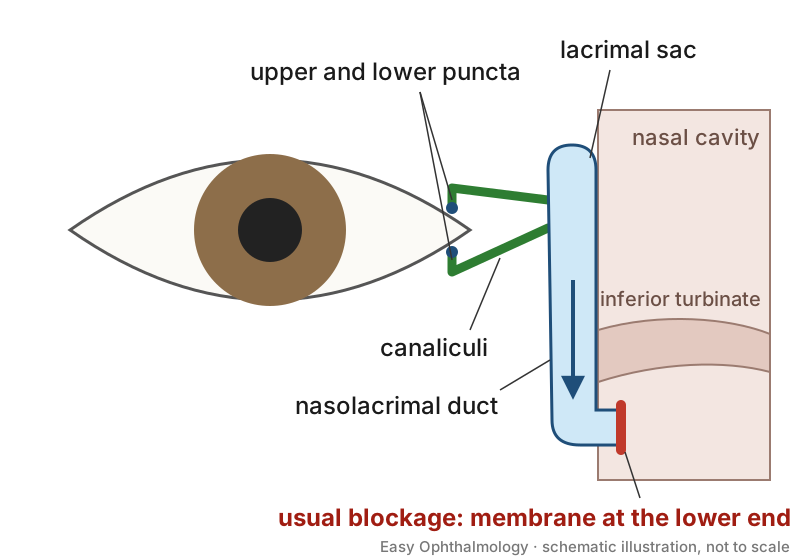
- Excessive tearing or mucoid discharge from birth, due to blockage of the nasolacrimal duct, typically at a membranous obstruction at the distal duct [S3].
- Clinical signs used in trials: epiphora, increased tear lake and mucous discharge [S1] [S2].
- Dacryocystocele: a rare variant (0.1% to 0.3% of CNLDO cases), more common in girls (64.2%), presenting at a mean of 7 days after birth [S5].
- Amblyopia risk: CNLDO persists in approximately 5-6% of cases; some studies found more anisometropia, hyperopia and amblyopia with unilateral or persistent CNLDO, others did not, and the evidence remains inconclusive [S11].
Confirm it
- Diagnosis includes the fluorescein dye disappearance test and, where needed, imaging [S10].
- Distinguish simple from complex CNLDO: success rates differ markedly (pooled 88% vs 57%) [S7].
- Given the possible link with amblyogenic risk factors, consider refraction in persistent or unilateral cases [S11].
Manage it
Before acting on this section, check the national and local guidelines, product information and regulatory approvals that apply where you practise. See the medical disclaimer.
Tier A (primary care / no specialist)
- Explain the natural history and observe. Most cases resolve within the first year [S10]; 66% of eyes resolved within 6 months of non-surgical management in infants aged 6 to under 10 months [S1].
- Lacrimal sac (Crigler) massage by parents. In a Japanese multicentre RCT of 102 infants aged 3-11 months, massage 10 strokes twice daily for 1 month did not increase resolution (31.4% vs 33.3%), though it may help compliant infants aged 3-5 months [S8]. In a Chinese RCT of 160 infants under 1 year, standardised massage for 3 months was non-inferior to office probing (86.2% vs 83.7% resolution), but symptoms took longer to settle (3.8 vs 1.1 weeks) [S12].
- Topical antibiotics as needed were part of non-surgical management in the PEDIG trial [S1]. Drug choice and dosing are not covered by these abstracts.
- Refer a swelling at the medial canthus in a newborn, or any sign of acute infection, as below [S5].
Tier B (general eye clinic)
- Office probing under topical anaesthesia succeeded in 75% of eyes aged 6 to under 15 months; success was lower with bilateral disease and with 2 or 3 clinical signs [S2]. Bleeding from the punctum occurred in 20% of probings in one trial; reported complications were not serious [S3].
- Immediate vs deferred probing. For unilateral CNLDO in infants aged 6 to under 10 months, immediate office probing gave 92% vs 82% success at 18 months (difference not significant), 3.0 fewer months of symptoms and likely better cost-effectiveness, but meant probing about two-thirds of infants who would have resolved anyway [S1]. A Cochrane review judged the effects and costs of immediate vs deferred probing uncertain [S3].
- Timing. Deferring treatment until 12 to 18 months of age is reasonable [S6].
Tier C (specialist centre)
- Facility-based probing after 6 months of observation had high success in unilateral (83%) and bilateral (82%) cases; bilateral CNLDO may be better treated in a facility [S6].
- Complex CNLDO: intubation raised success from 46% to 82% compared with probing and should be considered as primary treatment; in simple CNLDO it added no significant benefit (87% vs 92%) [S7].
- Silicone tube intubation had higher success than probing, especially over 12 months of age; monocanalicular tubes had fewer complications than bicanalicular, with similar success [S9].
- Balloon dacryoplasty after failed probing had success rates of 75% to 100%, similar to stenting, in level II and III evidence [S4].
- Dacryocystocele: endoscopy-assisted probing appears to give better outcomes than office probing; intranasal cysts are best marsupialised; dacryocystorhinostomy is very rarely needed [S5].
Refer when
| Situation | Urgency |
|---|---|
| Newborn with a medial canthal swelling plus breathing difficulty | Immediate to a paediatric and lacrimal service [EIC expert opinion] [S5] |
| Red, tender swelling over the lacrimal sac (acute dacryocystitis) | Same-day for intravenous antibiotics [G1] [S5] |
| Persistent watering or discharge beyond the first year | Routine, within months, for probing [S6] |
| Failed probing | Routine, within months, to a specialist centre [S4] [S9] |
Pitfalls
- Probing every infant early: most resolve without surgery [S1] [S10].
- Office probing in bilateral cases, where success is lower [S2] [S6].
- Treating complex CNLDO with probing alone [S7].
- Managing a dacryocystocele with acute infection conservatively [S5].
- Forgetting possible amblyogenic risk factors in persistent cases [S11].
Evidence notes
| Source | Date | Design |
|---|---|---|
| [S1] | 2012 | Multicentre RCT, 163 infants (PEDIG) |
| [S2] | 2014 | Pooled analysis of two prospective multicentre studies, 384 eyes |
| [S3] | 2017 | Cochrane systematic review, 2 RCTs, 242 participants |
| [S4] | 2018 | American Academy of Ophthalmology technology assessment, 8 studies |
| [S5] | 2019 | Systematic review, 1,063 patients |
| [S6] | 2021 | American Academy of Ophthalmology technology assessment, 21 articles |
| [S7] | 2024 | Systematic review and meta-analysis, 21 studies |
| [S8] | 2024 | Multicentre RCT, 102 infants (Japan) |
| [S9] | 2024 | Systematic review and meta-analysis, 23 studies |
| [S10] | 2025 | Narrative review |
| [S11] | 2026 | Systematic review, 24 studies |
| [S12] | 2026 | Non-inferiority RCT, 160 infants (China) |
- RCT evidence on probing timing is limited to two trials, examined at disparate time points [S3].
- Conflict on massage: [S8] (1 month, unilateral cases, 3-11 months) vs [S12] (3 months, single centre); the trials differed in duration and design.
- No level I evidence exists for balloon dacryoplasty [S4].
- Cost figures come from the United States [S1] [S6] and may not apply elsewhere.
- Not covered by these sources: antibiotic choice and dosing, anaesthesia risks in low-resource settings, and nasal endoscopy availability.
Related articles
References
See the numbered source list below. Each marker [S#] links to its PubMed and DOI record.
Sources
- [S1] Pediatric Eye Disease Investigator Group A randomized trial comparing the cost-effectiveness of 2 approaches for treating unilateral nasolacrimal duct obstruction. Archives of ophthalmology (Chicago, Ill. : 1960). (2012). PubMed 23229693 · doi:10.1001/archophthalmol.2012.2853
- [S2] Miller AM, Chandler DL, Repka MX, Hoover DL, Lee KA, Melia M, et al. Office probing for treatment of nasolacrimal duct obstruction in infants. Journal of AAPOS : the official publication of the American Association for Pediatric Ophthalmology and Strabismus. (2014). PubMed 24568978 · doi:10.1016/j.jaapos.2013.10.016
- [S3] Petris C, Liu D Probing for congenital nasolacrimal duct obstruction. The Cochrane database of systematic reviews. (2017). PubMed 28700811 · doi:10.1002/14651858.cd011109.pub2
- [S4] Wladis EJ, Aakalu VK, Yen MT, Bilyk JR, Sobel RK, Mawn LA Balloon Dacryoplasty for Congenital Nasolacrimal Duct Obstruction: A Report by the American Academy of Ophthalmology. Ophthalmology. (2018). PubMed 29887332 · doi:10.1016/j.ophtha.2018.05.005
- [S5] Singh S, Ali MJ Congenital Dacryocystocele: A Major Review. Ophthalmic plastic and reconstructive surgery. (2019). PubMed 30601463 · doi:10.1097/iop.0000000000001297
- [S6] Morrison DG, Binenbaum G, Chang MY, Heidary G, Trivedi RH, Galvin JA, et al. Office- or Facility-Based Probing for Congenital Nasolacrimal Duct Obstruction: A Report by the American Academy of Ophthalmology. Ophthalmology. (2021). PubMed 33358412 · doi:10.1016/j.ophtha.2020.10.028
- [S7] Eshraghi B, Babaei L, Moradi M, Chaibakhsh S, Aghajani A Assessing the success rate of treatment in simple and complex congenital nasolacrimal duct obstruction: a systematic review and meta-analysis. Graefe's archive for clinical and experimental ophthalmology = Albrecht von Graefes Archiv fur klinische und experimentelle Ophthalmologie. (2024). PubMed 38059998 · doi:10.1007/s00417-023-06318-4
- [S8] Asano M, Takeuchi M, Ohno T, Nakamura J, Mizuki N, Matsumura N Lacrimal sac massage for congenital nasolacrimal duct obstruction: a multicentre randomised controlled trial. The British journal of ophthalmology. (2024). PubMed 38242699 · doi:10.1136/bjo-2023-324595
- [S9] Alruwaili R, Alanazi F, Alrashidi A, Hazazi M, Alenezi M Comparative Analysis of Silicone Tube Intubation Versus Probing and Balloon Dilation for Congenital Nasolacrimal Duct Obstruction: A Systematic Review and Meta-Analysis. The Journal of craniofacial surgery. (2024). PubMed 38727216 · doi:10.1097/scs.0000000000010273
- [S10] Błaszczyk K, Biedka K, Estreicher A, Wesołowski M, Bulski J, Sobaś A, et al. Congenital Nasolacrimal Duct Obstruction: Natural Course, Diagnosis and Therapeutic Strategies. Journal of clinical medicine. (2025). PubMed 40507477 · doi:10.3390/jcm14113716
- [S11] Khademi B, Moallem M Congenital nasolacrimal duct obstruction and amblyogenic risk factors: a systematic review of the evidence and controversies. Orbit (Amsterdam, Netherlands). (2026). PubMed 41734059 · doi:10.1080/01676830.2025.2599282
- [S12] Zheng X, Yu X, Wu G, Zhang J, Wang K, Jin L, et al. Standardized Lacrimal Sac Massage vs Probing for Congenital Nasolacrimal Duct Obstruction in Infants: A Noninferiority Randomized Trial. JAMA ophthalmology. (2026). PubMed 42593819 · doi:10.1001/jamaophthalmol.2026.3169
Guidelines
- [G1] NHS Scotland Community Eyecare Guidelines. 2.3 Dacryocystitis, Acute (2026). https://www.eyes.nhs.scot/eyecare-guidelines/section-2-orbitlacrimal-system/23-dacryocystitis-acute/