Educational content only. Not personalised medical advice. Clinical decisions remain the responsibility of the treating clinician.
Ocular surface squamous neoplasia
Ocular surface squamous neoplasia (OSSN) is the most common neoplasia of the anterior segment [S10]. Africa has the highest incidence in the world, where it affects younger people, women as often as men, and is strongly associated with HIV [S1] [S3]. Recurrence after excision is common, and topical chemotherapy has become an effective alternative or adjunct to surgery [S4] [S6].
Key points - HIV increases the risk of OSSN about eight-fold (summary RR 8.06) [S2]; sunlight exposure and HPV are further risk factors [S3]. - In a Kenyan RCT, fluorouracil 1% drops after excision cut 1-year recurrence from 36% to 11% [S4]. - Topical 5-fluorouracil (5-FU), interferon alfa-2b and mitomycin C gave tumour resolution and recurrence comparable to surgery in a meta-analysis [S6]. - About 3.7% of lesions excised as pterygium contain OSSN, so histology of pterygium specimens may be considered [S12]. - 5-FU is far cheaper than interferon [S8].
Evidence last checked: 2026-10-17 (PubMed abstracts).
Red flags
- Young adult, especially in Africa. In Africa the disease affects people around 35 years of age, is more aggressive and presents after a mean history of three months [S1].
- HIV infection. Strongly associated with OSSN (meta-analysis OR 6.17 in African studies [S3]; RR 8.06 overall [S2]).
- Recurrence. Recurrence after treatment reaches up to 43% [S1].
- "Pterygium" in an atypical patient or setting. Co-existing OSSN was found in 10.25% of pterygium specimens from countries with predominantly medium skin pigmentation [S12].
Recognise it
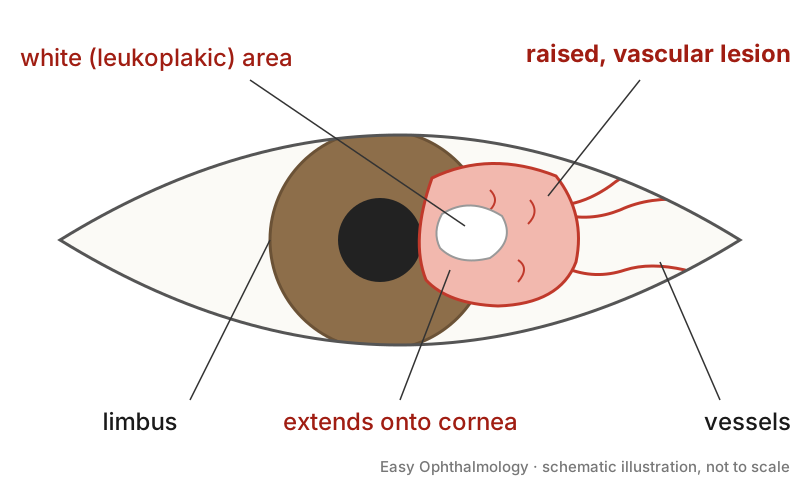
- Highest age-standardised incidence was reported from Zimbabwe (3.4 and 3.0 per 100 000 per year in males and females) [S3]. Conjunctival squamous cell carcinoma incidence was highest in Africa in a 2026 global meta-analysis [S11].
- Risk rises with 2 or more hours of direct daylight a day and with outdoor occupations [S3]. There is no evidence that antiretroviral therapy reduces the risk [S3].
- In a European series, prolonged sun exposure was the main risk factor and leukoplakic, bulbar conjunctival lesions were most common [S8]. Detailed clinical signs are otherwise not described in these abstracts.
Confirm it
- Histology after excision confirms the diagnosis and grade [S4] [S8]. Exfoliative or impression cytology was used to confirm OSSN before topical treatment in clinical studies [S7] [S9].
- Detailed clinical assessment and imaging are needed to define the extent of disease [S10]; anterior segment OCT was part of assessment in one series [S8].
- HIV is the strongest known risk factor [S2] [S3]; these abstracts do not address HIV testing pathways, so follow national HIV guidance.
Manage it
Before acting on this section, check the national and local guidelines, product information and regulatory approvals that apply where you practise. See the medical disclaimer.
Tier A (primary care / no specialist)
- Refer any growing, vascular or white conjunctival lesion, particularly in a person with HIV or a young adult, to an eye clinic (see Refer when).
- Risk is linked to daylight exposure [S3], but sun protection has not been evaluated in these sources.
Tier B (general eye clinic)
- Excision with histology. Surgical excision has been the standard treatment, with wide margins and a "no-touch" technique described [S6] [S10]. Send all specimens for histology, including suspected pterygium where possible [S12].
- Adjuvant 5-FU. In the Kenyan RCT (98 participants), fluorouracil 1% four times a day for 4 weeks after excision, as reported in [S4], reduced recurrence (odds ratio 0.21). Ocular discomfort, epiphora and eyelid skin inflammation were more common but transient and mild [S4]. A systematic review also graded adjuvant 5-FU as reducing relapse (level Ib, grade A) [S5].
- Primary topical therapy. Primary 0.5% 5-FU, given 4 times daily for 2 weeks then a 2-week pause as reported in [S9], achieved complete resolution in 70.4% of 54 Brazilian patients, with side effects in 35.2% and no treatment discontinuations [S9].
- Cost. In a Spanish series, interferon cost about 1025 euros versus 165.57 euros for 5-FU, and 5-FU was judged more cost-effective [S8].
Tier C (specialist centre)
- Mitomycin C and interferon alfa-2b. In a small phase IIb RCT (17 patients with localised intraepithelial neoplasia), MMC 0.04% or interferon alfa-2b 1 million IU/mL four times daily, as reported in [S7], resolved all lesions; resolution was faster with MMC (59 vs 143.5 days), and mild adverse reactions occurred in 77% and 50% [S7].
- Choosing an agent. Primary 5-FU, MMC and interferon have similar recurrence; side effects are most severe with 5-FU, then MMC, then interferon (low-level evidence) [S5].
- Advanced disease. Plaque brachytherapy and targeted immunotherapy are among the evolving options [S10]; details are not given in these abstracts.
Refer when
| Situation | Urgency |
|---|---|
| Suspected OSSN in any patient | Urgent to an eye clinic able to excise and send histology; timing per your local service or specialist advice |
| Large lesion, corneal involvement, or suspected orbital or intraocular spread | Urgent to a specialist centre; timing per your local service or specialist advice |
| Recurrence after treatment | Urgent to an eye clinic; timing per your local service or specialist advice |
Pitfalls
- Excising a "pterygium" without histology [S12].
- Omitting adjuvant treatment where recurrence is common [S1] [S4].
- Assuming antiretroviral therapy protects against OSSN [S3].
- Using interferon where 5-FU is cheaper and effective [S8].
Evidence notes
| Source | Date | Design |
|---|---|---|
| [S1] | 2013 | Cochrane systematic review (no eligible RCTs) |
| [S2] | 2013 | Systematic review and meta-analysis |
| [S3] | 2013 | Systematic review and meta-analysis, Africa |
| [S4] | 2016 | Multicentre double-blind placebo-controlled RCT, Kenya |
| [S5] | 2017 | Systematic review |
| [S6] | 2022 | Systematic review and meta-analysis, 4 studies in quantitative synthesis |
| [S7] | 2023 | Phase IIb RCT, 17 patients |
| [S8] | 2024 | Retrospective series, Spain |
| [S9] | 2024 | Retrospective series, Brazil |
| [S10] | 2025 | Narrative review |
| [S11] | 2026 | Systematic review and meta-analysis of incidence |
| [S12] | 2026 | Systematic review and meta-analysis of pterygium histology |
- The Cochrane review found no RCTs in HIV-infected people up to 2012, and practice rested on case series [S1]; the Kenyan RCT [S4] was published later and was stopped early after sample size recalculation.
- The surgery versus topical therapy meta-analysis is small and the confidence intervals are wide [S6].
- HPV association differs by subtype: only cutaneous subtypes seemed to be a risk factor in one meta-analysis [S2].
- Funding: [S4] was funded by the British Council for Prevention of Blindness and the Wellcome Trust.
- Not covered by these sources: clinical signs in detail, surgical technique with cryotherapy, management of invasive and orbital disease, and evidence-based referral timings.
Related articles
References
See the numbered source list below. Each marker [S#] links to its PubMed and DOI record.
Sources
- [S1] Gichuhi S, Irlam JH Interventions for squamous cell carcinoma of the conjunctiva in HIV-infected individuals. The Cochrane database of systematic reviews. (2013). PubMed 23450564 · doi:10.1002/14651858.cd005643.pub3
- [S2] Carreira H, Coutinho F, Carrilho C, Lunet N HIV and HPV infections and ocular surface squamous neoplasia: systematic review and meta-analysis. British journal of cancer. (2013). PubMed 24030075 · doi:10.1038/bjc.2013.539
- [S3] Gichuhi S, Sagoo MS, Weiss HA, Burton MJ Epidemiology of ocular surface squamous neoplasia in Africa. Tropical medicine & international health : TM & IH. (2013). PubMed 24237784 · doi:10.1111/tmi.12203
- [S4] Gichuhi S, Macharia E, Kabiru J, Zindamoyen AM, Rono H, Ollando E, et al. Topical fluorouracil after surgery for ocular surface squamous neoplasia in Kenya: a randomised, double-blind, placebo-controlled trial. The Lancet. Global health. (2016). PubMed 27198842 · doi:10.1016/s2214-109x(16)30052-3
- [S5] Viani GA, Fendi LI Adjuvant treatment or primary topical monotherapy for ocular surface squamous neoplasia: a systematic review. Arquivos brasileiros de oftalmologia. (2017). PubMed 28591290 · doi:10.5935/0004-2749.20170032
- [S6] Kozma K, Dömötör ZR, Csutak A, Szabó L, Hegyi P, Erőss B, et al. Topical pharmacotherapy for ocular surface squamous neoplasia: systematic review and meta-analysis. Scientific reports. (2022). PubMed 35987957 · doi:10.1038/s41598-022-18545-6
- [S7] Alvarado-Castillo B, Santa Cruz-Pavlovich FJ, Gonzalez-Castillo C, Vidal-Paredes IA, Garcia-Benavides L, Rosales-Gradilla ME, et al. Safety and efficacy of topical interferon alpha 2B and mitomycin C for localized conjunctival intraepithelial neoplasia: long-term report of their pharmacological safety and efficacy. BMC ophthalmology. (2023). PubMed 37501105 · doi:10.1186/s12886-023-03092-z
- [S8] San Román Llorens JJ, Fernández-Gurria M, Artaechevarria Artieda J, Alejandre Alba N, García Sandoval B, Jiménez-Alfaro Morote I Efficacy, safety and cost-effectiveness of 5-fluorouracil versus interferon α-2b as adjuvant therapy after surgery in ocular surface squamous neoplasia in a southern European tertiary hospital. International ophthalmology. (2024). PubMed 38630143 · doi:10.1007/s10792-024-03105-w
- [S9] Kato JM, Ballalai PL, de Lima PP, Santo RM Efficacy and safety of topical 0.5% 5-Fluorouracil as primary treatment of ocular surface squamous neoplasia. Canadian journal of ophthalmology. Journal canadien d'ophtalmologie. (2024). PubMed 38631493 · doi:10.1016/j.jcjo.2024.03.021
- [S10] Bansal R, Honavar SG Oncological principles in the management of ocular surface squamous neoplasia - A Review. Indian journal of ophthalmology. (2025). PubMed 39853137 · doi:10.4103/ijo.ijo_2340_24
- [S11] Sriranganathan A, Dhillon J, Al-Kaabi A, Koaik M Global incidence of ocular surface squamous neoplasia and histopathologic subtypes: A systematic review and meta-analysis. The ocular surface. (2026). PubMed 42679893 · doi:10.1016/j.jtos.2026.08.007
- [S12] Foroughi E, Pourmahdi-Boroujeni M, Chaibakhsh S, Ghasvarian A, Zivdari A, Ghafarian S, et al. Prevalence of ocular surface squamous neoplasia in clinically diagnosed pterygium specimens: A systematic review and meta-analysis. European journal of ophthalmology. (2026). PubMed 42852915 · doi:10.1177/11206721261496343