Educational content only. Not personalised medical advice. Clinical decisions remain the responsibility of the treating clinician.
Pterygium
A pterygium is a fleshy, wing-shaped growth of conjunctiva across the limbus onto the cornea, linked to ultraviolet light exposure [S1] [S12]. It can impair vision, limit eye movements and cause irritation and dryness, and in some patients it grows across the visual axis [S1]. Surgery is the only effective treatment, and the main problem is recurrence [S1].
Key points - Ultraviolet exposure is the main risk factor [S12]. - Bare sclera excision alone has been reported to recur in upwards of 80% of cases; excision with a tissue graft lowers recurrence [S1]. - Conjunctival autograft recurs less than amniotic membrane at 6 months (RR 0.53) [S1]. - Fibrin glue may reduce recurrence and operating time compared with sutures (low-certainty evidence) [S2] [S11]. - Mitomycin C is the most effective adjuvant in a network meta-analysis; adjuvants carry toxicity risks [S3] [S8].
Evidence last checked: 2026-10-17 (PubMed abstracts).
Red flags
- Pterygium approaching or covering the visual axis, which can block vision [S1].
- Growing pterygium causing astigmatism. Pterygia of 3 to 4 mm pose a notable risk of residual aberrations, and earlier removal reduces this risk [S9].
- Scleral thinning, corneal toxicity or graft problems after antimetabolite use. 5-FU can cause scleral thinning and corneal toxicity, ranging up to severe and sight-threatening [S8].
- Restricted eye movement [S1] [S2].
- An atypical ocular surface lesion is not covered by these sources; refer if in doubt (see "Refer when").
Recognise it
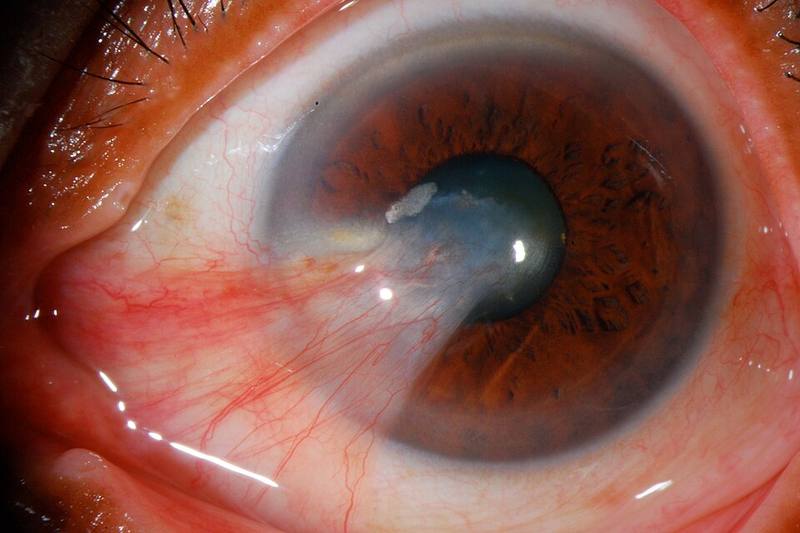
- Appearance. A wing-shaped conjunctival growth crossing the limbus onto the cornea [S1].
- Symptoms. Irritation, foreign body sensation, dryness, reduced vision and restricted motility [S1] [S2].
- Risk. Ultraviolet light is a major contributor [S1] [S12]; prevalence ranges widely around the world [S1].
- Refraction. Pterygium causes refractive errors through localised corneal flattening near its leading edge [S9].
Confirm it
- Diagnosis is clinical; these abstracts do not describe grading systems.
- Measure refraction and, where available, keratometry: surgery improved astigmatism, keratometry and aberrations in most of 23 studies (1663 eyes) [S9].
Manage it
Before acting on this section, check the national and local guidelines, product information and regulatory approvals that apply where you practise. See the medical disclaimer.
Tier A (primary care / no specialist)
- Advise protection from ultraviolet exposure, the main risk factor [S12]. Specific protective measures are not covered by these abstracts.
- Refer when the pterygium threatens the visual axis, affects vision or is growing (see "Refer when") [S1] [S9].
Tier B (general eye clinic)
- Avoid bare sclera excision alone because of high recurrence [S1].
- Conjunctival autograft is preferred [S12]. In a Cochrane review of 20 RCTs (1947 eyes), conjunctival autograft had lower 6-month recurrence than amniotic membrane (RR 0.53, 95% CI 0.33 to 0.85), particularly for recurrent pterygia (RR 0.45) [S1].
- Graft site. Inferior and superior conjunctival autografts had similar recurrence in 4 RCTs (438 eyes) [S6].
- Graft fixation.
- Fibrin glue versus sutures (Cochrane, 14 RCTs): less recurrence (RR 0.47; about 5 fewer recurrences per 100 operations) and about 17 minutes shorter surgery, but possibly more complications (RR 1.92), all low certainty [S2]. A 2026 meta-analysis of 20 RCTs also found lower recurrence, shorter surgery and less day-1 pain with glue [S11].
- Autologous blood (where glue is unavailable): recurrence did not differ from glue or sutures, but graft retraction and displacement were more common; evidence was low quality [S4].
Tier C (specialist centre)
- Adjuvants. In a network meta-analysis of 34 RCTs (2483 patients), recurrence was reduced by mitomycin C (OR 0.12), beta-radiotherapy (OR 0.17) and bevacizumab (OR 0.38), but not 5-FU (OR 0.41, 95% CI 0.12 to 1.39) [S3]. Mitomycin C 0.02% for 5 minutes, with or without autograft, gave favourable 15-year outcomes in 40 eyes with recurrent pterygium, as reported in [S5].
- Bevacizumab. A meta-analysis of 17 RCTs found lower recurrence (RR 0.652) without more complications [S7].
- Topical cyclosporine 0.05% reduced recurrence after bare sclera and conjunctival flap rotation, but not significantly after autograft techniques, in 12 studies [S10].
- 5-FU. As a surgical adjuvant its efficacy is suboptimal and the reviewers do not recommend it; intralesional injection for impending or true recurrence was more promising, and its low cost suits resource-limited settings, but it needs caution and long-term monitoring [S8].
- Adjuvant dosing beyond what is quoted above is not covered by these abstracts: follow local protocols.
Refer when
| Situation | Urgency |
|---|---|
| Pterygium near or covering the visual axis, or reducing vision | Routine to an eye surgeon; timing per your local service or specialist advice [S1] |
| Atypical lesion (rapid growth, unusual appearance) | Urgent to an eye clinic; timing per your local service or specialist advice |
| Pain, scleral thinning or a non-healing defect after pterygium surgery with adjuvants | Same-day to the operating surgeon or eye clinic [EIC expert opinion] [S8] |
Pitfalls
- Bare sclera excision alone [S1].
- Using 5-FU as an intraoperative adjuvant expecting reliable effect [S8].
- Late surgery for large pterygia, risking residual aberrations [S9].
- Ignoring graft complications with glue or autologous blood [S2] [S4].
Evidence notes
| Source | Date | Design |
|---|---|---|
| [S1] | 2016 | Cochrane systematic review, 20 RCTs |
| [S2] | 2016 | Cochrane systematic review, 14 RCTs |
| [S3] | 2017 | Network meta-analysis, 34 RCTs |
| [S4] | 2018 | Meta-analysis, 7 studies |
| [S5] | 2019 | 15-year follow-up of an RCT, 40 eyes |
| [S6] | 2021 | Meta-analysis, 4 RCTs |
| [S7] | 2021 | Meta-analysis, 17 RCTs |
| [S8] | 2022 | Systematic review, 34 studies (5-FU) |
| [S9] | 2025 | Systematic review, 23 studies |
| [S10] | 2025 | Meta-analysis, 12 studies |
| [S11] | 2026 | Meta-analysis, 20 RCTs |
| [S12] | 2026 | Umbrella review of 26 reviews |
- Many autograft trials had unclear risk of bias, and too few used mitomycin C to judge its added effect [S1].
- Fibrin glue evidence is low certainty, with a possible excess of complications [S2]; graft retraction results were inconsistent [S11].
- Many trials come from Asia, the Middle East and Latin America [S1] [S2].
- Not covered by these sources: ocular surface squamous neoplasia, cost, and specific sun protection advice.
Related articles
References
See the numbered source list below. Each marker [S#] links to its PubMed and DOI record.
Sources
- [S1] Clearfield E, Muthappan V, Wang X, Kuo IC Conjunctival autograft for pterygium. The Cochrane database of systematic reviews. (2016). PubMed 26867004 · doi:10.1002/14651858.cd011349.pub2
- [S2] Romano V, Cruciani M, Conti L, Fontana L Fibrin glue versus sutures for conjunctival autografting in primary pterygium surgery. The Cochrane database of systematic reviews. (2016). PubMed 27911983 · doi:10.1002/14651858.cd011308.pub2
- [S3] Zeng W, Liu Z, Dai H, Yan M, Luo H, Ke M, et al. Anti-fibrotic, anti-VEGF or radiotherapy treatments as adjuvants for pterygium excision: a systematic review and network meta-analysis. BMC ophthalmology. (2017). PubMed 29178848 · doi:10.1186/s12886-017-0601-5
- [S4] Zein H, Ismail A, Abdelmongy M, Elsherif S, Hassanen A, Muhammad B, et al. Autologous Blood for Conjunctival Autograft Fixation in Primary Pterygium Surgery: A Systematic Review and Meta-analysis. Current pharmaceutical design. (2018). PubMed 30277146 · doi:10.2174/1381612824666181001161352
- [S5] Kam KW, Young AL Fifteen-year results of a randomized controlled trial comparing 0.02% mitomycin C, limbal conjunctival autograft, and combined mitomycin C with limbal conjunctival autograft in recurrent pterygium surgery. Graefe's archive for clinical and experimental ophthalmology = Albrecht von Graefes Archiv fur klinische und experimentelle Ophthalmologie. (2019). PubMed 31650270 · doi:10.1007/s00417-019-04499-5
- [S6] Li W, Lou Y, Wang B Recurrence rate with inferior conjunctival autograft transplantation compared with superior conjunctival autograft transplantation in pterygium surgery: a meta-analysis. BMC ophthalmology. (2021). PubMed 33750344 · doi:10.1186/s12886-021-01889-4
- [S7] Zhang X, Jiang Y, Fu Q, Zhang X, Chen Y Efficacy of bevacizumab in the treatment of pterygium: An updated meta-analysis of randomized controlled trials. International immunopharmacology. (2021). PubMed 34225235 · doi:10.1016/j.intimp.2021.107921
- [S8] Lee BWH, Sidhu AS, Francis IC, Coroneo MT 5-Fluorouracil in primary, impending recurrent and recurrent pterygium: Systematic review of the efficacy and safety of a surgical adjuvant and intralesional antimetabolite. The ocular surface. (2022). PubMed 35961535 · doi:10.1016/j.jtos.2022.08.002
- [S9] Rad NR Treatment of Pterygium on the Refractive Errors: A Systematic Review. Korean journal of ophthalmology : KJO. (2025). PubMed 40235101 · doi:10.3341/kjo.2025.0003
- [S10] Aleksander-Ivanov Y, Cheidde L, Veiga DM, Filho LAZ, Afshari N Adjuvant Use of Topical 0.05% Cyclosporine A in Primary Pterygium Recurrence Rate: A Systematic Review and Meta-analysis. American journal of ophthalmology. (2025). PubMed 40562088 · doi:10.1016/j.ajo.2025.06.020
- [S11] Tsai JHJ, Tan EJ, Au Eong JTW, George SM, Au Eong KG Fibrin Glue Versus Sutures for Securing Conjunctival Autograft in Primary Pterygium Surgery: A Systematic Review and Meta-Analysis. American journal of ophthalmology. (2026). PubMed 41419075 · doi:10.1016/j.ajo.2025.12.004
- [S12] Kaplan Moscovici B, Rodrigues PF, Correa Dantas PE, Felberg S What is truly evidence-based in pterygium? An umbrella review of systematic reviews and meta-analyses. The ocular surface. (2026). PubMed 42276419 · doi:10.1016/j.jtos.2026.06.004