Educational content only. Not personalised medical advice. Clinical decisions remain the responsibility of the treating clinician.
Local anaesthesia for eye surgery
Unless medically contraindicated, cataract surgery is usually performed under local (regional) anaesthesia [S2]. The main options are topical drops (with or without intracameral lidocaine), sub-Tenon's, peribulbar and retrobulbar blocks, and subconjunctival injection [S1] [S2] [S3] [S8]. Each technique has acceptable effectiveness in trials, so the choice rests on the procedure, the patient and local skills [S2] [S3] [S11].
Key points - Peribulbar and retrobulbar blocks give similar anaesthesia and akinesia for cataract surgery; severe local or systemic complications were rare with both [S2]. - Topical anaesthesia slightly increases intraoperative pain compared with sub-Tenon's (about 1.1 points on a 0 to 10 scale), probably too small to be clinically relevant; both are accepted and safe [S3]. - Adding intracameral lidocaine to topical anaesthesia modestly reduces intraoperative pain without increasing corneal endothelial cell loss (moderate-quality evidence) [S8]. - In vitreoretinal surgery, sub-Tenon's gave the best pain scores and least need for supplementary anaesthesia; topical anaesthesia was significantly less effective [S11]. - Severe haemorrhagic complications of needle blocks were very low (0.04%) both with and without antithrombotics in a systematic review [S4].
Evidence last checked: 2026-10-18 (PubMed abstracts).
Red flags
- Retrobulbar haemorrhage after a needle block; it was uncommon in the Cochrane review and occurred only after retrobulbar block [S2].
- Postoperative binocular diplopia, especially after peribulbar or retrobulbar anaesthesia [S12].
- Elderly patients with cognitive problems: general anaesthesia may cause postoperative cognitive dysfunction about twice as often as local anaesthesia [S9].
Recognise it: technique-specific effects
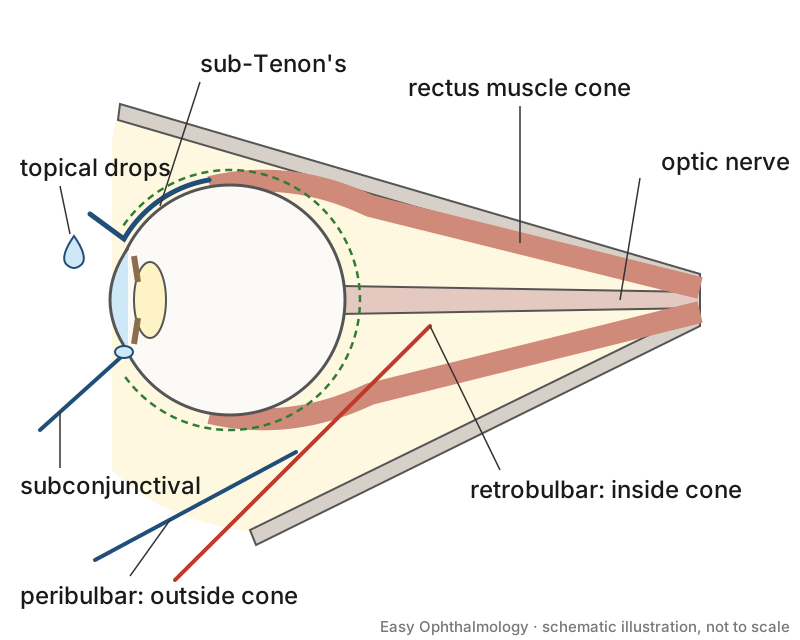
- Peribulbar vs retrobulbar. Conjunctival chemosis was more common after peribulbar block (RR 2.11), and lid haematoma more common after retrobulbar block [S2].
- Sub-Tenon's vs peribulbar. In a Nigerian randomised study of 152 patients, akinesia and analgesia were comparable, and 92% vs 97% reported mild or no pain during surgery; chemosis and subconjunctival haemorrhage were more common with sub-Tenon's [S5].
- Subconjunctival vs retrobulbar. In a Nigerian randomised study of 90 patients, pain and globe movement did not differ significantly; pain may be slightly more under retrobulbar anaesthesia [S1].
- Diplopia. The pooled incidence of postoperative binocular diplopia after cataract surgery was 0.9%; it was 1.2% with peribulbar and 0.2% with retrobulbar anaesthesia, and topical anaesthesia had lower odds than retrobulbar (very low to low certainty) [S12].
Confirm it: choosing the technique
- Antithrombotics. None of five studies showed significant bleeding with needle blocks in patients on aspirin, clopidogrel or vitamin K antagonists, but the data are underpowered [S4]. Decisions about stopping these drugs are outside these sources; follow local protocols.
- Topical vs sub-Tenon's. Surgeon and patient satisfaction were lower with topical anaesthesia, and there was not enough evidence on intraoperative complications [S3].
- Vitreoretinal surgery. Peribulbar block had the lowest risk of adverse events in a network meta-analysis of 11 studies [S11].
Manage it
Before acting on this section, check the national and local guidelines, product information and regulatory approvals that apply where you practise. See the medical disclaimer.
Tier A (primary care / no specialist)
- Local anaesthesia for eye surgery is not given at Tier A. Before referral for cataract surgery, list the patient's antithrombotic drugs and any cognitive problems so the surgical team can plan [S4] [S9].
- Ask about double vision after surgery and refer if it persists [S12].
Tier B (general eye clinic / outreach cataract service)
- Peribulbar, retrobulbar, sub-Tenon's and subconjunctival techniques were all effective and safe for cataract surgery in trials, including Nigerian studies [S1] [S2] [S5].
- Topical anaesthesia is acceptable for phacoemulsification; intracameral lidocaine 0.5% to 1% reduced the odds of any pain by 60%, as reported in [S8].
- Agents for peribulbar block. Levobupivacaine and bupivacaine performed similarly for akinesia, onset, pain, diplopia and hypotension in 8 RCTs [S10]. Ropivacaine was associated with lower block failure than bupivacaine in a meta-analysis of 21 studies [S7].
- Hyaluronidase. Its effect on intraoperative pain is uncertain (low-quality evidence), though participant and surgeon satisfaction were higher in small trials and no harm was reported [S6].
- Volumes and concentrations other than those reported above are not covered: follow your local anaesthesia protocol.
Tier C (specialist centre)
- For vitrectomy, sub-Tenon's had significantly less need for additional anaesthesia than other techniques; topical anaesthesia was less effective than sub-Tenon's and peribulbar block [S11].
- For elderly and high-risk patients, especially those with cognitive problems, choose the anaesthetic method with cognitive risk in mind; evidence on drugs such as ketamine, midazolam and dexmedetomidine is not conclusive [S9].
Refer when
| Situation | Urgency |
|---|---|
| Proptosis, tense orbit or loss of vision after a needle block (suspected retrobulbar haemorrhage) | Immediate, same-day surgical assessment [S2] |
| Persistent binocular diplopia after cataract surgery | Routine, for orthoptic or strabismus assessment [S12]; timing per your local service or specialist advice |
| New confusion after eye surgery in an older patient | Medical emergency assessment [S9]; follow your national protocol [EIC expert opinion] |
Pitfalls
- Assuming topical anaesthesia suits every patient: satisfaction is lower than with sub-Tenon's for some patients [S3].
- Using topical anaesthesia alone for vitreoretinal surgery [S11].
- Over-reading small differences in pain scores that may not be clinically meaningful [S3] [S8].
- Assuming antithrombotics are proven safe with needle blocks; the evidence is underpowered [S4].
Evidence notes
| Source | Date | Design |
|---|---|---|
| [S1] | 2011 | Randomised study, 90 patients (Nigeria) |
| [S2] | 2015 | Cochrane systematic review, 6 RCTs (1438 participants) |
| [S3] | 2015 | Cochrane systematic review, 7 studies analysed |
| [S4] | 2016 | Systematic review, 5 studies |
| [S5] | 2016 | Randomised study, 152 patients (Nigeria) |
| [S6] | 2018 | Cochrane systematic review, 7 RCTs |
| [S7] | 2021 | Meta-analysis of 21 RCTs |
| [S8] | 2020 | Cochrane systematic review, 13 RCTs |
| [S9] | 2025 | Systematic review, 9 trials |
| [S10] | 2025 | Meta-analysis of 8 RCTs |
| [S11] | 2025 | Network meta-analysis, 11 studies |
| [S12] | 2026 | Systematic review and meta-analysis, 22 studies |
- The sub-Tenon's vs topical Cochrane review included trials published between 1997 and 2005 [S3].
- Diplopia estimates had very high heterogeneity and very low certainty [S12].
- In the peribulbar vs retrobulbar review, all trials had unclear allocation concealment [S2].
- Not covered by these sources: globe perforation and brainstem anaesthesia rates, anaesthetic doses and volumes for blocks, monitoring and resuscitation standards, sedation practice, and paediatric anaesthesia.
Related articles
References
See the numbered source list below. Each marker [S#] links to its PubMed and DOI record.
Sources
- [S1] Nwosu SN, Nwosu VO, Anajekwu C, Ezenwa A Retrobulbar versus subconjunctival anesthesia for cataract surgery. Nigerian journal of clinical practice. (2011). PubMed 22037068 · doi:10.4103/1119-3077.86767
- [S2] Alhassan MB, Kyari F, Ejere HO Peribulbar versus retrobulbar anaesthesia for cataract surgery. The Cochrane database of systematic reviews. (2015). PubMed 26133124 · doi:10.1002/14651858.cd004083.pub3
- [S3] Guay J, Sales K Sub-Tenon's anaesthesia versus topical anaesthesia for cataract surgery. The Cochrane database of systematic reviews. (2015). PubMed 26308931 · doi:10.1002/14651858.cd006291.pub3
- [S4] Takaschima A, Marchioro P, Sakae TM, Porporatti AL, Mezzomo LA, De Luca Canto G Risk of Hemorrhage during Needle-Based Ophthalmic Regional Anesthesia in Patients Taking Antithrombotics: A Systematic Review. PloS one. (2016). PubMed 26800356 · doi:10.1371/journal.pone.0147227
- [S5] Iganga ON, Fasina O, Bekibele CO, Ajayi BG, Ogundipe AO Comparison of Peribulbar with Posterior Sub-Tenon's Anesthesia in Cataract Surgery Among Nigerians. Middle East African journal of ophthalmology. (2016). PubMed 27162452 · doi:10.4103/0974-9233.164609
- [S6] Rüschen H, Aravinth K, Bunce C, Bokre D Use of hyaluronidase as an adjunct to local anaesthetic eye blocks to reduce intraoperative pain in adults. The Cochrane database of systematic reviews. (2018). PubMed 29498413 · doi:10.1002/14651858.cd010368.pub2
- [S7] Miranda DB, Bastos MM, Govêia CS, Silva RE, Rodrigues FW Efficacy of ropivacaine versus bupivacaine in preventing peribulbar block failure: A meta-analysis. European journal of ophthalmology. (2021). PubMed 33135463 · doi:10.1177/1120672120969370
- [S8] Minakaran N, Ezra DG, Allan BD Topical anaesthesia plus intracameral lidocaine versus topical anaesthesia alone for phacoemulsification cataract surgery in adults. The Cochrane database of systematic reviews. (2020). PubMed 35658539 · doi:10.1002/14651858.cd005276.pub4
- [S9] Foroughi E, Brogi E, Forfori F, Hashemi ST The effect of anesthesia on postoperative cognitive dysfunction in adults undergoing cataract surgery: a systematic review. BMC anesthesiology. (2025). PubMed 39849420 · doi:10.1186/s12871-025-02897-3
- [S10] Alkhabbaz A, Karam M, Ghafri MA, Samet A, Arthurs B, El-Haddad C Levobupivacaine versus bupivacaine in peribulbar block for ophthalmic surgeries: a systematic review and meta-analysis. Canadian journal of ophthalmology. Journal canadien d'ophtalmologie. (2025). PubMed 40122121 · doi:10.1016/j.jcjo.2025.02.011
- [S11] Alsubhi AH, Alanazi S, Atham ST, Alshahrani S, Alhumimidi A, Almusalami S, et al. Comparing outcomes of local and regional anesthesia in vitreoretinal surgery: A systematic review and network meta-analysis. Survey of ophthalmology. (2025). PubMed 40354948 · doi:10.1016/j.survophthal.2025.05.003
- [S12] Dhivagaran T, Butt F, Sharma S, Tao BK, Khan HM, Nguyen MTB, et al. Incidence of Postoperative Diplopia after Cataract Surgery: A Systematic Review and Meta-Analysis. Ophthalmology. (2026). PubMed 41850492 · doi:10.1016/j.ophtha.2026.03.017