Educational content only. Not personalised medical advice. Clinical decisions remain the responsibility of the treating clinician.
Phacoemulsification: outcomes and techniques
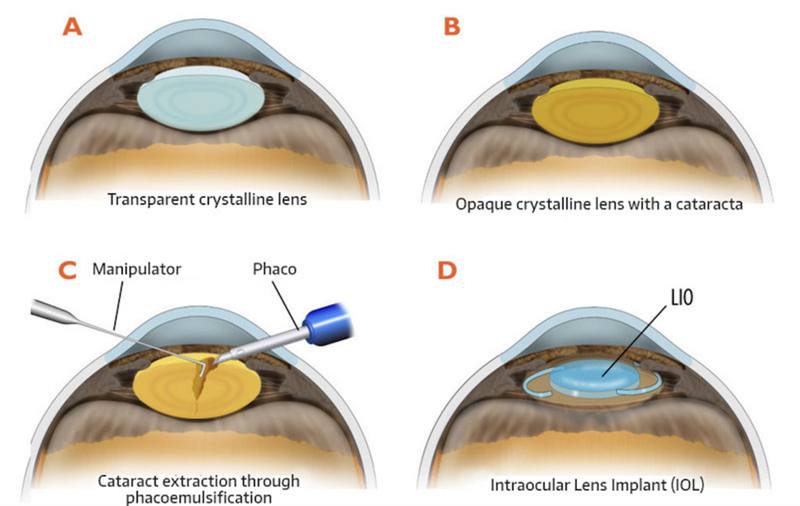
Phacoemulsification is the main surgical procedure used to treat age-related cataract [S3]. This article summarises what systematic reviews and trials say about incision size, pupil dilation, postoperative anti-inflammatory treatment, higher-risk eyes and surgical training [S2] [S3] [S5] [S6] [S10].
Key points - Smaller coaxial incisions (2.2 or 1.8 mm) may reduce surgically induced astigmatism by only about 0.2 D compared with about 3.0 mm, with very low-certainty evidence and similar best-corrected acuity [S3]. - Pseudoexfoliation roughly doubles the odds of posterior capsule rupture or zonular dialysis (pooled OR 2.1363) [S1], yet uncomplicated pseudoexfoliation eyes had similar 10-year decentration and capsulotomy rates in a large Indian trial cohort [S11]. - NSAIDs, alone or added to corticosteroids, may lower the risk of cystoid macular oedema (CME), with low-certainty evidence [S2]; in diabetes, topical steroids plus NSAIDs prevented 75.8% of pseudophakic CME events compared with steroids alone [S4]. - Uncomplicated phacoemulsification is followed by posterior vitreous detachment (PVD) in 33.3% of eyes over a mean 28.3 months [S9]. - Residents' complication risk rises with patient factors (pseudoexfoliation, small pupils, prior vitrectomy, zonular pathology) and with absent supervision [S10].
Evidence last checked: 2026-10-17 (PubMed abstracts).
Red flags
- Pseudoexfoliation, zonular pathology, small pupil, prior vitrectomy: recognised risk factors for complications [S1] [S10].
- Diabetes: endothelial damage is greater and corneal recovery is delayed after phacoemulsification [S8]; diabetic eyes also need CME prophylaxis planning [S4].
- New floaters or flashes after surgery, especially without a pre-existing PVD: phacoemulsification accelerates PVD, and PVD carries a risk of retinal tears and detachment [S9].
- Pain, redness and reduced vision after surgery: possible endophthalmitis; see Refer when.
Recognise it: patient selection and risk
- Patient-related risk factors for complications in resident-performed surgery include older age, hypertension, prior vitrectomy, zonular pathology, pseudoexfoliation, poor preoperative acuity, small pupils and selected cataract types [S10].
- Surgeon-related risk factors include postgraduate year; procedure factors include long phacoemulsification time and high power and torsion [S10].
- In open-angle glaucoma, RCTs show a consistent IOP reduction of 4.1 to 8.5 mmHg after cataract surgery and 0.2 to 1.0 fewer medications [S7].
Confirm it: preoperative assessment
- Evaluate the vitreoretinal interface before surgery, and follow up carefully those without a pre-existing PVD [S9].
- Note diabetes status: diabetic eyes had lower endothelial cell density at all postoperative time points up to 6 months and thicker corneas at 1 and 3 months [S8].
- Check pupil size and signs of pseudoexfoliation, which change the risk profile [S1] [S10].
Manage it: technique and perioperative care
Before acting on this section, check the national and local guidelines, product information and regulatory approvals that apply where you practise. See the medical disclaimer.
Tier A (primary care / no specialist)
- Identify patients with cataract, diabetes or pseudoexfoliation and refer to a surgical service with the history noted [S1] [S8].
- After surgery, escalate pain, worsening vision or new floaters and flashes as in Refer when [S9].
Tier B (general eye clinic)
- Incision size. A Cochrane review (2017) of 26 RCTs (3120 eyes) found 2.2 mm coaxial incisions gave less astigmatism than about 3.0 mm (MD -0.19 D, very low certainty) and similar BCVA; 1.8 mm gave MD -0.23 D. Smaller incisions were not consistently associated with less astigmatism, and safety outcomes were poorly reported [S3].
- Pupil dilation. A Cochrane review (2021) of 14 RCTs could not establish the superiority of topical, intracameral or depot mydriatics. Topical mydriatics may give a larger pupil at capsulorhexis (MD 1.06 mm, low certainty); ocular discomfort may be greater with topical than intracameral mydriatics (moderate certainty) [S5].
- Postoperative inflammation. A Cochrane review (2017) of 48 RCTs found insufficient evidence to establish the equivalence or superiority of NSAIDs with or without steroids versus steroids alone. NSAID alone vs steroid alone: lower CME risk at one month (RR 0.26, low certainty) [S2]. Drug choice and dosing are not covered by these abstracts: follow local formularies.
- Diabetic patients. A meta-analysis of RCTs found that topical steroids plus NSAIDs prevented 75.8% of pseudophakic CME events vs steroids alone in patients without preoperative macular oedema; depot plus topical steroids were superior but raised IOP more often; anti-VEGF added no benefit [S4].
- Glaucoma with cataract. Consider a medication reduction in well-controlled glaucoma after phacoemulsification [S7].
Tier C (specialist centre)
- Pseudoexfoliation. A meta-analysis of 22 studies found a pooled OR of 2.1363 for capsule rupture or zonular dialysis [S1]. In APEX (930 pseudoexfoliation eyes, 476 controls, randomised to 1- or 3-piece IOLs and to capsular tension ring or not), 10-year IOL decentration (2.4% vs 1.7%) and Nd:YAG capsulotomy (5.7% vs 5.67%) were similar; capsular phimosis and a capsulorhexis not overlapping the optic predicted both [S11]. APEX excluded phacodonesis, shallow chambers and pupils under 4 mm [S11].
- Training. Assign cases to residents with these risk factors in mind and ensure supervision [S10]. A Cochrane review (2021) of 6 RCTs (151 trainees) suggests virtual reality training may improve performance compared with no supplementary training, but all evidence was very low certainty [S6].
Refer when
| Situation | Urgency |
|---|---|
| Pain, redness and falling vision after surgery (possible endophthalmitis) | Immediate, same-day [G1] |
| New flashes, floaters or a field shadow after surgery (possible retinal tear) | Same-day to an eye service [S9] |
| Corneal oedema persisting after surgery, especially in diabetes | Urgent to an eye clinic; timing per your local service or specialist advice [S8] |
| Pseudoexfoliation, small pupil or prior vitrectomy needing cataract surgery | Routine to an experienced surgeon; timing per your local service or specialist advice [S1] [S10] |
Pitfalls
- Overselling micro-incisions: the astigmatism benefit is about 0.2 D and uncertain [S3].
- Assuming one dilation method is clearly best: the trials cannot show it [S5].
- Forgetting CME prophylaxis planning in diabetic patients [S4].
- Not warning patients without a PVD about retinal tear symptoms [S9].
- Giving trainees high-risk cases without supervision [S10].
Evidence notes
| Source | Date | Design |
|---|---|---|
| [S1] | 2016 | Meta-analysis of 22 observational and trial studies |
| [S2] | 2017 | Cochrane systematic review, 48 RCTs |
| [S3] | 2017 | Cochrane systematic review, 26 RCTs |
| [S4] | 2019 | Systematic review and meta-analysis of RCTs |
| [S5] | 2021 | Cochrane systematic review, 14 RCTs |
| [S6] | 2021 | Cochrane systematic review, 6 RCTs |
| [S7] | 2023 | Systematic review of 6 RCTs |
| [S8] | 2023 | Meta-analysis of 13 studies, 1744 eyes |
| [S9] | 2024 | Systematic review of 7 studies, 2034 eyes |
| [S10] | 2024 | Systematic review of 15 studies |
| [S11] | 2025 | 10-year follow-up of a randomised cohort, India |
- Most comparisons in [S2] [S3] [S5] [S6] are low or very low certainty; the Cochrane authors call for larger, better-reported trials.
- Pseudoexfoliation evidence conflicts on the surface: [S1] pools all pseudoexfoliation eyes, whereas [S11] excluded eyes with zonular weakness and small pupils and used experienced surgeons.
- Two of the VR training studies were industry-funded [S6].
- Not covered by these sources: nucleus disassembly techniques, fluidics settings, ophthalmic viscosurgical device choice, anaesthesia, endophthalmitis prophylaxis and drug doses.
Related articles
- Manual small-incision cataract surgery
- Femtosecond laser-assisted cataract surgery
- Biometry and IOL power calculation
References
See the numbered source list below. Each marker [S#] links to its PubMed and DOI record.
Sources
- [S1] Vazquez-Ferreiro P, Carrera-Hueso FJ, Poquet Jornet JE, Fikri-Benbrahim N, Diaz-Rey M, Sanjuan-Cerveró R Intraoperative complications of phacoemulsification in pseudoexfoliation: Metaanalysis. Journal of cataract and refractive surgery. (2016). PubMed 27956295 · doi:10.1016/j.jcrs.2016.09.010
- [S2] Juthani VV, Clearfield E, Chuck RS Non-steroidal anti-inflammatory drugs versus corticosteroids for controlling inflammation after uncomplicated cataract surgery. The Cochrane database of systematic reviews. (2017). PubMed 28670710 · doi:10.1002/14651858.cd010516.pub2
- [S3] Jin C, Chen X, Law A, Kang Y, Wang X, Xu W, et al. Different-sized incisions for phacoemulsification in age-related cataract. The Cochrane database of systematic reviews. (2017). PubMed 28931202 · doi:10.1002/14651858.cd010510.pub2
- [S4] Laursen SB, Erichsen JH, Holm LM, Kessel L Prevention of macular edema in patients with diabetes after cataract surgery. Journal of cataract and refractive surgery. (2019). PubMed 31146934 · doi:10.1016/j.jcrs.2019.04.025
- [S5] Iftikhar M, Abariga SA, Hawkins BS, Zafar S, Mir TA, Jampel H, et al. Pharmacologic interventions for mydriasis in cataract surgery. The Cochrane database of systematic reviews. (2021). PubMed 34043237 · doi:10.1002/14651858.cd012830.pub2
- [S6] Lin JC, Yu Z, Scott IU, Greenberg PB Virtual reality training for cataract surgery operating performance in ophthalmology trainees. The Cochrane database of systematic reviews. (2021). PubMed 34931701 · doi:10.1002/14651858.cd014953.pub2
- [S7] Brízido M, Rodrigues PF, Almeida AC, Abegão Pinto L Cataract surgery and IOP: a systematic review of randomised controlled trials. Graefe's archive for clinical and experimental ophthalmology = Albrecht von Graefes Archiv fur klinische und experimentelle Ophthalmologie. (2023). PubMed 36441227 · doi:10.1007/s00417-022-05911-3
- [S8] Yang Y, Chai H, Ding Z, Tang C, Liang Y, Li Y, et al. Meta-analysis of corneal endothelial changes after phacoemulsification in diabetic and non-diabetic patients. BMC ophthalmology. (2023). PubMed 37095472 · doi:10.1186/s12886-023-02924-2
- [S9] Hurley DJ, Murtagh P, Guerin M Posterior vitreous detachment rates post-uncomplicated phacoemulsification surgery: a systematic review. International ophthalmology. (2024). PubMed 38512501 · doi:10.1007/s10792-024-03091-z
- [S10] Kang C, Lee MJ, Chomsky A, Oetting TA, Greenberg PB Risk factors for complications in resident-performed cataract surgery: A systematic review. Survey of ophthalmology. (2024). PubMed 38648911 · doi:10.1016/j.survophthal.2024.04.002
- [S11] Haripriya A, Chandrashekharan S, Schehlein EM, Shekhar M, Venkatesh R, Narendran K, et al. Aravind Pseudoexfoliation Study (APEX): 10-Year Postoperative Results. American journal of ophthalmology. (2025). PubMed 40602476 · doi:10.1016/j.ajo.2025.06.043
Guidelines
- [G1] NHS Scotland (Community Eyecare Guidelines, eyes.nhs.scot). 7.4 Endophthalmitis, Post-Operative, (Exogenous Endophthalmitis) (2026). https://www.eyes.nhs.scot/eyecare-guidelines/section-7-uvea/74-endophthalmitis-post-operative-exogenous-endophthalmitis/