Educational content only. Not personalised medical advice. Clinical decisions remain the responsibility of the treating clinician.
The white pupil (leukocoria): urgent assessment
Leukocoria is a white pupillary reflex that can signal sight-threatening and life-threatening disease [S9]. Retinoblastoma, the most common intraocular tumour of childhood, most often presents with leukocoria [S3] [S7]. Survival exceeds 95% when retinoblastoma is diagnosed early and treated in specialist centres, but falls below 50% once the tumour has spread outside the eye [S3]; any abnormal red reflex warrants immediate evaluation by an ophthalmologist [S9].
Key points - Treat every white pupil as possible retinoblastoma until an ophthalmologist has examined the eye [S9] [S2]. - Retinoblastoma survival is about 40% in low-income countries compared with about 90% in developed countries, mainly because of delayed diagnosis [S6] [S11]. - Caregivers can see leukocoria as a glowing white "cat eye reflex" at night or in photographs [S4]; primary health workers can detect it with red reflex and Hirschberg tests during immunisation and well-baby visits in the first 24 months [S4]. - Diagnosis is usually by fundus examination and ultrasound; MRI is preferred for staging and CT is no longer recommended [S1] [S7]. - Early diagnosis, fast referral pathways and programmes to prevent treatment abandonment are recommended for low- and middle-income countries rather than universal screening [S11].
Evidence last checked: 2026-10-17 (PubMed abstracts).
Red flags
- Any white, absent or otherwise abnormal red reflex [S9] [S2].
- Leukocoria with a squint: squint is the second most common presentation of retinoblastoma [S3] [S2].
- Proptosis: with leukocoria, the most common presenting feature of retinoblastoma in Asian Indian populations [S7], and a sign of advanced disease [S11].
- Family history of retinoblastoma: heritable retinoblastoma accounts for 45% of cases, 80% of them bilateral [S3].
- Painful red eye in a child with known leukocoria: severe Coats disease can lead to a painful red eye [S10].
Recognise it: causes of a white pupil
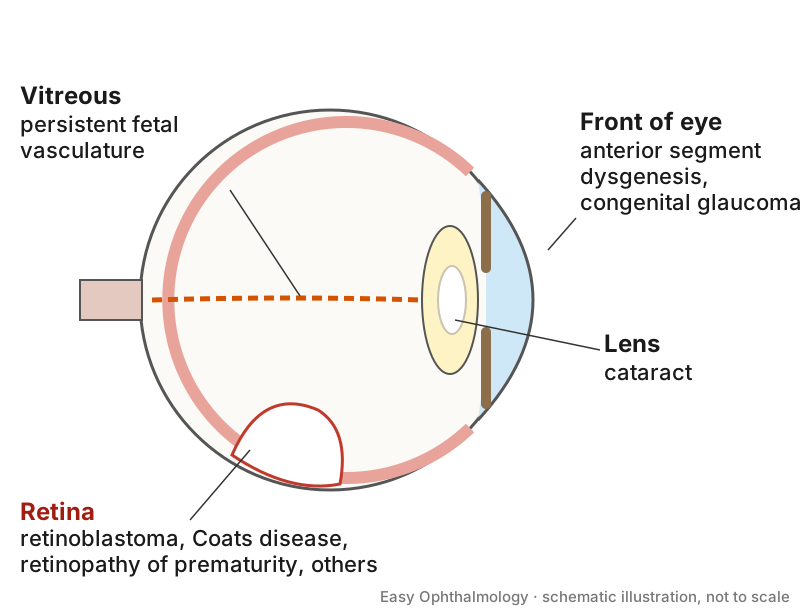
- Retinal: retinoblastoma, Coats disease, retinopathy of prematurity, familial exudative vitreoretinopathy, myelinated nerve fibres, ocular toxocariasis and toxoplasmosis, retinochoroidal coloboma, and hamartomas [S9].
- Vitreous: persistent fetal vasculature [S9] [S8].
- Lens: cataract [S9].
- Anterior segment and cornea: anterior segment dysgenesis, congenital glaucoma, birth trauma [S9].
- Retinoblastoma typically presents before the age of 5 years in over 90% of cases [S4]; incidence is 1 in 16,000-28,000 live births worldwide [S6].
- Coats disease mainly affects young males, often in one eye, and progresses to reduced vision, strabismus and leukocoria, typically in the first decade [S10].
Confirm it
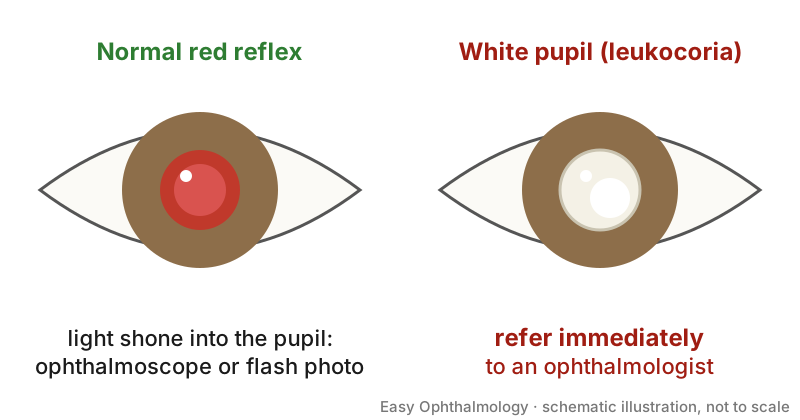
- Red reflex test with a direct ophthalmoscope [S9]; absence of the red reflex is an indication for urgent ophthalmology assessment [S2].
- Ophthalmic examination: retinoblastoma is usually diagnosed by fundus examination followed by ultrasound [S7] [S1]. Biopsy is usually not required for diagnosis or treatment decisions [S4].
- Imaging: high-resolution MRI is important for confirming diagnosis, local extent, and associated brain abnormalities or intracranial tumour (trilateral retinoblastoma); CT is no longer recommended because of radiation exposure, particularly in hereditary disease [S1] [S2].
- Other causes: fluorescein angiography and OCT help in Coats disease [S10].
Manage it
Before acting on this section, check the national and local guidelines, product information and regulatory approvals that apply where you practise. See the medical disclaimer.
Tier A (primary care / no specialist)
- Examine the red reflex at newborn, immunisation and well-baby visits [S4] [S9].
- Take parents' concerns seriously when they report a white glow in photographs [S4]. An antenatal information pamphlet made parents less likely to delay seeking help for leukocoria in an RCT of 518 pregnant women [S5].
- Refer immediately to an ophthalmologist; do not wait for a review appointment [S9] [S2].
- Smartphone and AI tools: machine learning models had a pooled sensitivity of 0.972 for retinoblastoma and leukocoria detection, but specificity was limited and studies were small and biased [S12]; their real-world usefulness is uncertain [S11]. They do not replace examination.
Tier B (general eye clinic)
- Examine both eyes with dilated fundoscopy and ultrasound where available [S7].
- Arrange urgent transfer to a retinoblastoma centre when a tumour is suspected; ensuring patients reach centres of excellence promptly and minimising treatment abandonment are essential in low- and middle-income countries [S11].
- Avoid CT where MRI is possible [S1] [S2].
Tier C (specialist centre)
- Retinoblastoma: management by a multidisciplinary team (ocular oncology, medical and radiation oncology, genetics, nursing, social work) [S3]; staging may include bone marrow sampling, lumbar puncture and MRI [S2]. Treatment options include enucleation, chemotherapy by intravenous, intravitreal, periocular and intra-arterial routes, laser, cryotherapy and brachytherapy [S4]. Genetic testing and counselling inform family screening [S7].
- Coats disease: options include anti-VEGF agents, steroids, laser, cryotherapy and vitrectomy; outcome depends on stage at presentation [S10].
- Persistent fetal vasculature: surgical indications and techniques are evolving [S8].
- Drug doses are not covered by these abstracts: follow local protocols.
Refer when
| Situation | Urgency |
|---|---|
| White, absent or otherwise abnormal red reflex, or a parent reports a white glow in photos | Immediate referral to an ophthalmologist [S9] [S2] |
| Suspected retinoblastoma after eye examination | Urgent to a retinoblastoma centre; timing per your local service or specialist advice [S11] |
| Leukocoria with proptosis or a painful red eye | Same-day to a specialist centre [EIC expert opinion] [S7] [S10] |
| Sibling or child of a person with retinoblastoma | Routine, early in infancy, to a retinoblastoma service for genetic advice and screening [S7] [S11] |
Pitfalls
- Reassuring parents without examining the eye [S4] [S9].
- Relying on a normal undilated red reflex or a smartphone app to exclude disease [S11] [S12].
- Ordering CT instead of MRI [S1].
- Referring without making sure the child arrives and stays in treatment [S11].
Evidence notes
| Source | Date | Design |
|---|---|---|
| [S1] | 2012 | Consensus imaging guideline (European Retinoblastoma Imaging Collaboration) |
| [S2] | 2015 | Narrative review (UK) |
| [S3] | 2018 | Narrative review |
| [S4] | 2019 | Narrative review (low-resource country, Nigeria) |
| [S5] | 2020 | Double-blind RCT, 518 pregnant women |
| [S6] | 2023 | Narrative review of epidemiology |
| [S7] | 2024 | National consensus guideline (India, ICMR) |
| [S8] | 2024 | Narrative review |
| [S9] | 2024 | Narrative review |
| [S10] | 2025 | Narrative review |
| [S11] | 2025 | Narrative review (low- and middle-income countries) |
| [S12] | 2026 | Diagnostic meta-analysis, 12 studies |
- Thin evidence: apart from one RCT on parent education [S5] and one diagnostic meta-analysis [S12], the sources are reviews and consensus statements; no trials address referral pathways for leukocoria.
- The RCT measured hypothetical help-seeking intention, not actual diagnosis [S5].
- Incidence figures differ slightly between sources (1:16,000-1:18,000 [S4] vs 1 in 16,000-28,000 [S6]).
- Not covered by these sources: frequency of each cause of leukocoria, retinoblastoma screening schedules for at-risk families, and chemotherapy regimens.
Related articles
References
See the numbered source list below. Each marker [S#] links to its PubMed and DOI record.
Sources
- [S1] de Graaf P, Göricke S, Rodjan F, Galluzzi P, Maeder P, Castelijns JA, et al. Guidelines for imaging retinoblastoma: imaging principles and MRI standardization. Pediatric radiology. (2012). PubMed 21850471 · doi:10.1007/s00247-011-2201-5
- [S2] Jenkinson H Retinoblastoma: diagnosis and management--the UK perspective. Archives of disease in childhood. (2015). PubMed 25940424 · doi:10.1136/archdischild-2014-306208
- [S3] AlAli A, Kletke S, Gallie B, Lam WC Retinoblastoma for Pediatric Ophthalmologists. Asia-Pacific journal of ophthalmology (Philadelphia, Pa.). (2018). PubMed 29737052 · doi:10.22608/apo.201870
- [S4] Ademola-Popoola DS, Opocher E, Reddy MA Contemporary management of retinoblastoma in the context of a low-resource country. The Nigerian postgraduate medical journal. (2019). PubMed 31187745 · doi:10.4103/npmj.npmj_21_19
- [S5] Staffieri SE, Rees G, Sanfilippo PG, Cole S, Mackey DA, Hewitt AW Improving parents' knowledge of early signs of paediatric eye disease: A double-blind randomized controlled trial. Clinical & experimental ophthalmology. (2020). PubMed 33058401 · doi:10.1111/ceo.13866
- [S6] Koochakzadeh L, Yekta A, Hashemi H, Pakzad R, Heydarian S, Khabazkhoob M Epidemiological aspect of retinoblastoma in the world: a review of recent advance studies. International journal of ophthalmology. (2023). PubMed 37332560 · doi:10.18240/ijo.2023.06.20
- [S7] Singh L, Chinnaswamy G, Meel R, Radhakrishnan V, Madan R, Kulkarni S, et al. Epidemiology, Diagnosis and Genetics of Retinoblastoma: ICMR Consensus Guidelines. Indian journal of pediatrics. (2024). PubMed 38492167 · doi:10.1007/s12098-024-05085-2
- [S8] Ozdemir Zeydanli E, Ozdek S Persistent Fetal Vasculature: Current Insights and Future Directions. Seminars in ophthalmology. (2024). PubMed 38628063 · doi:10.1080/08820538.2024.2344026
- [S9] Santos Oliveira J, Catarino S, Magalhães A, Rocha G, Santos Silva R The Red Reflex Test and Leukocoria in Childhood. Acta medica portuguesa. (2024). PubMed 39074051 · doi:10.20344/amp.21367
- [S10] Ucgul AY, Özdek Ş Coats' Disease: A Comprehensive Review of Its Pathophysiology, Diagnosis, and Advances in Treatment. Seminars in ophthalmology. (2025). PubMed 40094375 · doi:10.1080/08820538.2024.2447965
- [S11] Chantada GL, Villanueva G, Abramson DH Challenges for Early Diagnosis in Retinoblastoma in Low- and Middle-Income Countries. Pediatric blood & cancer. (2025). PubMed 40619694 · doi:10.1002/pbc.31859
- [S12] Łajczak PM, Nowakowski P, Jóźwik K, Żerdziński K, Janiec J Can machines see cancer? A systematic review and diagnostic meta-analysis of machine learning in retinoblastoma and leukocoria detection. European journal of ophthalmology. (2026). PubMed 40910534 · doi:10.1177/11206721251375239