Educational content only. Not personalised medical advice. Clinical decisions remain the responsibility of the treating clinician.
Infection prevention in eye care: adenovirus and instrument reprocessing
Eye clinics can spread infection because many patients are examined in a short time and several instruments touch each eye [S8]. Epidemic keratoconjunctivitis (EKC), caused by human adenovirus, is highly contagious and has caused large outbreaks in medical facilities [S11], with contact tonometers a recognised route [S2] [S10]. In the operating theatre, poor cleaning of intraocular instruments can cause toxic anterior segment syndrome (TASS) [S6].
Key points - Poor hygiene in clinical settings is a major cause of nosocomial EKC outbreaks; molecular studies have matched viral strains on instruments to those in infected patients [S8]. - There is still no effective drug treatment for EKC, so rigorous hygiene in medical facilities is the first priority [S1]. - In vitro, peroxide reduced adenovirus log growth by 64% compared with alcohol swabs for tonometer disinfection, but at a high cost per case averted [S2]. - TASS is mostly preventable through prevention protocols, regular staff training and strict adherence to instrument cleaning and sterilisation recommendations [S6]. - Routine enzymatic detergent leaves residues on intraocular instruments that are difficult to remove and carry a risk of TASS [S5].
Evidence last checked: 2026-10-18 (PubMed abstracts).
Red flags: signs that need urgent action
- A cluster of red, watery eyes among patients or staff after clinic visits; EKC is associated with outbreaks in medical facilities [S11].
- Bilateral keratoconjunctivitis with marked chemosis, epiphora and photophobia developing within hours or days of a unilateral foreign body sensation [S1].
- Pseudomembranes or corneal involvement; EKC is the only form of adenoviral conjunctivitis that involves the cornea [S9].
- After intraocular surgery: limbus-to-limbus corneal oedema and anterior chamber inflammation within 12 to 48 hours, suggesting TASS, which must be distinguished from infectious endophthalmitis [S7].
- More than one TASS case in a unit; prompt, thorough investigation of causes is critical [S6].
Recognise it
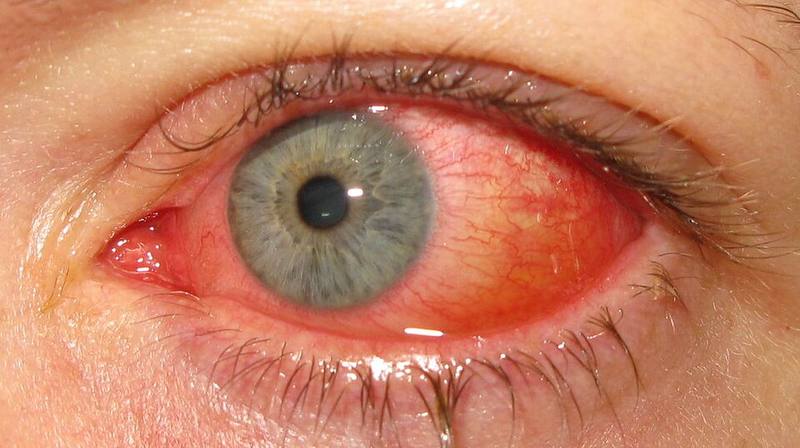
- Transmission routes: hand-to-eye contact, ocular secretions, respiratory droplets, and contact with eye-care providers and their instruments [S3].
- Instruments at risk: Goldmann applanation and Schiotz tonometers [S2] [S10]; viral and bacterial loads are also found on other common surfaces [S8].
- Clinical spectrum: EKC, pharyngoconjunctival fever and non-specific follicular conjunctivitis [S3] [S4].
- Long-term harm: subepithelial infiltrates can persist or recur for months to years, with glare and reduced vision [S9].
- TASS: a non-infectious anterior chamber inflammation with multiple causes; in over half of reported cases the cause was not found [S6] [S7].
Confirm it
- Adenoviral conjunctivitis is primarily a clinical diagnosis [S4], but clinical accuracy is below 50% [S3].
- Rapid diagnostic tests reduce unnecessary antibiotic use [S3].
- In TASS, onset can vary from hours to months, so investigate early and share information on new causes [S6].
Manage it: what to do at each resource tier
Before acting on this section, check the national and local guidelines, product information and regulatory approvals that apply where you practise. See the medical disclaimer.
Tier A (primary care / no specialist)
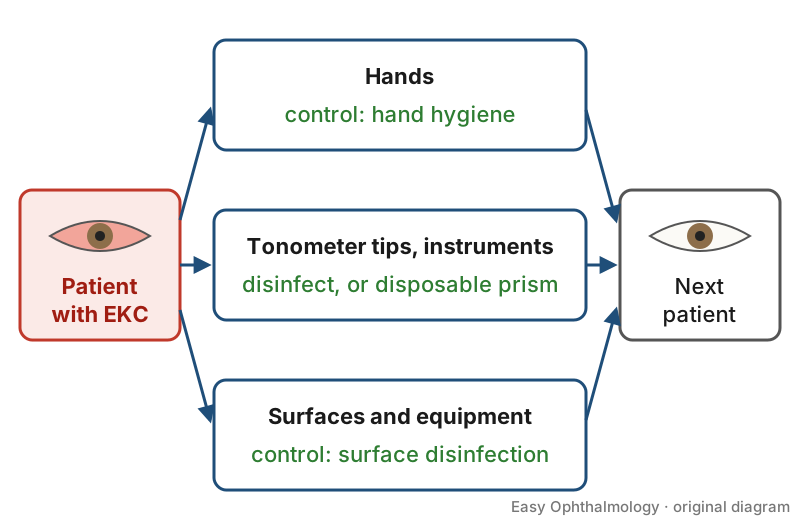
- Wash hands when visibly soiled and after contact with patients and equipment [S8].
- Treat adenoviral conjunctivitis supportively with artificial tears and cool compresses; topical antibiotics are indicated only if bacterial co-infection is suspected or in high-risk patients such as children [S4].
- Uncomplicated cases are self-limited and need no treatment [S3].
- Advise patients on hand hygiene to limit spread [S1].
Tier B (general eye clinic)
- Clinic hygiene: apply conscientious hand and surface disinfection [S1]; disinfect tonometer tips, a known risk factor for EKC transmission [S2].
- Tonometer options: alcohol swabs, peroxide immersion and disposable prisms are all plausible disinfection methods in vitro [S2].
- Disinfectants: alcohols, chlorine-based solutions (mainly sodium hypochlorite), glutaraldehyde, hydrogen peroxide, formaldehyde, iodophors and quaternary ammonium compounds have different spectra of activity [S10]. Concentrations and contact times are not covered by these sources; follow local infection control policy.
- Treatment evidence: povidone-iodine alone resolved signs and symptoms more often than artificial tears in the first week (low-certainty evidence) [S11], but another meta-analysis found great uncertainty about its usefulness [S12]. Antiviral benefit is inconclusive [S11]. Concentrations used varied between trials; follow local formularies.
Tier C (specialist centre and operating theatre)
- Follow consensus guidelines for cleaning and sterilising intraocular instruments [S5] [S6].
- Avoid routine enzymatic detergent for intraocular instruments [S5].
- Short-cycle instrument processing for sequential same-day anterior segment surgery was supported as safe by a task force study [S5].
- Establish TASS prevention protocols and train surgical staff regularly [S6].
- Weigh costly theatre protocols that add cost, waste and carbon footprint without proven safety benefit [S5].
- In an outbreak, use molecular typing where available to link cases and instruments [S8].
Refer when
| Situation | Urgency |
|---|---|
| Pain, vision loss and inflammation after intraocular surgery (TASS or endophthalmitis) | Immediate, same-day, to the operating surgeon; signs usually appear within 12 to 48 hours [S7] [G1] for timing |
| Suspected adenoviral conjunctivitis with reduced vision, corneal involvement or pseudomembranes | Urgent to an eye clinic; timing per your local service or specialist advice |
| Suspected clinic outbreak | Same-day notification to the infection control team [EIC expert opinion] |
Pitfalls
- Assuming an alcohol wipe of the tonometer is equivalent to other methods; peroxide was more effective in vitro [S2].
- Prescribing antibiotics for viral conjunctivitis without a bacterial indication [S3] [S4].
- Over-relying on clinical diagnosis, which is often wrong [S3].
- Using enzymatic detergent routinely on intraocular instruments [S5].
- Mistaking TASS for endophthalmitis, or the reverse [S7].
Evidence notes
| Source | Date | Design |
|---|---|---|
| [S1] | 2011 | Selective literature review, Germany |
| [S2] | 2014 | Systematic review and cost-effectiveness analysis (in vitro data) |
| [S3] | 2015 | Narrative review |
| [S4] | 2018 | Narrative review |
| [S5] | 2018 | Consensus subspecialty guideline (task force) |
| [S6] | 2018 | Narrative review |
| [S7] | 2019 | Narrative review |
| [S8] | 2020 | Narrative review |
| [S9] | 2020 | Narrative review |
| [S10] | 2021 | Narrative review |
| [S11] | 2022 | Cochrane systematic review, 10 RCTs, 892 participants |
| [S12] | 2023 | Systematic review and meta-analysis, 5 RCTs |
- Tonometer disinfection evidence is in vitro; clinical infection rates were assumed to match it [S2].
- The two povidone-iodine reviews reach different conclusions [S11] [S12]; most trials were small and at high or unclear risk of bias [S11].
- Most infection control recommendations here come from narrative reviews and one consensus guideline, not trials.
- Not covered by these sources: disinfectant concentrations and contact times, staff exclusion periods, steam sterilisation parameters and low-resource reprocessing equipment.
Related articles
References
See the numbered source list below. Each marker [S#] links to its PubMed and DOI record.
Sources
- [S1] Meyer-Rüsenberg B, Loderstädt U, Richard G, Kaulfers PM, Gesser C Epidemic keratoconjunctivitis: the current situation and recommendations for prevention and treatment. Deutsches Arzteblatt international. (2011). PubMed 21814523 · doi:10.3238/arztebl.2011.0475
- [S2] Omar Akhtar A, Singh H, Si F, Hodge WG A systematic review and cost-effectiveness analysis of tonometer disinfection methods. Canadian journal of ophthalmology. Journal canadien d'ophtalmologie. (2014). PubMed 25103651 · doi:10.1016/j.jcjo.2014.04.003
- [S3] Jhanji V, Chan TC, Li EY, Agarwal K, Vajpayee RB Adenoviral keratoconjunctivitis. Survey of ophthalmology. (2015). PubMed 26077630 · doi:10.1016/j.survophthal.2015.04.001
- [S4] Garcia-Zalisnak D, Rapuano C, Sheppard JD, Davis AR Adenovirus Ocular Infections: Prevalence, Pathology, Pitfalls, and Practical Pointers. Eye & contact lens. (2018). PubMed 29664772 · doi:10.1097/icl.0000000000000226
- [S5] Chang DF, Mamalis N, Ophthalmic Instrument Cleaning and Sterilization Task Force Guidelines for the cleaning and sterilization of intraocular surgical instruments. Journal of cataract and refractive surgery. (2018). PubMed 29909254 · doi:10.1016/j.jcrs.2018.05.001
- [S6] Park CY, Lee JK, Chuck RS Toxic anterior segment syndrome-an updated review. BMC ophthalmology. (2018). PubMed 30359246 · doi:10.1186/s12886-018-0939-3
- [S7] Hernandez-Bogantes E, Navas A, Naranjo A, Amescua G, Graue-Hernandez EO, Flynn HW, et al. Toxic anterior segment syndrome: A review. Survey of ophthalmology. (2019). PubMed 30703402 · doi:10.1016/j.survophthal.2019.01.009
- [S8] Abbas AA, Lian RR, Afshari NA Hand hygiene and instrument sanitization in ophthalmology clinics. Current opinion in ophthalmology. (2020). PubMed 31770164 · doi:10.1097/icu.0000000000000630
- [S9] Jonas RA, Ung L, Rajaiya J, Chodosh J Mystery eye: Human adenovirus and the enigma of epidemic keratoconjunctivitis. Progress in retinal and eye research. (2020). PubMed 31891773 · doi:10.1016/j.preteyeres.2019.100826
- [S10] Parikh SR, Parikh RS Chemical disinfectants in ophthalmic practice. Indian journal of ophthalmology. (2021). PubMed 33595464 · doi:10.4103/ijo.ijo_1549_20
- [S11] Liu SH, Hawkins BS, Ng SM, Ren M, Leslie L, Han G, et al. Topical pharmacologic interventions versus placebo for epidemic keratoconjunctivitis. The Cochrane database of systematic reviews. (2022). PubMed 35238405 · doi:10.1002/14651858.cd013520.pub2
- [S12] González Martín-Moro J, Zarallo-Gallardo J, Guzmán-Almagro E, Antón Rodríguez C A systematic review and meta-analysis on the efficacy of topical povidone iodine in adenoviral conjunctivitis. Contact lens & anterior eye : the journal of the British Contact Lens Association. (2023). PubMed 37380515 · doi:10.1016/j.clae.2023.101873
Guidelines
- [G1] NHS Scotland (Community Eyecare Guidelines, eyes.nhs.scot). 7.4 Endophthalmitis, Post-Operative, (Exogenous Endophthalmitis) (2026). https://www.eyes.nhs.scot/eyecare-guidelines/section-7-uvea/74-endophthalmitis-post-operative-exogenous-endophthalmitis/