Educational content only. Not personalised medical advice. Clinical decisions remain the responsibility of the treating clinician.
Immediately sequential bilateral cataract surgery
Immediately sequential bilateral cataract surgery (ISBCS) operates on both eyes on the same day as two separate procedures, instead of on separate days (delayed sequential surgery, DSBCS) [S7]. It means fewer visits and faster recovery at lower cost, but the main concern is bilateral sight-threatening complications such as bilateral endophthalmitis [S6] [S7].
Key points - A Cochrane review (2022) found probably no clinically important differences in outcomes between ISBCS and DSBCS, with lower costs for ISBCS; certainty was moderate to very low [S7]. - In the BICAT-NL RCT (865 patients), ISBCS was non-inferior for refractive outcome (97% vs 98% within 1.0 D), with no endophthalmitis, societal costs €403 lower and a 100% probability of cost-effectiveness [S9]. - Endophthalmitis risk was very low in both groups (1/14,076 ISBCS vs 55/556,246 DSBCS participants) [S7]. - Bilateral simultaneous endophthalmitis after ISBCS is rare (7 to 9 cases reported in 50 years); in these cases the recommended iSBCS protocol was generally breached or uncertain [S6]. - Careful patient selection, surgical expertise and standardised aseptic, independent surgery for each eye underpin the safety results [S3] [S9].
Evidence last checked: 2026-10-17 (PubMed abstracts).
Red flags
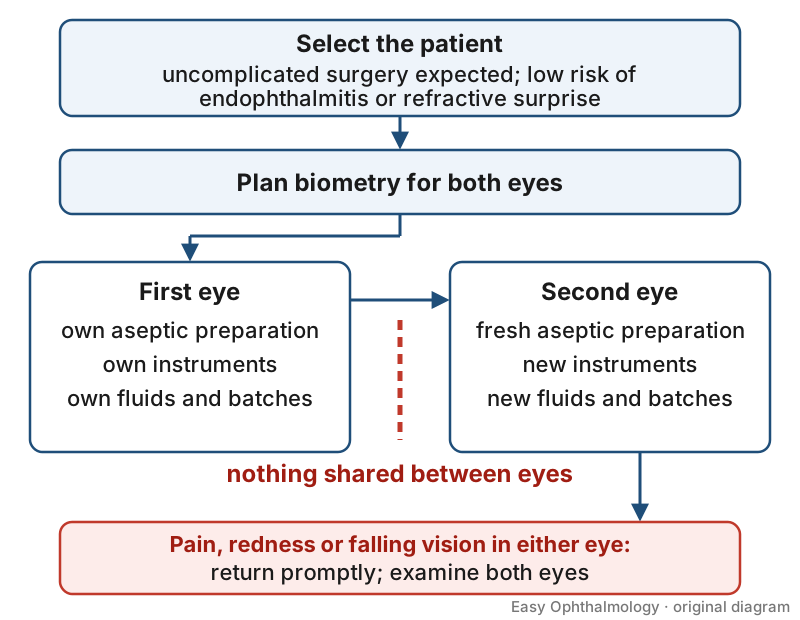
- Pain, redness or falling vision in either eye after ISBCS: examine both eyes; bilateral Pseudomonas endophthalmitis left light perception or worse [S6].
- Complication in the first eye: the abstracts do not specify a stopping rule; most surgeons would not proceed to the second eye [EIC expert opinion].
- Higher-risk patients: BICAT-NL excluded those with an increased risk of endophthalmitis or refractive surprise, and complicated surgery [S9].
Recognise it: who is suitable
- Adults expected to have uncomplicated surgery, without increased risk of endophthalmitis or refractive surprise, were eligible in BICAT-NL [S9].
- Reviews describe ISBCS as safe and effective in carefully selected patients [S12].
- The decision should follow careful discussion between surgeon and patient [S5].
Confirm it: outcomes
- Refraction and acuity. Helsinki RCT (520 patients): within ±1.00 D of target in 91.0% (same session) vs 90.3% (separate sessions); 95% very satisfied in both [S1]. Canary Islands RCT (1614 eyes): no difference in complications, acuity at 30 days or visual function at 1 year [S3].
- Patient-reported outcomes. No difference in Catquest-7SF, but more ISBCS patients were very satisfied with the approach (94.1% vs 63.8% at 3 months) [S11].
- Complications. A meta-analysis of 13 studies found no significant differences overall, but a higher risk of posterior capsule rupture with ISBCS in pooled non-randomised studies (RR 1.34) [S10]. Disturbing anisometropia differed between groups in BICAT-NL [S9]. In a Korean series, two ISBCS patients complained of postoperative strabismus [S8].
- Costs. ISBCS saved €449 per patient in health-care costs and up to €849 including lost working time in Finland [S2]; in a US non-randomised study, third-party payer costs, travel and visits were lower, but surgical centre expenses were higher [S4].
Manage it: running ISBCS safely
Before acting on this section, check the national and local guidelines, product information and regulatory approvals that apply where you practise. See the medical disclaimer.
Tier A (primary care / no specialist)
- Explain that same-day surgery on both eyes is an evidence-based option in selected patients and reduces travel and visits [S4] [S7].
- Teach patients to return the same day if either eye becomes painful or vision falls (see Refer when).
Tier B (general eye clinic)
- Select patients expected to have uncomplicated surgery and low risk of refractive surprise [S9].
- Treat each eye as a separate procedure with independent aseptic preparation, following standardised guidelines [S3]; strict adherence to the iSBCS General Principles of Excellence (2009) appears to considerably lessen the risk of bilateral endophthalmitis [S6].
- Plan biometry for both eyes carefully, since the second eye cannot be adjusted from the first eye's result [S9].
Tier C (specialist centre)
- Audit posterior capsule rupture, refractive outcomes and anisometropia, given the PCR signal from non-randomised data [S10].
- Investigate any bilateral infection for breaches in protocol or theatre construction [S6].
- ISBCS can improve efficiency in high-volume programmes; national savings in the Netherlands were estimated at €27.4 million a year [S9].
Refer when
| Situation | Urgency |
|---|---|
| Pain, redness or falling vision in one or both eyes after ISBCS | Immediate, same-day, examine both eyes [G1] [S6] |
| Disturbing anisometropia or double vision after ISBCS | Urgent to the operating surgeon; timing per your local service or specialist advice [S8] [S9] |
Pitfalls
- Offering ISBCS to patients at higher risk of endophthalmitis or refractive surprise, who were excluded from trials [S9].
- Sharing instruments, fluids or batches between eyes; breaches of the protocol featured in bilateral infections [S6].
- Assuming non-randomised data are reassuring on every outcome: PCR risk was higher in pooled non-randomised studies [S10].
Evidence notes
| Source | Date | Design |
|---|---|---|
| [S1] | 2011 | RCT, 520 patients, Finland |
| [S2] | 2011 | Economic analysis within the same RCT |
| [S3] | 2012 | Multicentre RCT, Spain |
| [S4] | 2015 | Prospective non-randomised controlled study, USA |
| [S5] | 2015 | Systematic review of 3 RCTs |
| [S6] | 2022 | Review of reported bilateral endophthalmitis cases |
| [S7] | 2022 | Cochrane systematic review, 14 studies |
| [S8] | 2022 | Retrospective single-surgeon series, Korea |
| [S9] | 2023 | Multicentre non-inferiority RCT (BICAT-NL), publicly funded |
| [S10] | 2023 | Meta-analysis of 13 studies |
| [S11] | 2025 | Single-centre RCT, 98 patients |
| [S12] | 2026 | Systematic review of 9 studies |
- An earlier Danish review could not make evidence-based recommendations because of low to very low quality evidence [S5]; later RCTs [S9] [S11] strengthened the evidence.
- The Cochrane review judged the single cost-effectiveness study then available to have methodological errors [S7]; BICAT-NL addressed this with a trial-based evaluation [S9].
- All trials are from high-income countries; none are from low- and middle-income settings.
- Not covered by these sources: ISBCS in children, dense or complicated cataracts, MSICS, and specific intracameral antibiotic protocols.
Related articles
- Post-operative endophthalmitis
- Phacoemulsification: outcomes and techniques
- Infection prevention in eye care: adenovirus and instrument reprocessing
References
See the numbered source list below. Each marker [S#] links to its PubMed and DOI record.
Sources
- [S1] Sarikkola AU, Uusitalo RJ, Hellstedt T, Ess SL, Leivo T, Kivelä T Simultaneous bilateral versus sequential bilateral cataract surgery: Helsinki Simultaneous Bilateral Cataract Surgery Study Report 1. Journal of cataract and refractive surgery. (2011). PubMed 21497049 · doi:10.1016/j.jcrs.2011.01.019
- [S2] Leivo T, Sarikkola AU, Uusitalo RJ, Hellstedt T, Ess SL, Kivelä T Simultaneous bilateral cataract surgery: economic analysis; Helsinki Simultaneous Bilateral Cataract Surgery Study Report 2. Journal of cataract and refractive surgery. (2011). PubMed 21596243 · doi:10.1016/j.jcrs.2010.12.050
- [S3] Serrano-Aguilar P, Ramallo-Fariña Y, Cabrera-Hernández JM, Perez-Silguero D, Perez-Silguero MA, Henríquez-de la Fe F, et al. Immediately sequential versus delayed sequential bilateral cataract surgery: safety and effectiveness. Journal of cataract and refractive surgery. (2012). PubMed 22884569 · doi:10.1016/j.jcrs.2012.05.024
- [S4] Rush SW, Gerald AE, Smith JC, Rush JA, Rush RB Prospective analysis of outcomes and economic factors of same-day bilateral cataract surgery in the United States. Journal of cataract and refractive surgery. (2015). PubMed 25754380 · doi:10.1016/j.jcrs.2014.07.034
- [S5] Kessel L, Andresen J, Erngaard D, Flesner P, Tendal B, Hjortdal J Immediate Sequential Bilateral Cataract Surgery: A Systematic Review and Meta-Analysis. Journal of ophthalmology. (2015). PubMed 26351576 · doi:10.1155/2015/912481
- [S6] Chen MY, Qi SR, Arshinoff SA Bilateral simultaneous postoperative endophthalmitis: review of cases reported over the past 50 years. Journal of cataract and refractive surgery. (2022). PubMed 34890384 · doi:10.1097/j.jcrs.0000000000000875
- [S7] Dickman MM, Spekreijse LS, Winkens B, Schouten JS, Simons RW, Dirksen CD, et al. Immediate sequential bilateral surgery versus delayed sequential bilateral surgery for cataracts. The Cochrane database of systematic reviews. (2022). PubMed 35467755 · doi:10.1002/14651858.cd013270.pub2
- [S8] Hong S, Park W, Eom Y, Kim HM, Song JS Comparisons of outcomes and complications of immediate sequential bilateral cataract surgery and unilateral cataract surgery in a tertiary hospital in South Korea. Scientific reports. (2022). PubMed 36572699 · doi:10.1038/s41598-022-26851-2
- [S9] Spekreijse L, Simons R, Winkens B, van den Biggelaar F, Dirksen C, Bartels M, et al. Safety, effectiveness, and cost-effectiveness of immediate versus delayed sequential bilateral cataract surgery in the Netherlands (BICAT-NL study): a multicentre, non-inferiority, randomised controlled trial. Lancet (London, England). (2023). PubMed 37201546 · doi:10.1016/s0140-6736(23)00525-1
- [S10] Aiello F, Gallo Afflitto G, Leviste K, Swaminathan SS, Yoo SH, Findl O, et al. Immediate sequential vs delayed sequential bilateral cataract surgery: systematic review and meta-analysis. Journal of cataract and refractive surgery. (2023). PubMed 37276258 · doi:10.1097/j.jcrs.0000000000001230
- [S11] Nielsen MA, Bjerager J, Citirak G, Holm LM, Nielsen E, Subhi Y, et al. Patient-reported visual function outcomes in immediately sequential versus delayed sequential bilateral cataract surgery. Acta ophthalmologica. (2025). PubMed 39582084 · doi:10.1111/aos.16785
- [S12] Al-Swailem S, Ahmad K, AlJbreen AJ, AlHilali S Immediate Versus Delayed Sequential Bilateral Cataract Surgery: A Systematic Review. Clinical ophthalmology (Auckland, N.Z.). (2026). PubMed 41847523 · doi:10.2147/opth.s581259
Guidelines
- [G1] NHS Scotland (Community Eyecare Guidelines, eyes.nhs.scot). 7.4 Endophthalmitis, Post-Operative, (Exogenous Endophthalmitis) (2026). https://www.eyes.nhs.scot/eyecare-guidelines/section-7-uvea/74-endophthalmitis-post-operative-exogenous-endophthalmitis/