Educational content only. Not personalised medical advice. Clinical decisions remain the responsibility of the treating clinician.
Idiopathic Orbital Inflammation and IgG4-Related Orbital Disease
Idiopathic orbital inflammation (IOI, orbital pseudotumor, nonspecific orbital inflammation) is a benign, non-specific inflammatory disorder, usually unilateral, most often in middle-aged adults [S9]. Orbital inflammation is a response, not a diagnosis, and its causes range from infection and autoimmune disease to neoplasia [S2]. IgG4-related orbital disease (IgG4-ROD) is an immune-mediated fibroinflammatory disease that can cause optic neuropathy [S11] and, if diagnosed late, irreversible organ damage [S12].
Key points - Presentation varies with site: orbital pain, swelling, diplopia, proptosis, restricted movement and reduced vision [S9]. - Glucocorticoids are first line for IOI [S9]. Experts disagree on whether to biopsy before treating [S1] [S2]. - A steroid response does not confirm the diagnosis: most lymphocytic orbital disorders respond [S2]. - For IgG4-ROD, rituximab was successful in 93% of reported patients, versus 36% to 75% for conventional DMARDs (case-level evidence) [S4].
Evidence last checked: 2026-10-18 (PubMed abstracts).
Red flags
- Reduced vision: optic neuropathy is the most severe ophthalmic lesion of IgG4-related disease; patients with very poor vision before treatment (light perception or worse) often did not recover [S10].
- Atypical or incomplete steroid response: biopsy is needed [S1] [S8].
- Lymphoma masquerade: lymphoma, including types other than MALT lymphoma, is an important differential of IgG4-ROD [S10].
- Infection: orbital inflammation has infectious causes, which must be considered before steroids [S2]; see the orbital cellulitis article.
Recognise it
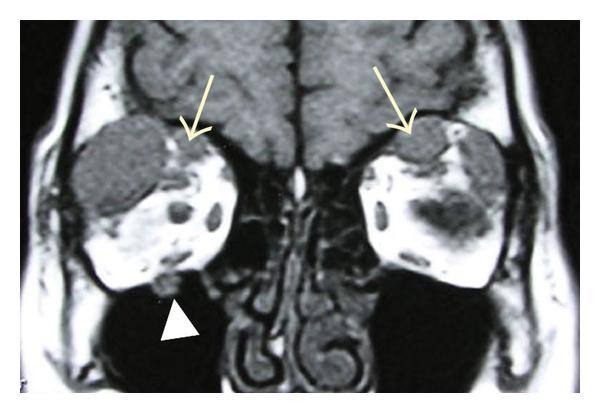
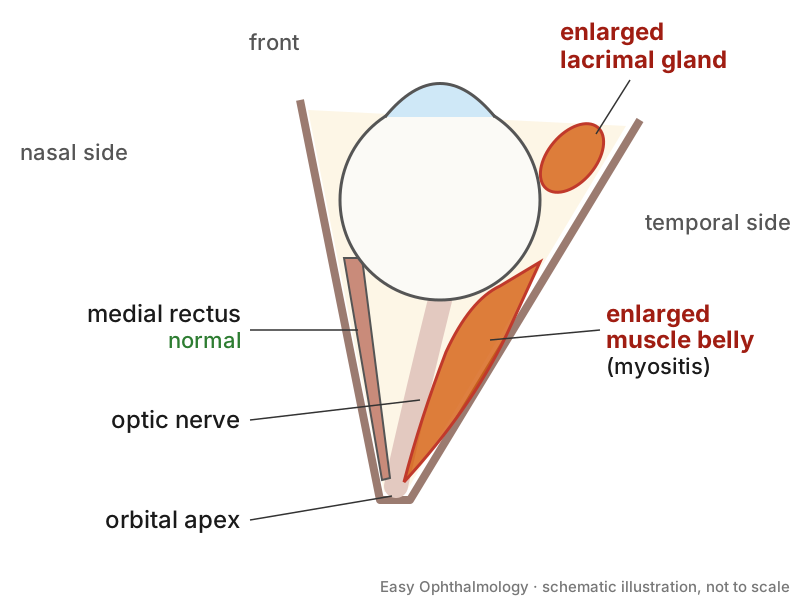
- IOI: clinical features vary with the site and degree of infiltration [S9].
- Idiopathic orbital myositis: acute orbital pain worse on eye movement, double vision, and lid or conjunctival redness or swelling, with homogeneous fusiform enlargement of one or more extraocular muscles on imaging [S8].
- IgG4-ROD: affects especially the lacrimal glands, extraocular muscles and trigeminal nerves; often with raised serum IgG4 [S11] [S10]. It is indolent and varied, often causing diagnostic delay [S12].
- Children: IgG4-related disease is little known among paediatricians; orbital disease was the commonest manifestation (44%) in 25 reported children [S3].
- Tolosa-Hunt syndrome: shares clinical and radiological features with IOI and both respond to steroids [S6].
Confirm it
- History, examination, targeted laboratory tests and imaging often allow a presumptive diagnosis [S1]. Clinical features, imaging and pathology often need to be evaluated together [S9].
- Biopsy-first view: when clinical and radiological findings are inconclusive, biopsy by a minimally invasive approach under local anaesthesia is advocated [S2].
- Steroids-first view: nearly all orbital inflammation can be treated empirically with steroids, sparing biopsy unless the response is atypical or incomplete [S1].
- In myositis with atypical features or poor steroid response, systemic and oncological work-up and muscle biopsy are warranted [S8].
- IgG4-ROD: use the 2023 revised diagnostic criteria, which add optic neuropathy [S10]. Comprehensive systemic evaluation is essential [S12].
- If steroids resolve symptoms without a tissue diagnosis, confirm resolution radiologically and follow up [S6].
Manage it
Before acting on this section, check the national and local guidelines, product information and regulatory approvals that apply where you practise. See the medical disclaimer.
Tier A (primary care / no specialist)
- Orbital inflammation has infectious and neoplastic causes, so refer painful proptosis, diplopia or lid swelling for specialist assessment [S2] [S9].
- Do not start steroids for presumed orbital inflammation without an eye specialist's assessment, because a steroid response is a weak diagnostic tool [S2].
Tier B (general eye clinic)
- Image the orbit where available; imaging is part of the diagnosis [S9] [S8].
- First-line treatment is glucocorticoids [S9]. Doses are not given in these abstracts: follow local protocols.
- Monitor response; an atypical or incomplete response calls for biopsy [S1].
Tier C (specialist centre)
- Biopsy inconclusive cases [S2].
- Steroid-resistant, steroid-dependent or intolerant IOI: radiotherapy, immunosuppressants and biologics can be considered [S9].
- Radiotherapy: a systematic review of 19 studies (241 patients) found response rates of 74% to 100% with a median recurrence of 10%; median total dose 20 Gy, most often 2 Gy per fraction, as reported in [S5]. Studies were heterogeneous and rarely assessed chronic pain or permanent deficits [S5].
- Rituximab: in 167 reported patients with refractory non-infectious, non-malignant orbital inflammation, 88.0% responded; most had granulomatosis with polyangiitis or IgG4-related disease [S7]. Regimens used were two 1 g infusions 14 days apart or four weekly 375 mg/m2 infusions, as reported in [S7]. Infusion-related temporary worsening occurred in 6.1% [S7].
- IgG4-ROD: no international treatment guideline exists [S4]. Early rituximab is proposed for refractory or organ- or life-threatening disease [S4]. In children, prednisone was first choice with favourable response in 83%, and 43% needed steroid-sparing maintenance [S3]. B-cell depletion has been reported as effective [S11]. Optic neuropathy often recovered with steroids, rituximab or orbital surgery [S10].
- Multidisciplinary care is essential for IgG4-ROD [S12].
Refer when
| Situation | Urgency |
|---|---|
| Orbital inflammation with reduced vision or a relative afferent pupil defect | Immediate, same-day [S10] |
| Painful proptosis or myositis without visual loss | Emergency referral [EIC expert opinion] |
| Incomplete or atypical steroid response, or recurrence | Urgent, for biopsy [S1]; timing per your local service or specialist advice |
Pitfalls
- Treating with steroids and calling the response diagnostic [S2].
- Missing lymphoma behind presumed inflammation [S10].
- Missing systemic IgG4-related disease by not evaluating beyond the orbit [S12].
- Accepting Tolosa-Hunt or IOI labels without radiological follow-up [S6].
Evidence notes
| Source | Date | Design |
|---|---|---|
| [S1] | 2016 | Expert opinion review ("corticosteroids first") |
| [S2] | 2016 | Expert opinion review ("biopsy first") |
| [S3] | 2016 | Systematic review of 25 paediatric cases |
| [S4] | 2019 | Systematic review, 95 patients (case reports and series) |
| [S5] | 2022 | Systematic review, 19 studies |
| [S6] | 2021 | Narrative review |
| [S7] | 2021 | Literature review, 167 patients |
| [S8] | 2022 | Narrative review |
| [S9] | 2023 | Narrative review |
| [S10] | 2024 | Review with revised diagnostic criteria (Japan) |
| [S11] | 2024 | Narrative review |
| [S12] | 2026 | Narrative review (India) |
- No RCTs: all treatment data come from case reports, series and reviews, prone to publication bias.
- Conflict: [S1] and [S2] are a deliberate debate on steroids versus biopsy first; the Editor-in-Chief should decide the article's stance.
- Not covered by these sources: steroid doses and tapering, specific imaging protocols, sclerosing orbital inflammation, and evidence from low-resource settings.
Related articles
References
See the numbered source list below. Each marker [S#] links to its PubMed and DOI record.
Sources
- [S1] Dagi Glass LR, Freitag SK Orbital inflammation: Corticosteroids first. Survey of ophthalmology. (2016). PubMed 26973286 · doi:10.1016/j.survophthal.2016.01.005
- [S2] Mombaerts I, Rose GE, Garrity JA Orbital inflammation: Biopsy first. Survey of ophthalmology. (2016). PubMed 26994870 · doi:10.1016/j.survophthal.2016.03.002
- [S3] Karim F, Loeffen J, Bramer W, Westenberg L, Verdijk R, van Hagen M, et al. IgG4-related disease: a systematic review of this unrecognized disease in pediatrics. Pediatric rheumatology online journal. (2016). PubMed 27012661 · doi:10.1186/s12969-016-0079-3
- [S4] Detiger SE, Karim AF, Verdijk RM, van Hagen PM, van Laar JAM, Paridaens D The treatment outcomes in IgG4-related orbital disease: a systematic review of the literature. Acta ophthalmologica. (2019). PubMed 30734497 · doi:10.1111/aos.14048
- [S5] Fionda B, Pagliara MM, Lancellotta V, Sammarco MG, Casà C, Savino G, et al. The Role of Radiotherapy in Orbital Pseudotumor: A Systematic Review of Literature. Ocular immunology and inflammation. (2022). PubMed 33561371 · doi:10.1080/09273948.2020.1871493
- [S6] Dutta P, Anand K Tolosa-Hunt Syndrome: A Review of Diagnostic Criteria and Unresolved Issues. Journal of current ophthalmology. (2021). PubMed 34409218 · doi:10.4103/joco.joco_134_20
- [S7] Ng CC, Sy A, Cunningham ET Rituximab for treatment of non-infectious and non-malignant orbital inflammatory disease. Journal of ophthalmic inflammation and infection. (2021). PubMed 34448063 · doi:10.1186/s12348-021-00253-3
- [S8] Mombaerts I, McNab AA Idiopathic Orbital Myositis Revisited. Current rheumatology reports. (2022). PubMed 35138592 · doi:10.1007/s11926-022-01052-y
- [S9] Fang Y, Shen B, Dai Q, Xie Q, Wu W, Wang M Orbital inflammatory pseudotumor: new advances in diagnosis, pathogenesis, and treatment. European journal of medical research. (2023). PubMed 37794419 · doi:10.1186/s40001-023-01330-0
- [S10] Takahira M, Goto H, Azumi A The 2023 revised diagnostic criteria for IgG4-related ophthalmic disease. Japanese journal of ophthalmology. (2024). PubMed 39037515 · doi:10.1007/s10384-024-01072-4
- [S11] Lai KKH, Ang TWX, Cheuk W, Kwok A, Lin M, Lustig Y, et al. Advances in understanding and management of IgG4-related ophthalmic disease. Asia-Pacific journal of ophthalmology (Philadelphia, Pa.). (2024). PubMed 39326526 · doi:10.1016/j.apjo.2024.100101
- [S12] Meel R, Saini M, Angku H, Pushker N, Agrawal S, Kashyap S, et al. IgG4-related orbital disease - An update. Indian journal of ophthalmology. (2026). PubMed 41498323 · doi:10.4103/ijo.ijo_603_25