Educational content only. Not personalised medical advice. Clinical decisions remain the responsibility of the treating clinician.
Ocular adnexal lymphoma
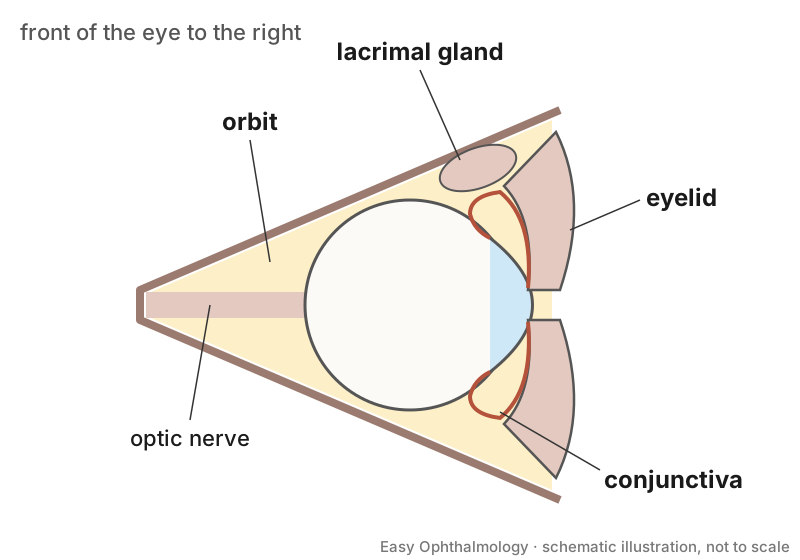
Ocular adnexal lymphoma (OAL) affects the orbit, conjunctiva, lacrimal gland and eyelid, and is almost always of B-cell origin [S5] [S7]. Extranodal marginal zone (MALT) lymphoma is the commonest subtype and carries a good prognosis, while high-grade subtypes do worse [S5] [S7]. Radiotherapy gives excellent local control for localised low-grade disease [S4].
Key points - MALT lymphoma made up 75% of cases in a review of 2009 treated patients [S4], 67.9% in Taiwan [S7] and 71.6% in Slovenia [S11]. - Subtype and stage are the best indicators of prognosis [S5] [S7]. - Radiotherapy gave average local control of 95.9% for MALT lymphoma, with 5-year overall survival of 93.8% [S4]. - Ultra-low-dose radiotherapy (4 Gy in 2 fractions) gave complete response in 90.0% in a phase 2 trial with no grade 3 or higher toxicity [S10]. - Doxycycline, targeting Chlamydophila psittaci, is an option for stage I MALT lymphoma, with lower response rates than radiotherapy [S1] [S4].
Evidence last checked: 2026-10-17 (PubMed abstracts).
Red flags
- High-grade subtype or advanced stage. Diffuse large B-cell and mantle cell lymphomas carry a poor prognosis [S5]; high-grade subtype and advanced stage predicted worse outcomes in Taiwan [S7].
- Systemic disease. Ocular manifestation was the first sign of lymphoma in 78.4% of a Slovenian cohort, but the ocular adnexa were the only site in 67.6% [S11]; systemic examination is therefore needed [S6].
- Relapse years later. Progression-free survival fell from 86.2% at 5 years to 44.6% at 15 years [S7].
Recognise it
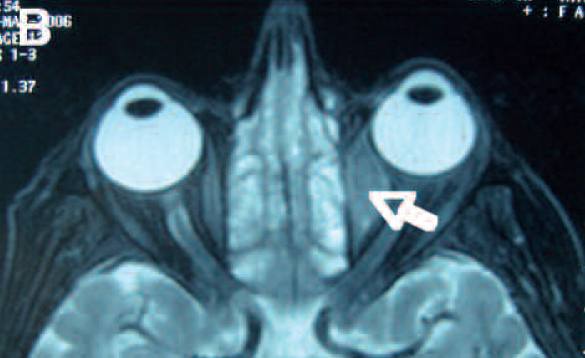
- Orbital lymphoma is primarily a disease of the elderly [S5]; median age at diagnosis was 68 years in Slovenia [S11] and mean 59.0 years in Taiwan [S7].
- Sites in a Taiwanese series: orbit 39.3%, conjunctiva 27.7%, lacrimal gland 25.0%, eyelid 7.1% [S7].
- MALT and follicular lymphoma show a female predominance; mantle cell lymphoma is 80% male [S5].
- Clinical signs are not described in these abstracts.
Confirm it
- Diagnosis is histological; all patients in the cohorts had histologically confirmed disease [S2] [S11].
- Subtype the lymphoma: in orbital lymphoma, 97% are B-cell, with marginal zone 59%, diffuse large B-cell 23%, follicular 9% and mantle cell 5% [S5].
- Stage the disease systemically [S6]; TNM stage independently predicted progression-free survival after doxycycline [S2].
- C. psittaci DNA was found in 89% of biopsies of stage I ocular adnexal MALT lymphoma in an Italian-led trial and can be monitored in conjunctival swabs and blood [S1].
- High-resolution OCT can be used for diagnosis and follow-up of conjunctival lymphoma [S6].
Manage it
Before acting on this section, check the national and local guidelines, product information and regulatory approvals that apply where you practise. See the medical disclaimer.
Tier A (primary care / no specialist)
- Refer an older adult with a new orbital, lacrimal or conjunctival mass to an eye clinic (see Refer when).
Tier B (general eye clinic)
- Arrange biopsy with histology through a service with pathology support, and refer for haematology or oncology staging [S6].
- Where radiotherapy is unavailable, note that doxycycline has been used first-line in stage I MALT lymphoma [S1] [S2]; the decision should involve a lymphoma team.
Tier C (specialist centre)
- Radiotherapy for localised low-grade disease. Radiotherapy is the treatment of choice for solitary low-grade lymphoma [S5]. Complete response occurred in 75-90% and local relapse in 3.5-5% across 25 studies; lens shielding was associated with better 5-year progression-free survival, and cataract risk rose above 30 Gy [S8].
- Ultra-low-dose radiotherapy. In a phase 2 trial of 50 patients, 4 Gy in 2 fractions, as reported in [S10], gave a 2-year local control of 89.4%; persistent disease received an additional 20 Gy in 10 fractions [S10]. A systematic review of 10 studies (591 patients) found complete response in 50% to 95% and no grade 3 or higher toxicity [S12].
- Doxycycline. In a phase 2 trial, doxycycline gave an overall response rate of 65% and 5-year progression-free survival of 55%; eradication of C. psittaci was associated with better response (86% vs 47%) [S1]. In a Korean cohort of 90 patients, doxycycline 100 mg twice daily for 3 weeks (one or two cycles), as reported in [S2], gave 5-year progression-free survival of 60.9%; failures were salvaged with chemotherapy and/or radiotherapy [S2]. The AAO review reported complete responses of only 4.4% to 13% with doxycycline [S4].
- Disseminated or high-grade disease. Chemotherapy with or without radiotherapy should be chosen [S5].
- Rituximab. In pooled conjunctival lymphoma cases, systemic rituximab gave complete response in 63% and intralesional rituximab in 75% [S9].
- Side effects. Cataract (12.1%) and dry eye (8.5%) were the commonest treatment complications [S4]; acute dry eye usually settled with artificial tears [S8].
Refer when
| Situation | Urgency |
|---|---|
| New orbital, lacrimal gland or conjunctival mass in an adult | Urgent to an eye service able to biopsy; timing per your local service or specialist advice |
| Proven OAL | Urgent to haematology or oncology for staging; timing per your local service or specialist advice |
| Rapidly enlarging mass, proptosis with visual loss, or systemic symptoms | Emergency referral, for proptosis with visual loss; otherwise urgent [EIC expert opinion] |
Pitfalls
- Treating the eye without systemic staging [S6].
- Assuming all OAL behaves like MALT lymphoma: high-grade subtypes have a poor prognosis [S5].
- Using standard-dose radiotherapy without considering lower-dose options for indolent disease [S10] [S12].
- Stopping follow-up at 5 years: late progression occurs [S7].
Evidence notes
| Source | Date | Design |
|---|---|---|
| [S1] | 2012 | International phase 2 trial, 47 patients |
| [S2] | 2015 | Prospective cohort, 90 patients (Korea) |
| [S3] | 2017 | Narrative review |
| [S4] | 2018 | AAO Ophthalmic Technology Assessment (27 studies) |
| [S5] | 2019 | Review of 2211 published cases |
| [S6] | 2019 | Narrative review, conjunctival lymphoma |
| [S7] | 2021 | Retrospective cohort, 112 patients (Taiwan) |
| [S8] | 2022 | Systematic review, 25 studies |
| [S9] | 2024 | Systematic review of case reports and series |
| [S10] | 2024 | Phase 2 nonrandomised trial, 50 patients |
| [S11] | 2024 | Retrospective cohort, 74 patients (Slovenia) |
| [S12] | 2025 | Systematic review, 10 studies |
- There are no RCTs comparing treatments; there is no consensus on the best upfront treatment [S3].
- Doxycycline response varies widely between sources [S1] [S2] [S4]; reasons are not explained in these abstracts.
- Not covered by these sources: clinical signs, regional C. psittaci prevalence, imaging protocols, staging investigations, chemotherapy regimens, and evidence-based referral timings.
Related articles
References
See the numbered source list below. Each marker [S#] links to its PubMed and DOI record.
Sources
- [S1] Ferreri AJ, Govi S, Pasini E, Mappa S, Bertoni F, Zaja F, et al. Chlamydophila psittaci eradication with doxycycline as first-line targeted therapy for ocular adnexae lymphoma: final results of an international phase II trial. Journal of clinical oncology : official journal of the American Society of Clinical Oncology. (2012). PubMed 22802315 · doi:10.1200/jco.2011.41.4466
- [S2] Han JJ, Kim TM, Jeon YK, Kim MK, Khwarg SI, Kim CW, et al. Long-term outcomes of first-line treatment with doxycycline in patients with previously untreated ocular adnexal marginal zone B cell lymphoma. Annals of hematology. (2015). PubMed 25338969 · doi:10.1007/s00277-014-2240-8
- [S3] Sassone M, Ponzoni M, Ferreri AJ Ocular adnexal marginal zone lymphoma: Clinical presentation, pathogenesis, diagnosis, prognosis, and treatment. Best practice & research. Clinical haematology. (2017). PubMed 28288706 · doi:10.1016/j.beha.2016.11.002
- [S4] Yen MT, Bilyk JR, Wladis EJ, Bradley EA, Mawn LA Treatments for Ocular Adnexal Lymphoma: A Report by the American Academy of Ophthalmology. Ophthalmology. (2018). PubMed 28712656 · doi:10.1016/j.ophtha.2017.05.037
- [S5] Olsen TG, Heegaard S Orbital lymphoma. Survey of ophthalmology. (2019). PubMed 30144455 · doi:10.1016/j.survophthal.2018.08.002
- [S6] Tanenbaum RE, Galor A, Dubovy SR, Karp CL Classification, diagnosis, and management of conjunctival lymphoma. Eye and vision (London, England). (2019). PubMed 31372366 · doi:10.1186/s40662-019-0146-1
- [S7] Hsu CR, Chen YY, Yao M, Wei YH, Hsieh YT, Liao SL Orbital and ocular adnexal lymphoma: a review of epidemiology and prognostic factors in Taiwan. Eye (London, England). (2021). PubMed 32994547 · doi:10.1038/s41433-020-01198-y
- [S8] Oktariana TP, Andriana A, Nugroho RS The outcome of radiation therapy as a primary treatment in orbital lymphoma: a systematic review. Reports of practical oncology and radiotherapy : journal of Greatpoland Cancer Center in Poznan and Polish Society of Radiation Oncology. (2022). PubMed 36196408 · doi:10.5603/rpor.a2022.0065
- [S9] Serbest Ceylanoglu K, Guneri Beser B, Singalavanija T, Juntipwong S, Worden FP, Demirci H Targeted Therapy and Immunotherapy for Advanced Malignant Conjunctival Tumors: Systematic Review. Ophthalmic plastic and reconstructive surgery. (2024). PubMed 38241616 · doi:10.1097/iop.0000000000002488
- [S10] Pinnix CC, Dabaja BS, Gunther JR, Fang PQ, Wu SY, Nastoupil LJ, et al. Response-Adapted Ultralow-Dose Radiation Therapy for Orbital Indolent B-Cell Lymphoma: A Phase 2 Nonrandomized Controlled Trial. JAMA oncology. (2024). PubMed 38990564 · doi:10.1001/jamaoncol.2024.2112
- [S11] Boltezar L, Strbac D, Pizem J, Hawlina G Ocular adnexal lymphoma - a retrospective study and review of the literature. Radiology and oncology. (2024). PubMed 39287167 · doi:10.2478/raon-2024-0048
- [S12] Grujić M, Volchenkov S, Akhmetali A, Živković Radojević M, Milosavljević N, Janković K, et al. Clinical Outcomes and Safety of Ultra-Low-Dose Radiotherapy for Ocular Adnexal Lymphoma: A Systematic Review. Cancers. (2025). PubMed 40940942 · doi:10.3390/cancers17172845