Educational content only. Not personalised medical advice. Clinical decisions remain the responsibility of the treating clinician.
Hydroxychloroquine retinopathy screening
Hydroxychloroquine (HCQ) is widely used for lupus and rheumatoid arthritis, and its major dose-limiting toxicity is a retinopathy that can lead to irreversible loss of vision [S5] [S1]. Retinopathy is not reversible and has no present therapy, so screening aims to detect it early, before visible fundus changes and central visual loss [S3]. The 2025 American Academy of Ophthalmology (AAO) revision updates dosing advice, risk factors and the primary screening tests [S10].
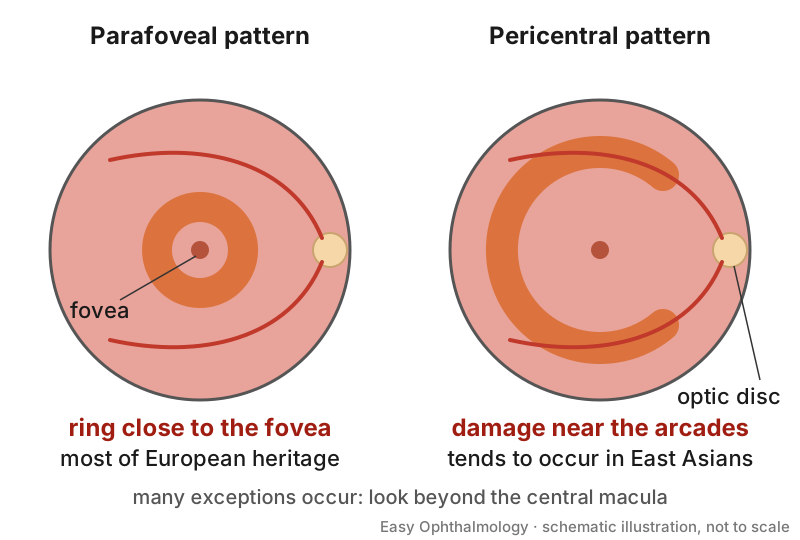
Key points - Risk depends on daily dose and duration: at recommended doses it was under 1% up to 5 years and under 2% up to 10 years, rising to almost 20% after 20 years, as estimated in the 2016 AAO guidance [S3]. - Doses, as reported in [S10]: the AAO recommended daily dosage remains ≤5.0 mg/kg real weight, and under 400 mg/day for severely obese patients [S10]. - Beyond dose and duration, renal disease, tamoxifen and starting HCQ at an older age increase risk [S10]. - The 2025 AAO revision makes OCT plus wide-pattern fundus autofluorescence (FAF) the primary screening tools, with visual fields and multifocal ERG as secondary confirmatory tests [S10]. - East Asian patients tend to show a pericentral pattern, so screening should look beyond the central macula [S10] [S4].
Evidence last checked: 2026-10-17 (PubMed abstracts).
Red flags
- Daily dose above the recommended level for real body weight [S10] [S3].
- Renal disease or tamoxifen use in a patient on HCQ [S10] [S3].
- Treatment for more than 5 years without screening [S10] [S1].
- Severe retinopathy: it may continue to worsen for many years after HCQ is stopped [S10].
Recognise it: who is at risk and what it looks like
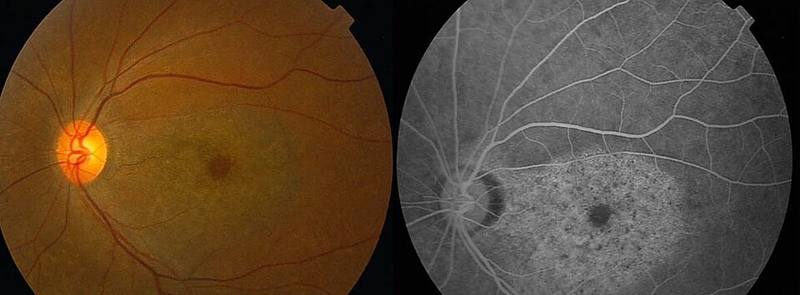
- The retina typically stays clinically normal for many years, until an unpredictable point when toxicity may develop [S10]. Early retinopathy is usually asymptomatic with preserved visual acuity [S2].
- Prevalence is higher than previously thought: 7.5% in patients taking HCQ for more than 5 years in one cited estimate [S4], and greater than 5% after 5 years or more in another review [S7].
- Most patients of European heritage show a parafoveal pattern, while East Asian patients tend to show pericentral toxicity, with many exceptions [S10].
- Bull's eye maculopathy is the classical presentation, but drug toxicities, inherited retinal disorders and systemic conditions can mimic it [S9].
- An older review lists commonly accepted risk factors as more than 6.5 mg/kg/day or a cumulative dose of more than 1000 g, more than 5 years of treatment, renal or liver dysfunction, pre-existing retinopathy and older age, as reported in [S1]; current dosing advice is lower [S10].
Confirm it: screening tests
- Baseline: fundus examination, OCT and FAF soon after HCQ is started, to exclude pre-existing disease and for later comparison [S10].
- Annual screening with OCT and FAF while on HCQ; it may be deferred during the first 5 years if there are no significant risk factors [S10].
- Secondary tests: visual fields and multifocal ERG confirm findings; newer field algorithms such as 24-2C can cover parafoveal and pericentral regions together [S10].
- No single ideal test with high sensitivity and specificity exists [S1]. Questionable results should be repeated or validated with additional tests to avoid stopping a valuable drug unnecessarily [S3].
- Novel imaging (en face OCT, OCT angiography, quantitative autofluorescence and others) shows promise but none is validated for general use [S7] [S10].
Manage it: running screening
Before acting on this section, check the national and local guidelines, product information and regulatory approvals that apply where you practise. See the medical disclaimer.
Tier A (primary care / no specialist)
- Know which patients take HCQ, record their dose and real body weight, and check that they have been referred for baseline and annual screening [S10].
- Counsel patients and prescribers about toxicity risk, proper dose and the importance of regular annual screening [S3].
- Dose adjustment belongs to the prescriber and local formulary; dosing beyond the figures above is not covered here.
Tier B (general eye clinic)
- Perform a baseline fundus examination [S3] and, where available, OCT [S10].
- Where FAF is unavailable, note that the 2016 AAO guidance used automated visual fields plus SD-OCT as the primary tests, extending beyond the central macula in Asian patients [S3]; the 2025 revision prefers OCT plus FAF [S10].
- Distinguishing HCQ toxicity from mimickers can be difficult for all but retina specialists [S9]; refer equivocal cases.
Tier C (specialist centre)
- Confirm suspected toxicity with multimodal imaging and functional tests [S10].
- When early signs appear, discuss with the patient and prescriber the options of stopping HCQ or continuing with cautious monitoring [S10]. Mild retinopathy is unlikely to progress after stopping, but severe retinopathy may keep worsening [S10].
- Recognising toxicity before any RPE loss is important to prevent central visual loss [S3].
Refer when
| Situation | Urgency |
|---|---|
| Suspected HCQ retinopathy on screening tests | Urgent to a retina service [S10]; timing per your local service or specialist advice |
| Patient on HCQ with new central vision symptoms | Urgent for OCT and fields; timing per your local service or specialist advice |
| Starting HCQ, or on HCQ beyond 5 years or with risk factors | Routine baseline or annual screening, scheduled within months [S10] |
Pitfalls
- Dosing by ideal rather than real body weight [S3] [S4].
- Screening only the central macula in East Asian patients [S10] [S4].
- Stopping HCQ on a single questionable test without confirmation [S3].
- Missing mimickers of bull's eye maculopathy [S9].
- Assuming lower doses keep disease control: the efficacy of low-dose HCQ in lupus and other rheumatic diseases is unknown [S5].
Evidence notes
| Source | Date | Design |
|---|---|---|
| [S1] | 2016 | Narrative review |
| [S2] | 2015 | Narrative review of imaging |
| [S3] | 2016 | AAO guideline (2016 revision) |
| [S4] | 2017 | Narrative review |
| [S5] | 2018 | Narrative review |
| [S6] | 2019 | EULAR recommendations (systematic review and Delphi consensus) |
| [S7] | 2022 | Narrative review |
| [S8] | 2023 | Narrative review |
| [S9] | 2024 | Narrative review |
| [S10] | 2026 | AAO guideline (2025 revision) |
- Conflict between guideline versions: the 2016 AAO guidance used automated fields plus SD-OCT as primary tests [S3]; the 2025 revision uses OCT plus wide-pattern FAF, with fields secondary [S10].
- The EULAR lupus recommendations advise HCQ for all patients with lupus at a dose not exceeding 5 mg/kg real body weight, as reported in [S6].
- Prevalence estimates differ between reviews (more than 5% vs 7.5% after 5 years) [S4] [S7]; one review compares current screening recommendations and identifies where more evidence is needed [S8].
- The AAO 2025 report states that proprietary disclosures are listed in the full text [S10].
- Not covered by these sources: chloroquine screening in detail (the 2016 AAO guidance suggests ≤2.3 mg/kg real weight, as reported in [S3]), screening in children and pregnancy, and cost-effective screening models for low-resource settings.
Related articles
References
See the numbered source list below. Each marker [S#] links to its PubMed and DOI record.
Sources
- [S1] Ding HJ, Denniston AK, Rao VK, Gordon C Hydroxychloroquine-related retinal toxicity. Rheumatology (Oxford, England). (2016). PubMed 26428520 · doi:10.1093/rheumatology/kev357
- [S2] Pandya HK, Robinson M, Mandal N, Shah VA Hydroxychloroquine retinopathy: A review of imaging. Indian journal of ophthalmology. (2015). PubMed 26458473 · doi:10.4103/0301-4738.167120
- [S3] Marmor MF, Kellner U, Lai TY, Melles RB, Mieler WF, American Academy of Ophthalmology Recommendations on Screening for Chloroquine and Hydroxychloroquine Retinopathy (2016 Revision). Ophthalmology. (2016). PubMed 26992838 · doi:10.1016/j.ophtha.2016.01.058
- [S4] Yusuf IH, Sharma S, Luqmani R, Downes SM Hydroxychloroquine retinopathy. Eye (London, England). (2017). PubMed 28282061 · doi:10.1038/eye.2016.298
- [S5] Jorge A, Ung C, Young LH, Melles RB, Choi HK Hydroxychloroquine retinopathy - implications of research advances for rheumatology care. Nature reviews. Rheumatology. (2018). PubMed 30401979 · doi:10.1038/s41584-018-0111-8
- [S6] Fanouriakis A, Kostopoulou M, Alunno A, Aringer M, Bajema I, Boletis JN, et al. 2019 update of the EULAR recommendations for the management of systemic lupus erythematosus. Annals of the rheumatic diseases. (2019). PubMed 30926722 · doi:10.1136/annrheumdis-2019-215089
- [S7] Yusuf IH, Charbel Issa P, Ahn SJ Novel imaging techniques for hydroxychloroquine retinopathy. Frontiers in medicine. (2022). PubMed 36314000 · doi:10.3389/fmed.2022.1026934
- [S8] Yusuf IH, Charbel Issa P, Ahn SJ Hydroxychloroquine-induced Retinal Toxicity. Frontiers in pharmacology. (2023). PubMed 37324471 · doi:10.3389/fphar.2023.1196783
- [S9] Jones P, Kalra G, Al-Sheikh M, Chhablani J Mimickers of hydroxychloroquine retinal toxicity. Clinical & experimental ophthalmology. (2024). PubMed 39626654 · doi:10.1111/ceo.14461
- [S10] Marmor MF, Ahn SJ, Ehlers JP, Melles RB, Mieler WF, Sarraf D, et al. Special AAO Report: Recommendations on Screening for Hydroxychloroquine Retinopathy (2025 Revision). Ophthalmology. (2026). PubMed 41232611 · doi:10.1016/j.ophtha.2025.11.001