Educational content only. Not personalised medical advice. Clinical decisions remain the responsibility of the treating clinician.
Childhood esotropia
Esotropia is an inward deviation of the eye [S8]. In childhood it takes several forms, mainly infantile, accommodative and acute acquired comitant esotropia, each with different treatment [S12] [S2]. Infantile and accommodative esotropia are associated with profound and permanent disruption of stereopsis [S1], and acute acquired esotropia can be associated with significant neurological disease [S2].
Key points - Full cycloplegic hyperopic correction is the most effective first-line treatment for accommodative esotropia (systematic review, 34 studies) [S12]. - Sudden-onset comitant esotropia can be associated with brain tumours, hydrocephalus and other neurological disorders that need neuroimaging [S10]. - For infantile esotropia, medial rectus recession may give more successful alignment than botulinum toxin, but the evidence is very uncertain (Cochrane) [S8]. - Very early surgery for infantile esotropia (within 6 months of onset) is associated with better stereopsis and binocular vision, though not better alignment (review) [S6]. - Botulinum toxin commonly causes transient ptosis and vertical deviation [S9].
Evidence last checked: 2026-10-17 (PubMed abstracts).
Red flags
- Sudden-onset esotropia in an older child. Acute acquired comitant esotropia (AACE) can be associated with astrocytoma, medulloblastoma, brainstem or cerebellar tumours, Chiari malformation, idiopathic intracranial hypertension, hydrocephalus and myasthenia gravis [S10].
- Neurological signs with any esotropia. Headache, cerebellar imbalance, weakness, nystagmus, papilloedema, clumsiness or poor motor coordination call for a comprehensive neurological assessment and neuroimaging [S10].
- Deviation that varies with direction of gaze. An incomitant angle suggests restrictive or paretic strabismus rather than common childhood esotropia [S2].
Recognise it
- Infantile esotropia: onset before six months [S8] or before one year of age in trials [S8]; dissociated vertical deviation, latent nystagmus or both occurred in 8% to 21% of trial participants [S8].
- Accommodative esotropia: convergent misalignment associated with hyperopia, abnormal fusional divergence and sometimes an abnormal AC/A ratio; it often presents first as an intermittent esodeviation at age 1.5 to 4 years, with an estimated prevalence near 1-2% in the United States [S4].
- AACE: sudden, usually late onset of a relatively large comitant angle with diplopia in older children and adults [S10]; many cases have no clear cause, and functional factors include accommodative spasm and excessive near work on smartphones and other digital screens [S10] [S11].
- Children with Down syndrome or developmental delay have a high rate of strabismus, in particular esotropia [S5].
Confirm it
- Measure the angle in prism dioptres (PD); review and trial success was usually defined as a residual deviation of 10 PD or less [S8] [S12].
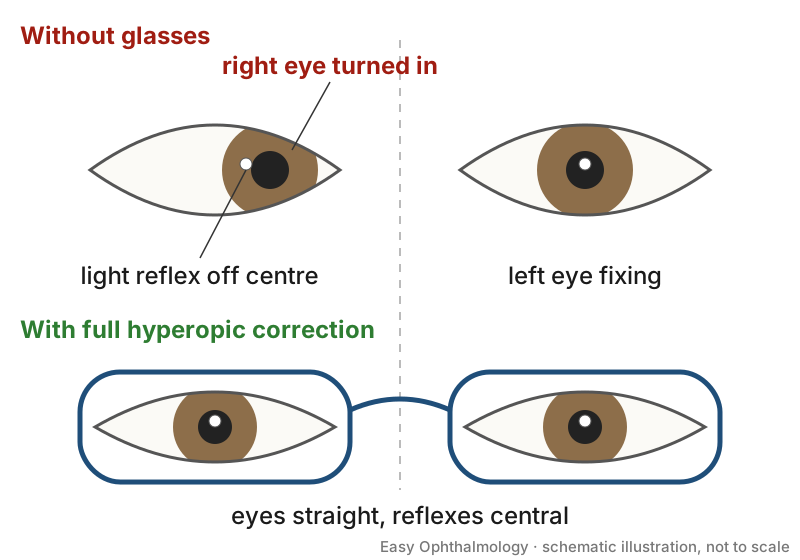
- Perform cycloplegic refraction: treatment of accommodative esotropia depends on full cycloplegic hyperopic correction [S12].
- Check whether the angle is equal in all gaze positions (comitant) [S2].
- In AACE, especially with nystagmus or abnormal neurological signs, arrange neurological assessment and neuroimaging [S10].
Manage it
Before acting on this section, check the national and local guidelines, product information and regulatory approvals that apply where you practise. See the medical disclaimer.
Tier A (primary care / no specialist)
- Refer any child with a turned eye to an eye clinic; refer sudden-onset esotropia or a squint with neurological symptoms urgently [S10].
Tier B (general eye clinic)
- Glasses first in accommodative esotropia. Prescribe full cycloplegic hyperopic correction [S12]. Optical correction had the highest effectiveness, 79.31% after an average follow-up of 5.57 years, across childhood esotropia types [S12]. Optical correction alone usually restores alignment, but surgery is needed in approximately 30% of cases [S4].
- Residual deviation. Prisms were highly successful for residual deviation in partially accommodative esotropia [S12].
- Treat amblyopia alongside alignment: better stereoacuity outcomes are associated with lower risk and severity of amblyopia [S1].
Tier C (specialist centre)
- Surgery for accommodative esotropia may be required if the deviation remains over 15 PD in full cycloplegic correction [S12].
- Infantile esotropia: surgery vs botulinum toxin. In one South African RCT (110 children, angle 40 PD or more), surgery may increase success compared with up to three botulinum toxin injections (RR 1.88), but the evidence was very low certainty; the toxin arm had transient ptosis in 16.7%, transient vertical deviation in 5.6% and consecutive exotropia in 24.1% [S8]. Bilateral and unilateral surgery did not differ importantly [S8].
- Botulinum toxin in general. Across 4 RCTs (242 participants, adults and children), surgery may be more likely to correct strabismus (low-certainty evidence); toxin may have little or no effect on fusion and stereopsis compared with surgery in children needing retreatment; partial transient ptosis occurred in 16.7% to 37.0% [S9]. A meta-analysis of 9 studies reported a pooled success of 76% with toxin in infantile esotropia, ptosis in 27% and consecutive exotropia in 1%, with very high heterogeneity [S3]. Bilateral toxin was reported effective first-line for acute-onset esotropia and infantile esotropia without a vertical component [S12].
- Timing in infantile esotropia. Very early surgery within 6 months of onset showed benefits for stereopsis, binocular vision and less dissociated vertical deviation, without different alignment [S6]; the Cochrane review could not resolve the question of age at intervention [S8].
- Developmental delay and Down syndrome. An exaggerated surgical effect has been reported in developmental delay, which may justify a reduced dose; evidence does not support a reduced dose in Down syndrome [S5].
- Refractive surgery may be an alternative to glasses for adults with accommodative esotropia of 10 PD or less; there is not enough evidence to recommend it under 18 years [S7].
- Botulinum toxin dose is not covered by these abstracts: follow local protocols.
Refer when
| Situation | Urgency |
|---|---|
| Sudden-onset esotropia with headache, papilloedema, nystagmus, imbalance or other neurological signs | Same-day to a service with neuroimaging [S10] |
| Sudden-onset comitant esotropia without other signs | Emergency, within 24 hours, to an eye specialist [S10] [EIC expert opinion] |
| Infantile esotropia | Urgent: earlier surgery may favour binocular vision; timing per your local service or specialist advice [S6] |
| Esotropia persisting in full hyperopic correction | Routine, within months, to a strabismus surgeon [S12] |
Pitfalls
- Treating sudden-onset esotropia as benign without a neurological assessment [S10].
- Operating before full cycloplegic hyperopic correction has been tried in accommodative esotropia [S12].
- Promising stereopsis: rehabilitation of stereoacuity remains a challenge [S1].
- Underestimating botulinum toxin side effects such as ptosis [S9].
- Using standard surgical doses without considering developmental delay [S5].
Evidence notes
| Source | Date | Design |
|---|---|---|
| [S1] | 2009 | Narrative review |
| [S2] | 2017 | Narrative review |
| [S3] | 2017 | Systematic review and meta-analysis, 9 studies |
| [S4] | 2019 | Literature review |
| [S5] | 2020 | Literature review |
| [S6] | 2022 | Systematic literature review |
| [S7] | 2022 | Systematic review of case series and case reports |
| [S8] | 2023 | Cochrane systematic review, 2 trials, 234 children |
| [S9] | 2023 | Cochrane systematic review, 4 RCTs, 242 participants |
| [S10] | 2023 | Narrative review |
| [S11] | 2025 | Narrative review |
| [S12] | 2025 | Systematic review, 34 studies, 3,877 children, 14 countries |
- RCT evidence is scarce and of low or very low certainty [S8] [S9]. The one RCT of toxin vs surgery in infantile esotropia was conducted in South Africa [S8].
- Conflict: the toxin meta-analysis reported 1% consecutive exotropia [S3], while the South African RCT reported 24.1% [S8]; the meta-analysis had very high heterogeneity (I² 94.25%) [S3].
- Effectiveness rates in [S12] come from pooled observational follow-up, not head-to-head trials.
- AACE neurological associations come from narrative reviews of reported cases; no frequency is given [S10] [S11].
- Not covered by these sources: surgical dose tables, bifocals for high AC/A ratio, sixth nerve palsy, and cost.
Related articles
- Amblyopia: patching, atropine and binocular treatment
- Intermittent exotropia
- Ocular Motor Cranial Nerve Palsies
References
See the numbered source list below. Each marker [S#] links to its PubMed and DOI record.
Sources
- [S1] Birch EE, Wang J Stereoacuity outcomes after treatment of infantile and accommodative esotropia. Optometry and vision science : official publication of the American Academy of Optometry. (2009). PubMed 19390468 · doi:10.1097/opx.0b013e3181a6168d
- [S2] Gilbert AL, Koo EB, Heidary G Evaluation and Management of Acute Acquired Comitant Esotropia in Children. Seminars in ophthalmology. (2017). PubMed 27726470 · doi:10.1080/08820538.2016.1228398
- [S3] Issaho DC, Carvalho FRS, Tabuse MKU, Carrijo-Carvalho LC, de Freitas D The Use of Botulinum Toxin to Treat Infantile Esotropia: A Systematic Review With Meta-Analysis. Investigative ophthalmology & visual science. (2017). PubMed 29059315 · doi:10.1167/iovs.17-22576
- [S4] Lembo A, Serafino M, Strologo MD, Saunders RA, Trivedi RH, Villani E, et al. Accommodative esotropia: the state of the art. International ophthalmology. (2019). PubMed 29332227 · doi:10.1007/s10792-018-0821-6
- [S5] Harrison A, Allen L, O'Connor A Strabismus Surgery for Esotropia, Down Syndrome and Developmental Delay; Is an Altered Surgical Dose Required? A Literature Review. The British and Irish orthoptic journal. (2020). PubMed 32999987 · doi:10.22599/bioj.140
- [S6] Bhate M, Flaherty M, Martin FJ Timing of surgery in essential infantile esotropia - What more do we know since the turn of the century? Indian journal of ophthalmology. (2022). PubMed 35086202 · doi:10.4103/ijo.ijo_1129_21
- [S7] Ferreira A, Marta A, Baptista PM, Caiado F, Abreu AC, Maia S, et al. Refractive Surgery for Older Children and Adults with Accommodative Esotropia: A Systematic Review. Ophthalmic research. (2022). PubMed 35226900 · doi:10.1159/000523816
- [S8] Mehner L, Ng SM, Singh J Interventions for infantile esotropia. The Cochrane database of systematic reviews. (2023). PubMed 36645238 · doi:10.1002/14651858.cd004917.pub4
- [S9] Bort-Martí AR, Rowe FJ, Ruiz Sifre L, Ng SM, Bort-Martí S, Ruiz Garcia V Botulinum toxin for the treatment of strabismus. The Cochrane database of systematic reviews. (2023). PubMed 36916692 · doi:10.1002/14651858.cd006499.pub5
- [S10] Nouraeinejad A Neurological pathologies in acute acquired comitant esotropia. Graefe's archive for clinical and experimental ophthalmology = Albrecht von Graefes Archiv fur klinische und experimentelle Ophthalmologie. (2023). PubMed 37145335 · doi:10.1007/s00417-023-06092-3
- [S11] Nishikawa N, Sato M Acute acquired comitant esotropia: Current understanding of its etiological classification and treatment strategies. Taiwan journal of ophthalmology. (2025). PubMed 40213304 · doi:10.4103/tjo.tjo-d-23-00084
- [S12] Alrasheed SH, Challa NK, Aljohani S, Almutairi NM, Alnawmasi MM Effectiveness of treatment modalities for childhood esotropia: a systematic review. PeerJ. (2025). PubMed 40538735 · doi:10.7717/peerj.19584