Educational content only. Not personalised medical advice. Clinical decisions remain the responsibility of the treating clinician.
Entropion and Ectropion
Entropion is inward turning of the eyelid margin against the globe; ectropion is outward turning, usually of the lower lid [S10] [S9]. Both are common in older people and becoming more common with population ageing [S10] [S9]. Malpositions such as cicatricial entropion and paralytic lid deformity can cause exposure, inflammation and significant visual impairment [S12].
Key points - Entropion is involutional, cicatricial, spastic or congenital; involutional is the most common [S10]. - Acquired ectropion is involutional, paralytic, mechanical or cicatricial; involutional is the most common [S9]. - Lid instability usually comes from horizontal laxity or from disinsertion or attenuation of the lower lid retractors, so surgery should correct horizontal and vertical instability [S1]. - In the only RCT, everting sutures plus lateral tarsal strip was more effective for involutional entropion than everting sutures alone [S2].
Evidence last checked: 2026-10-17 (PubMed abstracts).
Red flags
- Corneal exposure in facial palsy: lagophthalmos, ectropion and exposure keratopathy are ophthalmic complications of facial paralysis [S8].
- Cicatricial entropion from inflammatory or iatrogenic posterior lamellar contraction is among the malpositions most harmful to the ocular surface [S12].
- Lashes rubbing the cornea with a corneal ulcer or reduced vision [G1].
Recognise it
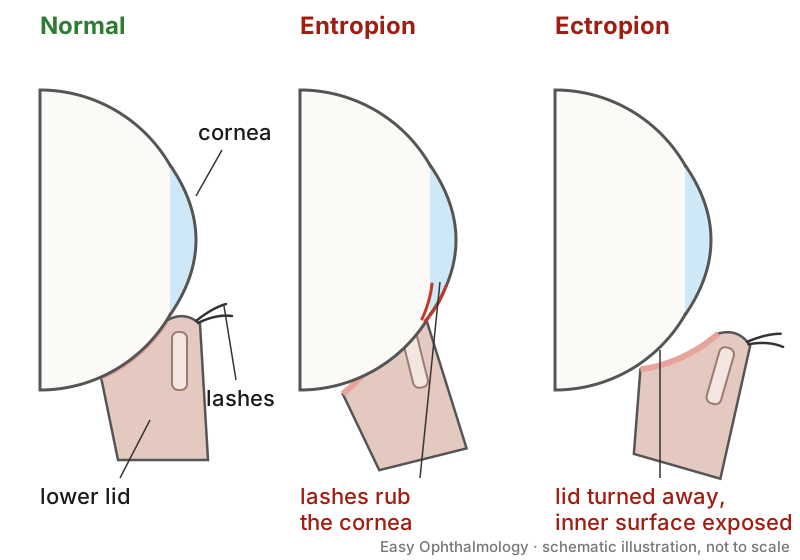
Entropion - Involutional entropion is one of the commonest lower lid malpositions in the elderly [S2]. Asian eyelids develop it more often [S3]. - Proposed causes: vertical and horizontal lid laxity and preseptal orbicularis overriding the pretarsal orbicularis [S5]. Retractor attenuation appears to be the predominant factor in most patients; tarsal atrophy, enophthalmos and fat prolapse may contribute in some [S11]. - Cicatricial entropion arises from posterior lamellar contraction after inflammatory or iatrogenic injury [S12].
Ectropion - Involutional ectropion is caused by age-related degeneration of periocular tissues, with horizontal and vertical factors [S7]. - Cicatricial ectropion occurs when a scar below the eye pulls the lid down enough to evert it [S6]. - Paralytic: facial nerve palsy causes incomplete blinking, punctal malposition and lacrimal pump dysfunction, with tearing and ocular surface instability [S12].
Confirm it
- Assess horizontal laxity; the distraction test often shows margin laxity in involutional entropion, although the lids are typically not elongated [S11].
- Look for vertical laxity, orbicularis override and retractor dehiscence, since procedure choice depends on which are present [S5].
- In cicatricial ectropion, assess the medial or lateral extent, degree of scarring and lid laxity [S6].
- In facial palsy, grading scales are used to measure severity and track outcomes [S8].
Manage it
Before acting on this section, check the national and local guidelines, product information and regulatory approvals that apply where you practise. See the medical disclaimer.
Tier A (primary care / no specialist)
- Lubricate and protect the cornea; in lagophthalmos or ectropion, temporary measures aim to lubricate and cover the eye [S8].
- Refer for surgical assessment; the treatments described are surgical [S2].
- Refer facial palsy early: assessment by a skilled ophthalmologist shortly after diagnosis can help prevent long-term complications [S8].
Tier B (general eye clinic)
- Involutional entropion: a lateral tarsal strip is the typical treatment and may be combined with eversion techniques [S10]. Everting sutures plus lateral tarsal strip outperformed everting sutures alone in one RCT of 63 participants, supported by retrospective case series [S2]. Minimally invasive retractor procedures (everting sutures, transconjunctival approaches) work in patients without horizontal laxity, but recurrence is higher if a lax lid is not tightened horizontally [S3].
- Temporary option: in a case series of 11 patients, orbicularis botulinum toxin resolved involutional entropion within about 7 days, with 27% recurrence at 6 and 9 months [S4]. This is low-level evidence.
- Involutional ectropion: the lateral tarsal strip is the most used and effective surgery for horizontal laxity [S7].
- Facial palsy: temporary surgical options include lateral tarsorrhaphy, weighted lid implants and lateral canthoplasty [S8]. Scleral lenses can help but may be expensive and hard to obtain [S8].
Tier C (specialist centre)
- Combining procedures that correct several causative factors further lowers entropion recurrence [S5].
- Cicatricial entropion is best treated with lamellar repositioning or grafting [S12].
- Cicatricial ectropion: no single technique has been shown superior for most patients; choice depends on extent, scarring, donor tissue and laxity [S6].
- Chronic facial paralysis: dynamic reconstruction uses regional or free muscle flap transfer [S8].
Refer when
| Situation | Urgency |
|---|---|
| Entropion or exposure with corneal ulcer or reduced vision | Same-day |
| New facial palsy with incomplete lid closure | Within days, to an ophthalmologist, shortly after diagnosis [S8] |
| Symptomatic involutional entropion without corneal damage | Routine; timing per your local service or specialist advice |
| Ectropion with tearing or irritation, cornea healthy | Routine; timing per your local service or specialist advice |
Pitfalls
- Using everting sutures alone in a horizontally lax lid: recurrence is higher [S3].
- Treating cicatricial entropion as involutional: it needs posterior lamellar surgery [S12].
- Missing corneal exposure in facial palsy [S8].
- One operation for every patient: repair should be individualised to each patient's anatomy [S11] [S5].
Evidence notes
| Source | Date | Design |
|---|---|---|
| [S1] | 2006 | Narrative review |
| [S2] | 2011 | Cochrane systematic review, one RCT |
| [S3] | 2015 | Narrative review |
| [S4] | 2016 | Case series, 11 patients |
| [S5] | 2019 | Literature review |
| [S6] | 2020 | Literature review (41 articles) |
| [S7] | 2023 | Literature review |
| [S8] | 2023 | Narrative review, facial palsy |
| [S9] | 2024 | Clinical review |
| [S10] | 2024 | Clinical review |
| [S11] | 2025 | Literature review with author observations |
| [S12] | 2025 | Narrative review (115 publications) |
- Thin evidence: a single small RCT [S2]; the Cochrane authors judged one RCT unlikely to change practice and called for more trials. Everything else is review or case-series level.
- Congenital and spastic forms are named but not described in these abstracts.
- Not covered by these sources: trachomatous entropion (see the trichiasis article), complication rates, anaesthesia, and outcomes in low-resource settings.
Related articles
References
See the numbered source list below. Each marker [S#] links to its PubMed and DOI record.
Sources
- [S1] Piskiniene R Eyelid malposition: lower lid entropion and ectropion. Medicina (Kaunas, Lithuania). (2006). PubMed 17172788
- [S2] Boboridis KG, Bunce C Interventions for involutional lower lid entropion. The Cochrane database of systematic reviews. (2011). PubMed 22161369 · doi:10.1002/14651858.cd002221.pub2
- [S3] Marcet MM, Phelps PO, Lai JS Involutional entropion: risk factors and surgical remedies. Current opinion in ophthalmology. (2015). PubMed 26154839 · doi:10.1097/icu.0000000000000186
- [S4] Iozzo I, Tengattini V, Antonucci VA Senile lower lid entropion successfully treated with botulinum toxin A. Journal of cosmetic dermatology. (2016). PubMed 26777720 · doi:10.1111/jocd.12210
- [S5] Lin P, Kitaguchi Y, Mupas-Uy J, Sabundayo MS, Takahashi Y, Kakizaki H Involutional lower eyelid entropion: causative factors and therapeutic management. International ophthalmology. (2019). PubMed 30315389 · doi:10.1007/s10792-018-1004-1
- [S6] Kooistra LJ, Scott JF, Bordeaux JS Cicatricial Ectropion Repair for Dermatologic Surgeons. Dermatologic surgery : official publication for American Society for Dermatologic Surgery [et al.]. (2020). PubMed 31517657 · doi:10.1097/dss.0000000000002150
- [S7] AlHarthi AS Involutional ectropion: etiological factors and therapeutic management. International ophthalmology. (2023). PubMed 36053479 · doi:10.1007/s10792-022-02475-3
- [S8] Moncaliano MC, Ding P, Goshe JM, Genther DJ, Ciolek PJ, Byrne PJ Clinical features, evaluation, and management of ophthalmic complications of facial paralysis: A review. Journal of plastic, reconstructive & aesthetic surgery : JPRAS. (2023). PubMed 37931512 · doi:10.1016/j.bjps.2023.10.102
- [S9] Khan AZ, Ueland HO, Bohman E, Tønseth KA, Utheim TP Ectropion. Tidsskrift for den Norske laegeforening : tidsskrift for praktisk medicin, ny raekke. (2024). PubMed 38258716 · doi:10.4045/tidsskr.23.0309
- [S10] Khan AZ, Ueland HO, Bohman E, Tønseth KA, Utheim TP Entropion. Tidsskrift for den Norske laegeforening : tidsskrift for praktisk medicin, ny raekke. (2024). PubMed 39692657 · doi:10.4045/tidsskr.24.0191
- [S11] Custer PL Observations on the Etiology of Involutional Entropion. Ophthalmic plastic and reconstructive surgery. (2025). PubMed 39700401 · doi:10.1097/iop.0000000000002859
- [S12] Quaranta Leoni FM, Marabottini N, Iuliano A, Strianese D, Savino G Eyelid Malpositions and Ocular Surface Disease: Clinical Correlations and Management Strategies. Journal of clinical medicine. (2025). PubMed 41375826 · doi:10.3390/jcm14238523
Guidelines
- [G1] NHS Scotland (Community Eyecare Guidelines, eyes.nhs.scot). 1.6 Entropion (2026). https://www.eyes.nhs.scot/eyecare-guidelines/section-1-eyelids/16-entropion/