Educational content only. Not personalised medical advice. Clinical decisions remain the responsibility of the treating clinician.
Trachomatous Trichiasis Surgery
Trachoma is the leading infectious cause of blindness, and trachomatous trichiasis (TT), in which lashes scratch the globe, leads to corneal opacity, visual impairment and blindness [S5] [S8]. WHO's SAFE strategy puts Surgery for trichiasis first [S5]. Postoperative trichiasis (PTT) is the main programme challenge [S9].
Key points - Full-thickness incision of the tarsal plate with rotation of the lash-bearing margin is the best-supported technique, preferably delivered in the community; trained ophthalmic assistants achieve outcomes comparable to ophthalmologists [S5]. - Posterior lamellar tarsal rotation (PLTR) had less PTT than bilamellar tarsal rotation (BLTR) in one large RCT and a real-world study; a later RCT found no meaningful difference between PLTR and BLTR with a 3 mm incision [S6] [S11] [S10]. - Single-dose oral azithromycin after surgery reduced recurrence by one third compared with topical tetracycline in one RCT [S1]; pooled evidence is imprecise [S5]. - Oral doxycycline and topical fluorometholone did not reduce PTT in large RCTs [S7] [S12]. - For minor TT, good-quality epilation is a reasonable second-line option where people decline or cannot reach surgery [S4] [S3].
Evidence last checked: 2026-10-17 (PubMed abstracts).
Red flags
- Lashes touching the cornea with corneal opacity or reduced vision: the pathway to blindness [S8].
- Postoperative trichiasis: pooled prevalence 19% across endemic regions, higher than WHO's recommendation [S8].
- Women: odds of trichiasis are 1.82 times those in men; women must be deliberately targeted for surgery [S2].
Recognise it
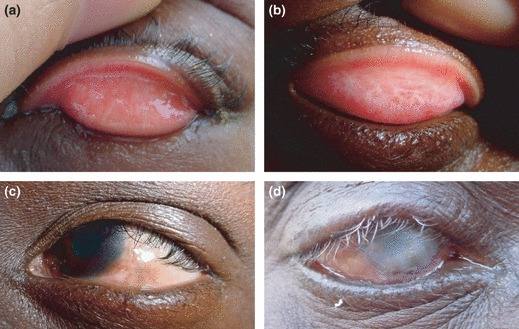
- TT follows repeated conjunctival Chlamydia trachomatis infection [S9].
- Trial definitions: one or more lashes touching the globe or evidence of epilation, with tarsal conjunctival scarring [S6]. Minor TT was defined as fewer than six lashes touching the eye [S4].
- PTT was more common in older adults and in major (versus minor) trichiasis [S8].
Confirm it
- Count lashes touching the globe and look for evidence of epilation and tarsal conjunctival scarring [S6] [S12].
- Record visual acuity and corneal opacity; trials measured both [S3] [S4].
- Follow up after surgery to detect PTT: trials examined at 6 and 12 months [S6].
Manage it
Before acting on this section, check the national and local guidelines, product information and regulatory approvals that apply where you practise. See the medical disclaimer.
Tier A (primary care / community, trained epilator)
- Identify TT in the community and refer for surgery; community-based surgery increased uptake with comparable outcomes compared with health centres [S5].
- Epilation for minor TT: in a 1300-person Ethiopian RCT, epilation with good forceps by a trained person failed more often than surgery over 24 months (13.2% vs 2.2%) but gave comparable visual acuity and corneal outcomes [S3]. At four years, most epilation-only participants controlled their TT, with no difference in vision or corneal opacity change [S4]. The authors recommend surgery whenever possible, with epilation for those who decline or lack access [S3].
Tier B (trained TT surgeon or general eye clinic)
- Procedure: PLTR or BLTR are both WHO-recommended [S6]. In the Ethiopian RCT of 1000 participants, recurrent TT by 12 months was 22% after BLTR vs 13% after PLTR [S6]. In a real-world programme, 1-year PTT was 8.2% with PLTR vs 21.4% with BLTR [S11]. In the MTSS RCT (4914 participants), PTT did not differ meaningfully between BLTR with a 3 mm incision and PLTR, while a 5 mm BLTR incision increased PTT; the authors do not recommend changing the 3 mm incision [S10]. Continuing BLTR may be appropriate for surgeons already trained in it [S11].
- Sutures: absorbable sutures gave comparable outcomes to silk with less granuloma formation [S5].
- Lid clamp: reduced lid contour abnormalities and granuloma [S5].
- Azithromycin: single-dose oral azithromycin (1 g) reduced recurrence compared with topical tetracycline (6.9 vs 10.3 per 100 person-years), as reported in [S1]; treating household members added no benefit [S1]. Follow your national trachoma programme formulary.
- Not recommended: oral doxycycline 100 mg for 28 days did not reduce PTT (12% in both arms) and caused more adverse events [S7]; fluorometholone 0.1% twice daily for 4 weeks was safe but not efficacious or cost-effective (PTT 13.4% in both arms) [S12].
Tier C (specialist centre or programme lead)
- Managing PTT: the literature is sparse and no management guidelines exist; good PTT outcomes probably require enhanced training of a smaller group of highly skilled surgeons [S9].
- Programme quality: periodic surgeon training, close follow-up and health education are recommended [S8]. Only one trial has reported cumulative PTT below 10% at one year [S9].
Refer when
| Situation | Urgency |
|---|---|
| TT with corneal ulcer or sudden vision loss | Urgent; timing per your local service or specialist advice |
| Any TT, including minor TT in people willing to have surgery | Routine, at the next surgical outreach [S3] [EIC expert opinion] |
| Postoperative trichiasis | Routine to an experienced TT surgeon [S9]; timing per your local service or specialist advice |
Pitfalls
- Using a 5 mm BLTR incision: more PTT [S10].
- Prescribing doxycycline or fluorometholone to prevent PTT [S7] [S12].
- Overlooking women in case-finding [S2].
- Offering epilation as the first choice when surgery is accessible [S3].
Evidence notes
| Source | Date | Design |
|---|---|---|
| [S1] | 2006 | RCT, 1452 patients, Ethiopia |
| [S2] | 2009 | Meta-analysis of 24 prevalence surveys, 12 countries |
| [S3] | 2011 | Non-inferiority RCT, 1300 participants, Ethiopia |
| [S4] | 2015 | Four-year follow-up of [S3] |
| [S5] | 2015 | Cochrane review, 13 RCTs, 8586 participants |
| [S6] | 2016 | RCT, 1000 participants, Ethiopia |
| [S7] | 2018 | RCT, 1000 participants, Ethiopia |
| [S8] | 2023 | Meta-analysis, 18 studies |
| [S9] | 2024 | Systematic review |
| [S10] | 2024 | Three-arm RCT, 4914 participants, Ethiopia |
| [S11] | 2025 | Non-randomised comparison in a programme |
| [S12] | 2026 | RCT, 2410 participants, Ethiopia |
- Conflict to check: the Cochrane review pooled two older studies favouring bilamellar over "unilamellar" rotation [S5], whereas later trials favour PLTR or show equivalence [S6] [S10] [S11]; the abstract does not define the unilamellar procedure.
- [S11] was not randomised; PLTR surgeons were less experienced and operated on more severe lids.
- Most trials come from Ethiopia, which may limit generalisability.
- No trial was designed to show that surgery prevents blindness, although several found modest improvement in vision [S5].
- Funding: Wellcome Trust [S6] [S7]; National Eye Institute and AbbVie [S12].
- Not covered by these sources: surgical training curricula, anaesthesia, lower lid TT, argon laser and electrolysis.
Related articles
References
See the numbered source list below. Each marker [S#] links to its PubMed and DOI record.
Sources
- [S1] West SK, West ES, Alemayehu W, Melese M, Munoz B, Imeru A, et al. Single-dose azithromycin prevents trichiasis recurrence following surgery: randomized trial in Ethiopia. Archives of ophthalmology (Chicago, Ill. : 1960). (2006). PubMed 16534049 · doi:10.1001/archopht.124.3.309
- [S2] Cromwell EA, Courtright P, King JD, Rotondo LA, Ngondi J, Emerson PM The excess burden of trachomatous trichiasis in women: a systematic review and meta-analysis. Transactions of the Royal Society of Tropical Medicine and Hygiene. (2009). PubMed 19362326 · doi:10.1016/j.trstmh.2009.03.012
- [S3] Rajak SN, Habtamu E, Weiss HA, Kello AB, Gebre T, Genet A, et al. Surgery versus epilation for the treatment of minor trichiasis in Ethiopia: a randomised controlled noninferiority trial. PLoS medicine. (2011). PubMed 22180731 · doi:10.1371/journal.pmed.1001136
- [S4] Habtamu E, Rajak SN, Tadesse Z, Wondie T, Zerihun M, Guadie B, et al. Epilation for minor trachomatous trichiasis: four-year results of a randomised controlled trial. PLoS neglected tropical diseases. (2015). PubMed 25768796 · doi:10.1371/journal.pntd.0003558
- [S5] Burton M, Habtamu E, Ho D, Gower EW Interventions for trachoma trichiasis. The Cochrane database of systematic reviews. (2015). PubMed 26568232 · doi:10.1002/14651858.cd004008.pub3
- [S6] Habtamu E, Wondie T, Aweke S, Tadesse Z, Zerihun M, Zewudie Z, et al. Posterior lamellar versus bilamellar tarsal rotation surgery for trachomatous trichiasis in Ethiopia: a randomised controlled trial. The Lancet. Global health. (2016). PubMed 26774708 · doi:10.1016/s2214-109x(15)00299-5
- [S7] Habtamu E, Wondie T, Aweke S, Tadesse Z, Zerihun M, Gashaw B, et al. Oral doxycycline for the prevention of postoperative trachomatous trichiasis in Ethiopia: a randomised, double-blind, placebo-controlled trial. The Lancet. Global health. (2018). PubMed 29653629 · doi:10.1016/s2214-109x(18)30111-6
- [S8] Adimassu NF, Assem AS, Fekadu SA Postoperative trachomatous trichiasis: a systematic review and meta-analysis study. International health. (2023). PubMed 36852770 · doi:10.1093/inthealth/ihad014
- [S9] Kreis AJ, Gower EW, Kropp M, Kello AB, Nouhoum G, Resnikoff S, et al. The prevention and management of postoperative trachomatous trichiasis: A systematic review. Survey of ophthalmology. (2024). PubMed 36878359 · doi:10.1016/j.survophthal.2023.02.008
- [S10] Gower EW, Sisay A, Bayissasse B, Seyum D, Weaver J, Munoz B, et al. The impact of modified incision height and surgical procedure on trichiasis surgery outcomes: Results of the maximizing trichiasis surgery success (MTSS) randomized trial. PLoS neglected tropical diseases. (2024). PubMed 39226693 · doi:10.1371/journal.pntd.0012034
- [S11] Kempen JH, Chen Y, Abashawl A, Mohammed AA, Dodson S, Alemayehu W, et al. Outcomes of posterior lamellar tarsal rotation vs bilamellar tarsal rotation for trachomatous trichiasis. PLoS neglected tropical diseases. (2025). PubMed 40737343 · doi:10.1371/journal.pntd.0013152
- [S12] Kempen JH, Abashawl A, Mohammed AA, Dodson S, Alemayehu W, Jin F, et al. Evaluation of fluorometholone as adjunctive medical therapy for trachomatous trichiasis surgery (FLAME): a parallel, double-blind, randomised controlled field trial in the Jimma Zone, Ethiopia. The Lancet. Global health. (2026). PubMed 41539314 · doi:10.1016/s2214-109x(25)00493-0