Educational content only. Not personalised medical advice. Clinical decisions remain the responsibility of the treating clinician.
Drug-induced optic neuropathy: ethambutol, linezolid and amiodarone
Several systemic drugs can damage the optic nerve. Ethambutol and linezolid, both central to tuberculosis (TB) treatment, cause dose- and duration-related optic neuropathy [S5] [S11], and amiodarone has been associated with optic neuropathy, mainly in case reports and pharmacovigilance data [S1] [S2]. Early recognition and prompt stopping of the drug, in agreement with the prescriber, give the best chance of visual recovery [S9] [S12].
Key points - Ethambutol optic neuropathy (EON) had a pooled incidence of 1.54% in a 2026 meta-analysis; renal impairment and hypertension were significant risk factors [S12]. - Extending ethambutol beyond 2 months increases optic nerve toxicity [S7]; revised TB programmes using fixed-dose combinations and longer ethambutol use are expected to increase cases [S5]. - Linezolid optic neuropathy appears after long-term use, usually beyond 28 days [S3] [S11]; only 66.7% of 67 reported cases recovered complete visual function [S8]. - In the ZeNix RCT, optic neuropathy occurred in 9% of participants given linezolid 1200 mg daily for 26 weeks (all resolved), and the 600 mg for 26 weeks regimen had the best risk-benefit balance, as reported in [S6]. - For amiodarone, a large RCT found that bilateral vision loss occurs infrequently, if at all, at commonly used doses [S1], while case reports describe optic disc oedema and legal blindness in some cases [S2].
Evidence last checked: 2026-10-17 (PubMed abstracts).
Red flags
- Any new loss of vision, colour vision or visual field in a patient on ethambutol or linezolid [S5] [S8].
- Ethambutol in a patient with renal impairment or hypertension [S12].
- Linezolid for more than 28 days, at higher doses, in younger patients or with high cumulative doses [S3] [S10].
- Optic disc oedema in a patient on amiodarone [S2].
Recognise it
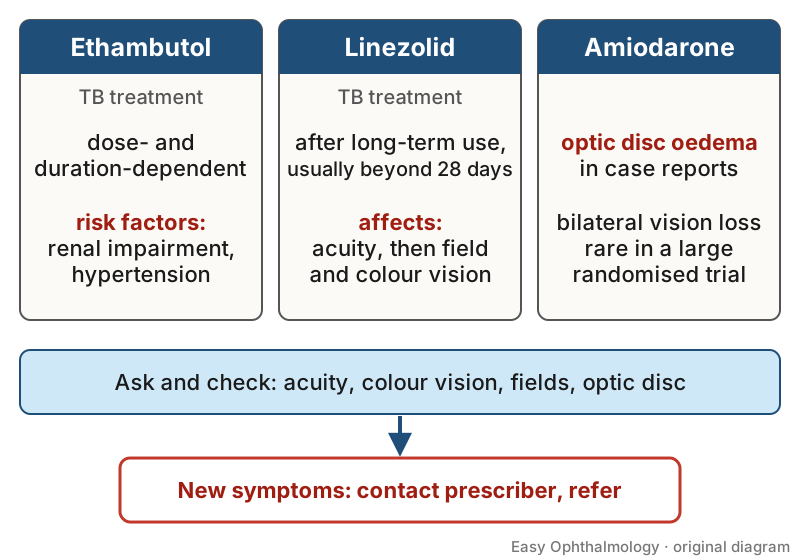
- Ethambutol. Toxicity is dose- and duration-dependent and may cause permanent vision loss [S5]. Younger age and earlier discontinuation were associated with better recovery [S12].
- Linezolid. Vision loss most often affects visual acuity, then visual field and colour vision [S8]. In a review of 33 cases, symptoms began after more than 28 days in 90.6% of documented cases, with a mean of 8.5 months of exposure [S3]. Peripheral neuropathy and haematological toxicity are other main adverse reactions [S11]. Pharmacovigilance data link optic nerve disorders to age under 60 and cumulative doses of 720 mg/kg or more [S10].
- Amiodarone. In 296 reports, mean duration of therapy before vision loss was 9 months; onset was insidious in 44%, nearly one third were asymptomatic, and disc oedema was present in 85% [S2]. Vortex keratopathy is the commonest ocular effect overall [S4].
Confirm it
- Use visual acuity, colour vision, visual fields, OCT and visual evoked potentials (VEP) as outcome and diagnostic measures [S7].
- VEP detected subclinical changes better than OCT in a meta-analysis [S12].
- The Indian expert consensus focuses on early suspicion through screening at the physician's office, opportunistic screening by ophthalmologists and specific clinical biomarkers [S5].
Manage it
Before acting on this section, check the national and local guidelines, product information and regulatory approvals that apply where you practise. See the medical disclaimer.
Tier A (primary care / TB programme / no specialist)
- Ask every patient on ethambutol or linezolid about blurred vision and colour change at each visit, and test visual acuity where possible [S5] [S3].
- Tell patients and health workers about vision-threatening adverse effects [S5].
- If vision symptoms appear, contact the prescriber about stopping the drug and refer [S5] [S3].
- Dosing is not covered here beyond the trial figures above: follow national TB guidelines and local formularies.
Tier B (general eye clinic)
- Examine acuity, colour vision, fields and the optic disc, and document a baseline for patients on long courses [S3] [S7].
- Recovery after ethambutol is stopped. In a cohort of 35 eyes, 77.1% recovered, with a mean estimated recovery time of 15.2 months; delay from symptom onset to discontinuation beyond 14 days was linked with slower recovery [S9]. Follow patients for 1 to 2 years or more [S9].
- Visual acuity improved significantly after stopping ethambutol, but colour vision and fields did not improve in the same way [S7].
- Linezolid. Withdrawal was followed by clinical improvement in 93.9% of 33 cases [S3], though complete recovery was less frequent in drug-resistant TB [S8].
- Report suspected cases to the national pharmacovigilance programme, as the Indian consensus describes [S5].
Tier C (specialist centre)
- Use VEP and OCT to detect subclinical toxicity in high-risk patients [S12].
- Support therapeutic drug monitoring and intensive monitoring for linezolid regimens [S11].
- Amiodarone. Annual incidence estimates from case reports were not confirmed in an RCT (837 amiodarone vs 832 placebo), in which no participant left the study because of bilateral vision loss; mean dose was 3.7 mg/kg (300 mg) daily, as reported in [S1]. Collaboration between the prescribing physician and eye care is important [S4].
Refer when
| Situation | Urgency |
|---|---|
| Reduced vision, colour vision or field on ethambutol or linezolid | Urgent, with prompt contact with the prescriber [S9]; timing per your local service or specialist advice |
| Optic disc oedema or vision loss on amiodarone | Urgent [S2]; timing per your local service or specialist advice |
| Long-term linezolid or extended ethambutol, no symptoms | Routine follow-up during treatment, especially courses beyond 28 days [S3] [S8] |
Pitfalls
- Assuming ethambutol toxicity always reverses: recovery occurred in 52.4% of clinical cases in a meta-analysis [S12].
- Delaying discontinuation after symptoms begin [S9].
- Missing linezolid toxicity because the dose is low: optic neuropathy has occurred regardless of the dose [S3].
- Attributing every optic neuropathy on amiodarone to the drug; the RCT evidence suggests it is rare [S1].
Evidence notes
| Source | Date | Design |
|---|---|---|
| [S1] | 2007 | RCT secondary end point, 837 vs 832 participants |
| [S2] | 2012 | Review of FAERS and published case reports (296 reports) |
| [S3] | 2019 | Systematic review of 33 cases |
| [S4] | 2020 | Systematic review of 25 case reports |
| [S5] | 2021 | Expert panel consensus (India) |
| [S6] | 2022 | RCT (ZeNix), 181 participants |
| [S7] | 2023 | Systematic review of 12 studies |
| [S8] | 2023 | Review of 67 reported cases |
| [S9] | 2024 | Retrospective cohort, 35 eyes |
| [S10] | 2025 | Pharmacovigilance disproportionality analysis (FAERS) |
| [S11] | 2025 | Systematic review of 7 studies |
| [S12] | 2026 | Systematic review and meta-analysis, 22 studies |
- Conflict on linezolid dose: one case review concluded optic neuropathy occurs regardless of dose [S3], whereas other sources found dose- and duration-dependence [S8] [S10] [S11].
- Conflict on amiodarone: case and pharmacovigilance reports describe optic neuropathy [S2], but the RCT found bilateral vision loss infrequent, if it occurs at all [S1].
- Pooled EON incidence had very high heterogeneity (I² = 98.2%) [S12]. Much of the evidence is case-based or observational.
- The ZeNix trial was funded by the TB Alliance and others [S6].
- Not covered by these sources: ethambutol dosing per kilogram, specific screening intervals, other drugs (for example tacrolimus or PDE5 inhibitors), and treatment of established toxic optic neuropathy.
Related articles
References
See the numbered source list below. Each marker [S#] links to its PubMed and DOI record.
Sources
- [S1] Mindel JS, Anderson J, Hellkamp A, Johnson G, Poole JE, Mark DB, et al. Absence of bilateral vision loss from amiodarone: a randomized trial. American heart journal. (2007). PubMed 17452162 · doi:10.1016/j.ahj.2007.02.010
- [S2] Passman RS, Bennett CL, Purpura JM, Kapur R, Johnson LN, Raisch DW, et al. Amiodarone-associated optic neuropathy: a critical review. The American journal of medicine. (2012). PubMed 22385784 · doi:10.1016/j.amjmed.2011.09.020
- [S3] Brandariz-Núñez D, Hernández-Corredoira V, Guarc-Prades E, García-Navarro B Optic neuropathy associated with linezolid: systematic review of cases. Farmacia hospitalaria : organo oficial de expresion cientifica de la Sociedad Espanola de Farmacia Hospitalaria. (2019). PubMed 30848179 · doi:10.7399/fh.11133
- [S4] Alshehri M, Joury A Ocular Adverse Effects of Amiodarone: A Systematic Review of Case Reports. Optometry and vision science : official publication of the American Academy of Optometry. (2020). PubMed 32697562 · doi:10.1097/opx.0000000000001534
- [S5] Saxena R, Singh D, Phuljhele S, Kalaiselvan V, Karna S, Gandhi R, et al. Ethambutol toxicity: Expert panel consensus for the primary prevention, diagnosis and management of ethambutol-induced optic neuropathy. Indian journal of ophthalmology. (2021). PubMed 34827033 · doi:10.4103/ijo.ijo_3746_20
- [S6] Conradie F, Bagdasaryan TR, Borisov S, Howell P, Mikiashvili L, Ngubane N, et al. Bedaquiline-Pretomanid-Linezolid Regimens for Drug-Resistant Tuberculosis. The New England journal of medicine. (2022). PubMed 36053506 · doi:10.1056/nejmoa2119430
- [S7] Sabhapandit S, Gella V, Shireesha A, Thankachan L, Ismail M, Rao R, et al. Ethambutol optic neuropathy in the extended anti-tubercular therapy regime: A systematic review. Indian journal of ophthalmology. (2023). PubMed 36872667 · doi:10.4103/ijo.ijo_1920_22
- [S8] Miller HV, Cao AA, McClelland CM, Lee MS Linezolid optic neuropathy. Current opinion in ophthalmology. (2023). PubMed 37603423 · doi:10.1097/icu.0000000000000995
- [S9] An HR, Lee BJ, Moon Y Visual Recovery Time in Patients with Ethambutol-induced Toxic Optic Neuropathy. Korean journal of ophthalmology : KJO. (2024). PubMed 38351490 · doi:10.3341/kjo.2023.0095
- [S10] Nakano Y, Miyazaki M, Fukuyama A, Hasuwa H, Imakyure O Linezolid-related Optic Nerve Disorders: Insight From a Pharmacovigilance Analysis of the US FDA Adverse Event Reporting System. Open forum infectious diseases. (2025). PubMed 40980569 · doi:10.1093/ofid/ofaf520
- [S11] Oktaviani E, Anggadiredja K, Amalia L Adverse Drug Reaction to Linezolid in Drug-Resistant Tuberculosis: A Systematic Review. Medical sciences (Basel, Switzerland). (2025). PubMed 41562893 · doi:10.3390/medsci14010003
- [S12] Alessa AA, Awan AZ, Almutairi AB, Ajabnoor IG, Jan MMM, Azzam AY, et al. Neuro-ophthalmic complications of tuberculosis and its treatment: a systematic review and meta-analysis. Frontiers in ophthalmology. (2026). PubMed 42293031 · doi:10.3389/fopht.2026.1818640