Educational content only. Not personalised medical advice. Clinical decisions remain the responsibility of the treating clinician.
Chalazion and Hordeolum
A hordeolum is a common, painful, usually bacterial inflammation of the eyelid oil glands; internal hordeola involve the meibomian glands and external hordeola (styes) the glands of Zeis or Moll [S6] [S7]. A chalazion is a common eyelid mass caused by chronic inflammation of the sebaceous glands [S12]. Both are usually benign, but a lid nodule treated as a chalazion can hide a malignant tumour [S10].
Key points - Many hordeola drain spontaneously, often in about a week; recurrences are common [S6] [S7]. - No trials support or refute non-surgical treatments for acute internal hordeolum [S6]. - For chalazion, warm compresses and lid hygiene are first line, but complete resolution with conservative treatment alone was 18% in one RCT [S8] [S12]. - Incision and curettage (I&C) is more effective than steroid injection after one procedure, with the gap narrowing after one or two attempts [S5].
Evidence last checked: 2026-10-17 (PubMed abstracts).
Red flags
- Recurrent or atypical "chalazion": a nodular lid thickening treated as chalazion can be a malignant neoplasm [S10].
- Spreading redness and swelling: an unresolved internal hordeolum can progress to generalised eyelid cellulitis [S7]; see the orbital and preseptal cellulitis article.
- Steroid injection in pigmented skin: skin depigmentation is relatively common [S1].
Recognise it
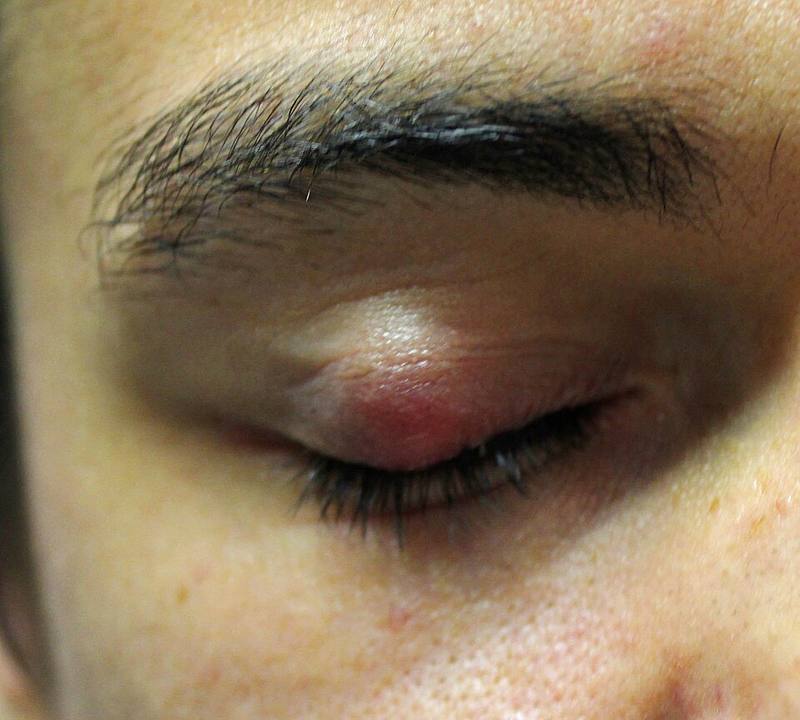
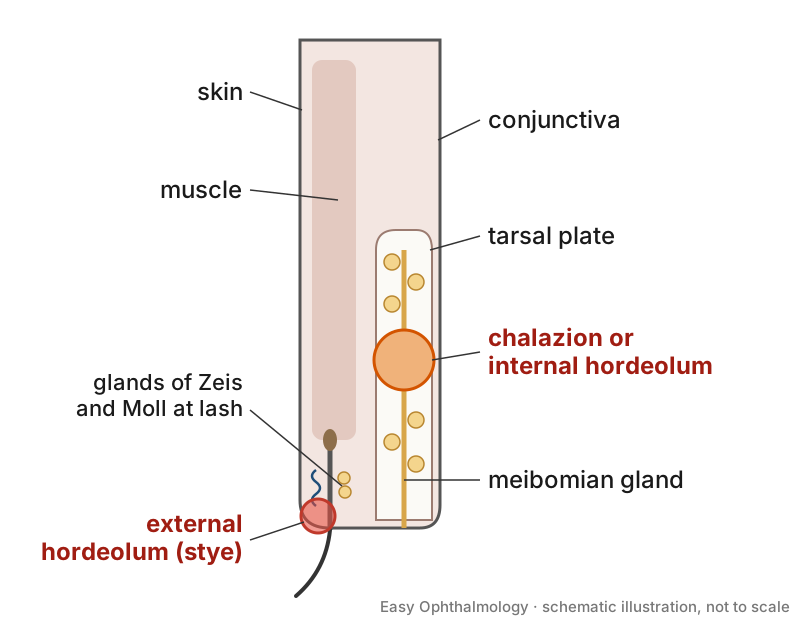
- Hordeolum: acute, painful, purulent inflammation of the lid margin [S7]. It is infectious, whereas a chalazion is not [S10].
- Chalazion: a lid mass from retained meibomian or Zeis gland secretion, seen in all age groups [S11] [S12]. An unresolved internal hordeolum can become chronic or develop into a chalazion [S6].
- Children: consider underlying vitamin A deficiency, Demodex infestation or rosacea [S12].
Confirm it
- Diagnosis is clinical [S10].
- Send tissue for histology when the lesion is recurrent or atypical, because a malignant tumour can masquerade as a chalazion [S10]. Steroid injection is suited to cases where the diagnosis is straightforward and no biopsy is required [S4].
Manage it
Before acting on this section, check the national and local guidelines, product information and regulatory approvals that apply where you practise. See the medical disclaimer.
Tier A (primary care / no specialist)
- Hordeolum: expect spontaneous drainage in many cases [S6]. Warm compresses, lid scrubs, antibiotics and steroids are used but are unproven by trials [S6]. Acupuncture trials from China gave low to very low certainty evidence of short-term benefit [S7].
- Chalazion: warm compresses and lid hygiene first [S12]. In a 149-patient RCT, adding tobramycin or tobramycin/dexamethasone to hot compresses did not improve resolution (21%, 16% and 18% complete resolution; no significant difference) [S8].
- Refer lesions that persist beyond about 2 months: older lesions were less likely to resolve conservatively [S8].
Tier B (general eye clinic)
Intralesional triamcinolone (steroid injection) - In an RCT of 94 patients after failed conservative treatment, 4 mg triamcinolone gave 81% complete resolution vs 79% with I&C, as reported in [S4]; average time to resolution was 5 days [S4]. - A three-arm RCT (136 patients) found 0.2 mL of 10 mg/mL triamcinolone almost as effective as I&C (84% vs 87%) with less pain and inconvenience; hot compresses alone resolved 46%, as reported in [S3]. - An RCT from Nepal (118 patients) found triamcinolone as effective as I&C for medium and large chalazia [S9]. An RCT from Pakistan (141 patients) found 62% success after one injection vs 79% after surgery, rising to 80% vs 89% after a second treatment, with depigmentation relatively common in pigmented skin [S1]. - Extralesional subcutaneous triamcinolone (0.3 mL of 10 mg/mL) outperformed conservative treatment (93.8% vs 58.3%) in a small RCT, as reported in [S2].
Incision and curettage - A meta-analysis of 8 RCTs: I&C succeeded in 78.0% after one procedure vs 60.4% for one steroid injection; complication rates did not differ [S5]. - Surgical excision remains effective for persistent lesions in children [S12].
Tier C (specialist centre)
- Recurrent or atypical lesions: biopsy and histology [S10].
- Children: topical antibiotics and steroids show mixed results with potential adverse effects; probiotics, omega-3 and intense pulsed light are experimental [S12].
Refer when
| Situation | Urgency |
|---|---|
| Lid swelling with spreading redness, fever, proptosis or reduced vision | Same-day [G1] |
| Recurrent chalazion in the same site, lash loss or ulceration (possible malignancy) | Suspected-cancer pathway referral, for biopsy [S10] [EIC expert opinion] |
| Chalazion persisting more than 2 months despite compresses | Routine, within weeks, for injection or I&C [S8] |
Pitfalls
- Repeating antibiotic drops for chalazion: no added benefit over hot compresses [S8].
- Injecting steroid where biopsy is needed [S4] [S10].
- Not warning patients with pigmented skin about depigmentation [S1].
- Missing systemic or skin associations in children [S12].
Evidence notes
| Source | Date | Design |
|---|---|---|
| [S1] | 2006 | Comparative RCT, Pakistan |
| [S2] | 2006 | Small RCT, 28 patients, Hong Kong |
| [S3] | 2007 | Three-arm RCT, 136 patients |
| [S4] | 2011 | RCT, 94 patients |
| [S5] | 2016 | Meta-analysis of 8 RCTs |
| [S6] | 2017 | Cochrane review, no trials found |
| [S7] | 2017 | Cochrane review, 6 RCTs from China |
| [S8] | 2018 | Multicentre RCT, 149 patients |
| [S9] | 2018 | RCT, 118 patients, Nepal |
| [S10] | 2022 | Narrative review (ophthalmic pathology) |
| [S11] | 2025 | Scoping review, 39 studies |
| [S12] | 2025 | Scoping review, children |
- Definitions of resolution vary widely between chalazion studies [S11], so success rates are not directly comparable.
- The acupuncture trials lacked a valid sham control and had short follow-up [S7].
- Three-arm RCT outcomes were collected by telephone at 3 weeks [S3].
- Not covered by these sources: external hordeolum (stye) treatment trials, anaesthesia for I&C, and steroid-related intraocular pressure risk beyond the trial reports.
Related articles
References
See the numbered source list below. Each marker [S#] links to its PubMed and DOI record.
Sources
- [S1] Ahmad S, Baig MA, Khan MA, Khan IU, Janjua TA Intralesional corticosteroid injection vs surgical treatment of chalazia in pigmented patients. Journal of the College of Physicians and Surgeons--Pakistan : JCPSP. (2006). PubMed 16441988
- [S2] Chung CF, Lai JS, Li PS Subcutaneous extralesional triamcinolone acetonide injection versus conservative management in the treatment of chalazion. Hong Kong medical journal = Xianggang yi xue za zhi. (2006). PubMed 16912354
- [S3] Goawalla A, Lee V A prospective randomized treatment study comparing three treatment options for chalazia: triamcinolone acetonide injections, incision and curettage and treatment with hot compresses. Clinical & experimental ophthalmology. (2007). PubMed 17997772 · doi:10.1111/j.1442-9071.2007.01617.x
- [S4] Ben Simon GJ, Rosen N, Rosner M, Spierer A Intralesional triamcinolone acetonide injection versus incision and curettage for primary chalazia: a prospective, randomized study. American journal of ophthalmology. (2011). PubMed 21257145 · doi:10.1016/j.ajo.2010.10.026
- [S5] Aycinena AR, Achiron A, Paul M, Burgansky-Eliash Z Incision and Curettage Versus Steroid Injection for the Treatment of Chalazia: A Meta-Analysis. Ophthalmic plastic and reconstructive surgery. (2016). PubMed 26035035 · doi:10.1097/iop.0000000000000483
- [S6] Lindsley K, Nichols JJ, Dickersin K Non-surgical interventions for acute internal hordeolum. The Cochrane database of systematic reviews. (2017). PubMed 28068454 · doi:10.1002/14651858.cd007742.pub4
- [S7] Cheng K, Law A, Guo M, Wieland LS, Shen X, Lao L Acupuncture for acute hordeolum. The Cochrane database of systematic reviews. (2017). PubMed 28181687 · doi:10.1002/14651858.cd011075.pub2
- [S8] Wu AY, Gervasio KA, Gergoudis KN, Wei C, Oestreicher JH, Harvey JT Conservative therapy for chalazia: is it really effective? Acta ophthalmologica. (2018). PubMed 29338124 · doi:10.1111/aos.13675
- [S9] Singhania R, Sharma N, Vashisht S, Dewan T Intralesional Triamcinolone Acetonide (TA) Versus Incision and Curettage (I & C) for Medium and Large Size Chalazia. Nepalese journal of ophthalmology : a biannual peer-reviewed academic journal of the Nepal Ophthalmic Society : NEPJOPH. (2018). PubMed 31056570 · doi:10.3126/nepjoph.v10i1.21661
- [S10] Weller JM, Messmer E Focus on Ophthalmopathology - Orbital Infections from Hordeolum to Necrotizing Fasciitis. Klinische Monatsblatter fur Augenheilkunde. (2022). PubMed 35858598 · doi:10.1055/a-1709-6152
- [S11] Park JK, Vyas C, Dagi Glass LR Chalazia: A Scoping Review to Identify the Evidence Behind Treatments. Ophthalmic plastic and reconstructive surgery. (2025). PubMed 39656051 · doi:10.1097/iop.0000000000002840
- [S12] Kornhauser T, Elhusseiny AM, Pemberton JD Management strategies for chalazia in pediatric patients: A scoping review. European journal of ophthalmology. (2025). PubMed 40156262 · doi:10.1177/11206721251330146
Guidelines
- [G1] NHS Scotland (Community Eyecare Guidelines, eyes.nhs.scot). 2.2 Cellulitis, Orbital (2026). https://www.eyes.nhs.scot/eyecare-guidelines/section-2-orbitlacrimal-system/22-cellulitis-orbital/