Educational content only. Not personalised medical advice. Clinical decisions remain the responsibility of the treating clinician.
Eyelid Tumours: Basal Cell Carcinoma and Beyond
Between 5% and 10% of cutaneous malignancies occur around the eye; basal cell carcinoma (BCC) is the most common, followed by squamous cell carcinoma (SCC), sebaceous carcinoma, melanoma and Merkel cell carcinoma [S2]. Periocular cancers can invade the orbit, sinuses and brain, so timely diagnosis matters [S2]. Malignant tumours are much less frequent than benign lid lesions and are often overlooked [S10].
Key points - Every eyelid lesion suspected of malignancy should be examined histologically [S10]. - Surgical excision with tumour-free margins is the gold standard; margin-controlled techniques such as Mohs surgery are preferred for most non-melanoma skin cancers [S10] [S2]. - BCC rarely metastasises, but SCC, sebaceous carcinoma, melanoma and Merkel cell carcinoma need staging for possible metastasis [S10]. - Sebaceous carcinoma and Merkel cell carcinoma are often mistaken for benign lesions such as chalazion [S8] [S5].
Evidence last checked: 2026-10-18 (PubMed abstracts).
Red flags
- Lesion misdiagnosed as benign: sebaceous carcinoma was correctly diagnosed at first presentation in only 42.8% of reported cases, with a mean diagnostic delay of 14.7 months [S8]. Merkel cell carcinoma may be mistaken for chalazion or BCC [S5].
- Medial canthal or recurrent tumours: high-risk disease [S4].
- Perineural invasion: a high-risk feature in all periocular cancers [S4]; SCC is characterised by perineural involvement and regional node metastasis in 10% to 25% [S1].
- Immunosuppression, including HIV: a significant risk factor for Merkel cell carcinoma [S5]; people living with HIV may have higher risk of SCC, Merkel cell and sebaceous carcinoma [S11].
Recognise it
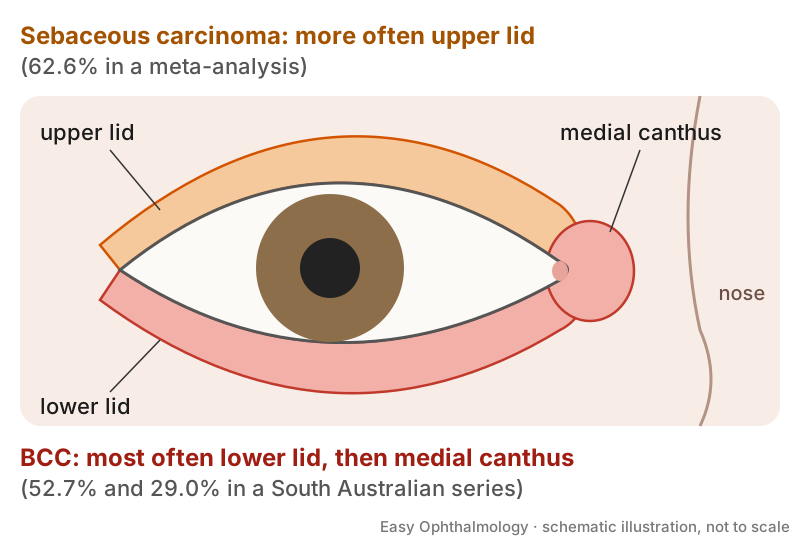
- BCC: in 1713 periocular BCCs from South Australia, 52.7% involved the lower lid and 29.0% the medial canthus; nodular was the main subtype (65.7%), and 25.6% had more than one subtype [S3].
- SCC: often mistaken for BCC [S7].
- Sebaceous carcinoma: usually in adults older than 60 [S6]; more common in women and on the upper lid (62.6%) [S8].
- Merkel cell carcinoma: a painless, expanding nodule, in older patients; mortality up to 40% [S5].
- Melanoma: less common but more deadly, with relatively high rates of metastasis and death [S7].
- History and inspection give initial indications of malignancy [S10].
Confirm it
- Biopsy any suspicious lesion for histology [S10]. In sebaceous carcinoma, deep biopsy is often required and special stains exclude mimics [S6].
- Conjunctival mapping biopsies help plan surgery for sebaceous carcinoma [S6].
- Staging for SCC, sebaceous carcinoma, melanoma and Merkel cell carcinoma [S10]; sentinel lymph node biopsy helps detect early regional spread in sebaceous carcinoma, melanoma and Merkel cell carcinoma [S4] [S5].
Manage it
Before acting on this section, check the national and local guidelines, product information and regulatory approvals that apply where you practise. See the medical disclaimer.
Tier A (primary care / no specialist)
- Recognising periocular skin cancer is an important primary care skill, as prompt diagnosis can save sight or life [S7].
- Refer any non-healing, growing or recurrent lid lesion, or "chalazion" that recurs, for biopsy [S8] [S10].
- Offer HIV-positive patients skin examination; screening is generally recommended, though guidelines vary [S11].
Tier B (general eye clinic)
- Biopsy suspicious lesions [S10]. BCC should be excised promptly [S7].
- Where Mohs or frozen-section control is not available, excision with safety margins is used: in a Tunisian series of 114 operated lesions, margins were 4 mm in 63.2% and 5 to 6 mm in 34.2%, excision was incomplete in 16.7%, and recurrence occurred in 6.1% [S9]. Oncological outcome depends on surgical quality [S9].
- Because mixed BCC with aggressive subtypes is common, margin-controlled excision should be considered [S3].
Tier C (specialist centre)
- Margin control: Mohs surgery gives the greatest success in complete excision of BCC and SCC, especially high-risk medial canthal and recurrent disease [S4]. Mohs or excision with frozen sections is the standard for periocular SCC [S1].
- Sebaceous carcinoma: surgery with peripheral and deep margin assessment is first line; radiotherapy for nerve or node involvement or for patients unfit for surgery; examination every 6 months for at least 3 years, as reported in the guideline [S6]. Outcomes did not differ significantly between wide local excision and Mohs [S8]. Overall recurrence, metastasis and tumour-related mortality were 15.9%, 12.1% and 6.2% [S8].
- Merkel cell carcinoma: wide local excision, commonly with radiotherapy [S5].
- Reconstruction: eyelid repair often involves both anterior and posterior lamellae [S9].
- Advanced disease: checkpoint inhibitors (PD-1, PD-L1) and hedgehog inhibitors are used for unresectable or metastatic disease [S12]; no specific systemic therapy can yet be recommended for advanced sebaceous carcinoma [S6].
- Care is increasingly multidisciplinary, with long-term surveillance [S12].
Refer when
| Situation | Urgency |
|---|---|
| Suspected melanoma, Merkel cell or sebaceous carcinoma | Urgent; timing per your local service or specialist advice |
| Tumour with orbital signs (proptosis, restricted movement), or perineural symptoms | Urgent [S2] [S4]; timing per your local service or specialist advice |
| Suspected BCC | Routine, for prompt excision [S7]; timing per your local service or specialist advice |
Pitfalls
- Treating a recurrent "chalazion" repeatedly without histology [S8] [S5].
- Assuming all BCC is low risk: aggressive subtypes are common in mixed tumours [S3].
- Incomplete excision when margins cannot be checked [S9].
- Forgetting surveillance after sebaceous carcinoma [S6].
Evidence notes
| Source | Date | Design |
|---|---|---|
| [S1] | 2008 | Case report and literature review |
| [S2] | 2012 | Literature review |
| [S3] | 2014 | Retrospective histology series, 1713 specimens |
| [S4] | 2017 | Narrative review |
| [S5] | 2019 | Review of published cases |
| [S6] | 2019 | Evidence-based guideline (expert panel after systematic review) |
| [S7] | 2020 | Narrative review |
| [S8] | 2021 | Meta-analysis of observational studies, 1333 patients |
| [S9] | 2023 | Retrospective case series, Tunisia |
| [S10] | 2024 | Narrative review |
| [S11] | 2026 | Narrative review, HIV |
| [S12] | 2026 | Narrative review |
- No RCTs exist in this set; evidence is guideline, observational and review level.
- The South Australian BCC data [S3] come from one Australian population and may not apply elsewhere.
- Not covered by these sources: recommended excision margins by tumour type, conjunctival or ocular surface squamous neoplasia, cryotherapy and topical treatments in detail, and benign lesion management.
Related articles
References
See the numbered source list below. Each marker [S#] links to its PubMed and DOI record.
Sources
- [S1] Thosani MK, Schneck G, Jones EC Periocular squamous cell carcinoma. Dermatologic surgery : official publication for American Society for Dermatologic Surgery [et al.]. (2008). PubMed 18248482 · doi:10.1111/j.1524-4725.2007.34115.x
- [S2] Slutsky JB, Jones EC Periocular cutaneous malignancies: a review of the literature. Dermatologic surgery : official publication for American Society for Dermatologic Surgery [et al.]. (2012). PubMed 22404129 · doi:10.1111/j.1524-4725.2012.02367.x
- [S3] Wu A, Sun MT, Huilgol SC, Madge S, Selva D Histological subtypes of periocular basal cell carcinoma. Clinical & experimental ophthalmology. (2014). PubMed 24533627 · doi:10.1111/ceo.12298
- [S4] Allen RC Surgical Management of Periocular Cancers: High- and Low-Risk Features Drive Treatment. Current oncology reports. (2017). PubMed 28735439 · doi:10.1007/s11912-017-0618-1
- [S5] North VS, Habib LA, Yoon MK Merkel cell carcinoma of the eyelid: A review. Survey of ophthalmology. (2019). PubMed 30871952 · doi:10.1016/j.survophthal.2019.03.002
- [S6] Owen JL, Kibbi N, Worley B, Kelm RC, Wang JV, Barker CA, et al. Sebaceous carcinoma: evidence-based clinical practice guidelines. The Lancet. Oncology. (2019). PubMed 31797796 · doi:10.1016/s1470-2045(19)30673-4
- [S7] Moran JM, Phelps PO Periocular skin cancer: Diagnosis and management. Disease-a-month : DM. (2020). PubMed 32600650 · doi:10.1016/j.disamonth.2020.101046
- [S8] Desiato VM, Byun YJ, Nguyen SA, Thiers BH, Day TA Sebaceous Carcinoma of the Eyelid: A Systematic Review and Meta-Analysis. Dermatologic surgery : official publication for American Society for Dermatologic Surgery [et al.]. (2021). PubMed 33347004 · doi:10.1097/dss.0000000000002660
- [S9] Zgolli H, Choura R, Elzarrug HKH, Abdelhedi C, Chebbi A Management of eyelids' primary malignancies. The Libyan journal of medicine. (2023). PubMed 37731362 · doi:10.1080/19932820.2023.2258668
- [S10] Gniesmer S, Sonntag SR, Schiemenz C, Ranjbar M, Heindl LM, Varde MA, et al. Diagnosis and treatment of malignant eyelid tumors. Die Ophthalmologie. (2024). PubMed 37851118 · doi:10.1007/s00347-023-01945-y
- [S11] Kosche C, Chio MT, Arron ST Skin cancer and human immunodeficiency virus. Clinics in dermatology. (2026). PubMed 41067545 · doi:10.1016/j.clindermatol.2025.09.014
- [S12] Banlin M, Goh MS, Khong JJ Contemporary Management of Malignant Eyelid Tumours: Surgical and Immunotherapeutic Advances. Clinical & experimental ophthalmology. (2026). PubMed 41603445 · doi:10.1111/ceo.70062