Educational content only. Not personalised medical advice. Clinical decisions remain the responsibility of the treating clinician.
Thyroid Eye Disease
Thyroid eye disease (Graves' orbitopathy) is the main extrathyroidal manifestation of Graves' disease and affects up to 50% of patients, with a large impact on quality of life [S5] [S6]. Treatment depends on clinical activity and severity [S5], and dysthyroid optic neuropathy can threaten sight [S7].
Key points - Assess activity and severity before choosing treatment; early referral to specialised centres is fundamental for most patients [S5]. - Mild active disease: control risk factors, local treatment and selenium in selenium-deficient areas are usually sufficient [S5]. - Moderate-to-severe active disease: the 2021 EUGOGO guideline recommends intravenous methylprednisolone with mycophenolate first line [S5]. - Teprotumumab improved proptosis, activity, diplopia and quality of life versus placebo in RCTs, with hyperglycaemia and hearing impairment as key risks [S4] [S10]. - Sight-threatening disease: high-dose intravenous methylprednisolone, then urgent orbital decompression if unresponsive [S5].
Evidence last checked: 2026-10-17 (PubMed abstracts).
Red flags
- Dysthyroid optic neuropathy (DON): sight-threatening; the guideline treats sight-threatening disease with several high single doses of intravenous methylprednisolone per week and urgent decompression if unresponsive [S5].
- Hyperglycaemia on teprotumumab, especially in people with diabetes [S10] [S4].
- Hearing impairment on teprotumumab [S10].
- Radioactive iodine planned in a patient with eye disease: low-dose oral prednisone prophylaxis is needed, especially with coexisting risk factors [S5].
Recognise it: risk factors and activity
- Risk factors: smoking, thyroid dysfunction, high thyrotropin receptor antibody levels, radioactive iodine treatment and hypercholesterolaemia [S5].
- Clinical Activity Score (CAS): scored 0 to 7; 3 or more indicates active disease in trials [S6]. A CAS of 0 or 1 indicates no or minimal inflammation [S4].
- Severity features used in trials include proptosis, lid width, diplopia and eye muscle motility [S2].
Confirm it
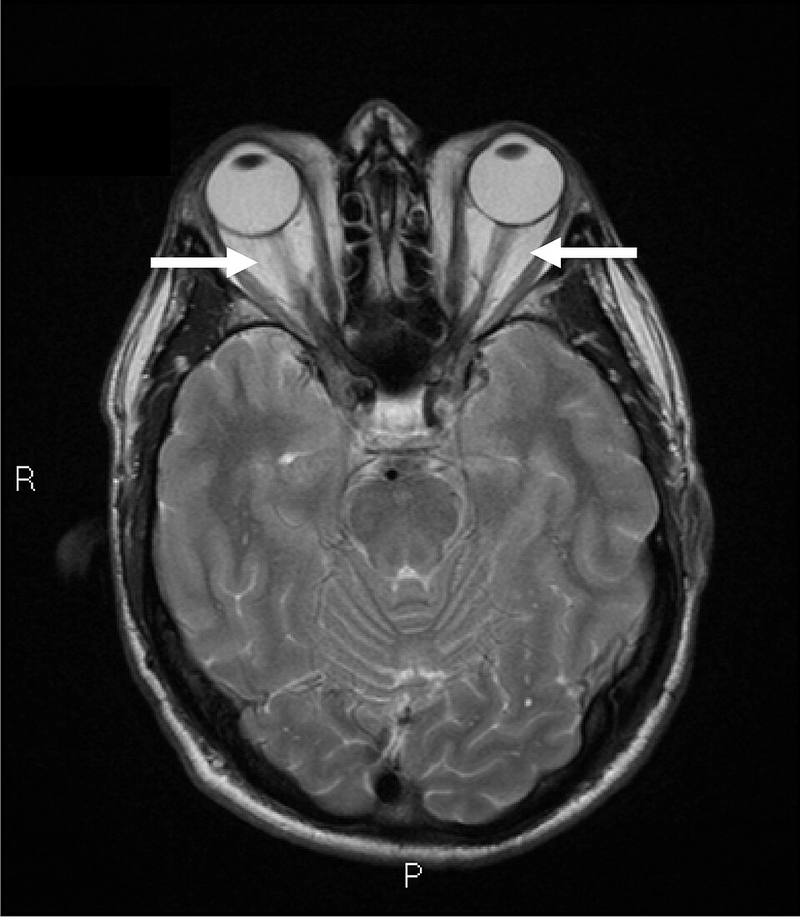
- Record CAS, proptosis (mm) and diplopia grade at each visit; these were the outcome measures in the main trials [S4].
- In DON, best corrected visual acuity, visual field mean deviation, proptosis and intraocular pressure were the outcomes compared in the meta-analysis [S7].
- Orbital imaging showed reductions in extraocular muscle or fat volume after teprotumumab in a subset of trial patients [S4]. Imaging protocols are not otherwise covered by these sources.
Manage it
Before acting on this section, check the national and local guidelines, product information and regulatory approvals that apply where you practise. See the medical disclaimer.
Tier A (primary care / no specialist)
- Ask about smoking and support stopping; smoking is a risk factor [S5].
- Help control thyroid function; for active moderate-to-severe or sight-threatening disease, antithyroid drugs are preferred for the hyperthyroidism [S5].
- Refer early: early referral to specialised centres is fundamental for most patients [S5].
- Refer on any loss of vision or colour vision [EIC expert opinion].
Tier B (general eye clinic)
- Mild active disease: control risk factors, local treatment and selenium in selenium-deficient areas [S5]. A meta-analysis of 4 RCTs found selenium lowered CAS at 6 months (MD -1.27) and improved quality of life and palpebral aperture, without effect on proptosis or motility [S8].
- Grade activity and severity to decide who needs systemic therapy [S5].
- Co-ordinate with the endocrinologist before radioactive iodine (steroid prophylaxis) [S5].
Tier C (specialist centre)
Active moderate-to-severe disease
- First line (guideline): intravenous methylprednisolone with mycophenolate sodium; the optimal methylprednisolone regimen is a cumulative 4.5 g in 12 weekly infusions, as reported in [S5]. Higher cumulative doses not exceeding 8 g may be used as monotherapy in the most severe cases, as reported in [S5]. Intravenous glucocorticoids are more effective and better tolerated than oral [S5].
- MINGO (RCT, 164 patients): methylprednisolone 500 mg weekly for 6 weeks then 250 mg weekly for 6 weeks, with or without mycophenolate 360 mg twice daily for 24 weeks, as reported in [S2]. Response at 12 weeks did not differ significantly (63% vs 49%); post hoc, response at 24 weeks (71% vs 53%) and sustained response at 36 weeks (67% vs 46%) favoured combination therapy [S2].
- Second-line options (guideline): a second methylprednisolone course (7.5 g), oral steroid with ciclosporin or azathioprine, orbital radiotherapy with steroids, teprotumumab, rituximab or tocilizumab [S5].
- Teprotumumab (IGF-IR inhibitor): in the OPTIC phase 3 RCT, proptosis response at week 24 was 83% vs 10% with placebo, with better diplopia and quality of life; funded by the manufacturer [S4]. A 2026 meta-analysis of 7 RCTs (438 participants) found a mean proptosis reduction of 2.46 mm, with higher risks of hyperglycaemia, muscle spasms, dry skin and hearing impairment [S10]. A network meta-analysis ranked teprotumumab highest for overall response and CAS, and mycophenolate plus intravenous steroid best for proptosis [S9].
- Tocilizumab: in a small RCT of 32 steroid-resistant patients (Spain), CAS improvement of at least 2 at week 16 occurred in 93.3% vs 58.8% with placebo [S3].
- Rituximab: a Cochrane review of 2 small RCTs found insufficient evidence to support its use [S6].
- Radiotherapy and azathioprine: in CIRTED (126 patients on 24 weeks of oral prednisolone), radiotherapy added no benefit and azathioprine showed benefit only in a post hoc analysis of completers [S1].
Dysthyroid optic neuropathy
- A meta-analysis of 17 studies found orbital decompression, or intravenous steroids plus decompression, may improve acuity and visual field more than intravenous steroids alone; the evidence level is low [S7].
Inactive disease
- Rehabilitative surgery (orbital decompression, squint and eyelid surgery) is indicated for inactive residual disease [S5].
Low-resource note: the guideline weighs cost, reimbursement and drug availability in its first-line choice [S5]; biologics may not be available or affordable, and steroid-based regimens remain the guideline foundation [S5].
Refer when
| Situation | Urgency |
|---|---|
| Reduced vision, colour vision or visual field (possible DON) | Immediate, same-day, to an orbit or neuro-ophthalmology service [EIC expert opinion] [S5] |
| Severe exposure keratopathy or corneal breakdown | Same-day [EIC expert opinion] |
| Active moderate-to-severe disease (CAS 3 or more with proptosis or diplopia) | Urgent; timing per your local service or specialist advice, to a specialised centre; EUGOGO advises early referral [S5] |
| Mild or inactive disease | Routine; timing per your local service or specialist advice, for specialist assessment [S5] |
Pitfalls
- Starting radioactive iodine without steroid prophylaxis in at-risk patients [S5].
- Overlooking smoking cessation [S5].
- Not checking glucose and hearing on teprotumumab [S10].
- Operating for rehabilitation while disease is still active [S5].
- Treating CAS alone: response definitions in trials combine CAS and proptosis [S4].
Evidence notes
| Source | Date | Design |
|---|---|---|
| [S1] | 2018 | RCT, 2 x 2 factorial (CIRTED), UK |
| [S2] | 2018 | Observer-masked RCT (MINGO) |
| [S3] | 2018 | Double-masked RCT, 32 patients |
| [S4] | 2020 | Phase 3 RCT (OPTIC), industry-funded |
| [S5] | 2021 | Guideline (EUGOGO) |
| [S6] | 2022 | Cochrane systematic review |
| [S7] | 2023 | Meta-analysis, mostly non-randomised |
| [S8] | 2024 | Meta-analysis of 4 RCTs |
| [S9] | 2025 | Network meta-analysis |
| [S10] | 2026 | Meta-analysis of 7 RCTs |
- MINGO was funded by Novartis and its positive findings were post hoc [S2]; OPTIC was funded by Horizon Therapeutics [S4].
- CIRTED had many withdrawals, limiting conclusions [S1].
- The network meta-analysis and the guideline differ in which therapy they favour; the guideline also weighs cost and availability [S5] [S9].
- The selenium guideline recommendation applies to selenium-deficient areas [S5].
- Not covered by these sources: surgical technique, steroid toxicity monitoring, paediatric disease, and evidence from low- and middle-income settings.
Related articles
References
See the numbered source list below. Each marker [S#] links to its PubMed and DOI record.
Sources
- [S1] Rajendram R, Taylor PN, Wilson VJ, Harris N, Morris OC, Tomlinson M, et al. Combined immunosuppression and radiotherapy in thyroid eye disease (CIRTED): a multicentre, 2 × 2 factorial, double-blind, randomised controlled trial. The lancet. Diabetes & endocrinology. (2018). PubMed 29396245 · doi:10.1016/s2213-8587(18)30021-4
- [S2] Kahaly GJ, Riedl M, König J, Pitz S, Ponto K, Diana T, et al. Mycophenolate plus methylprednisolone versus methylprednisolone alone in active, moderate-to-severe Graves' orbitopathy (MINGO): a randomised, observer-masked, multicentre trial. The lancet. Diabetes & endocrinology. (2018). PubMed 29396246 · doi:10.1016/s2213-8587(18)30020-2
- [S3] Perez-Moreiras JV, Gomez-Reino JJ, Maneiro JR, Perez-Pampin E, Romo Lopez A, Rodríguez Alvarez FM, et al. Efficacy of Tocilizumab in Patients With Moderate-to-Severe Corticosteroid-Resistant Graves Orbitopathy: A Randomized Clinical Trial. American journal of ophthalmology. (2018). PubMed 30081019 · doi:10.1016/j.ajo.2018.07.038
- [S4] Douglas RS, Kahaly GJ, Patel A, Sile S, Thompson EHZ, Perdok R, et al. Teprotumumab for the Treatment of Active Thyroid Eye Disease. The New England journal of medicine. (2020). PubMed 31971679 · doi:10.1056/nejmoa1910434
- [S5] Bartalena L, Kahaly GJ, Baldeschi L, Dayan CM, Eckstein A, Marcocci C, et al. The 2021 European Group on Graves' orbitopathy (EUGOGO) clinical practice guidelines for the medical management of Graves' orbitopathy. European journal of endocrinology. (2021). PubMed 34297684 · doi:10.1530/eje-21-0479
- [S6] Kang S, Hamed Azzam S, Minakaran N, Ezra DG Rituximab for thyroid-associated ophthalmopathy. The Cochrane database of systematic reviews. (2022). PubMed 35709102 · doi:10.1002/14651858.cd009226.pub3
- [S7] Wang M, Jiang X, Geng J, Hui S, Li D Outcomes of Patients With Dysthyroid Optic Neuropathy Treated With Intravenous Corticosteroids and/or Orbital Decompression Surgery: A Systematic Review and Meta-analysis. The Journal of clinical endocrinology and metabolism. (2023). PubMed 37066814 · doi:10.1210/clinem/dgad211
- [S8] Sharabati I, Qafesha RM, Hindawi MD, Amro S, Ayesh BM The efficacy and safety of selenium supplementation versus placebo in the treatment of Graves' orbitopathy: A systematic review and meta-analysis of randomised controlled trials. Clinical endocrinology. (2024). PubMed 39138905 · doi:10.1111/cen.15128
- [S9] Xu Y, Liu R, Huang L, Qin Y, Liu W, Huang S, et al. Comprehensive Comparisons of Different Treatments for Active Graves Orbitopathy: A Systematic Review and Bayesian Model-Based Network Meta-Analysis. The Journal of clinical endocrinology and metabolism. (2025). PubMed 39680569 · doi:10.1210/clinem/dgae877
- [S10] Song R, Zhao W, Li S, Niu X, Guo J, Zhang X, et al. Redefining evidence for teprotumumab in thyroid eye disease: an updated meta-analysis of efficacy and safety. Frontiers in endocrinology. (2026). PubMed 41767371 · doi:10.3389/fendo.2026.1735660