Educational content only. Not personalised medical advice. Clinical decisions remain the responsibility of the treating clinician.
Phakic intraocular lenses
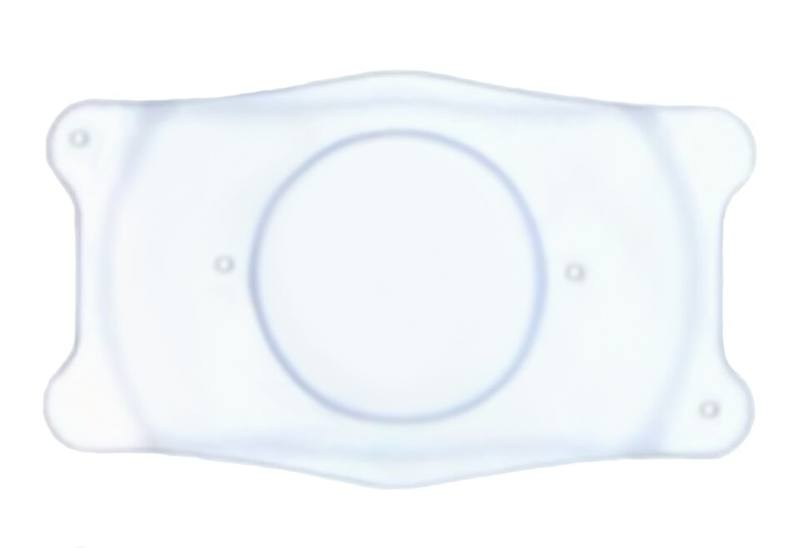
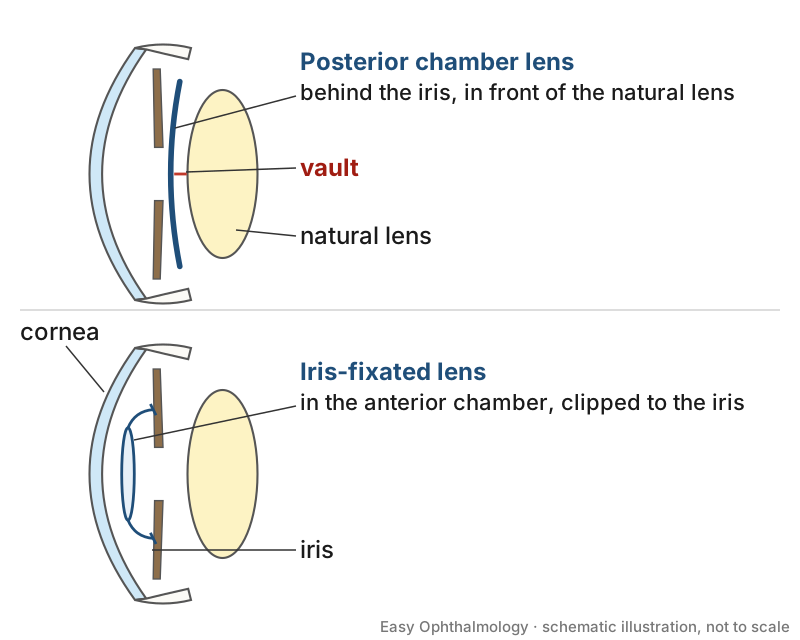
Phakic intraocular lenses (pIOLs) are implanted in front of the natural lens to correct high refractive errors, and are the main option for patients with high ametropia or contraindications to laser refractive surgery [S4]. Posterior chamber lenses such as the implantable collamer lens (ICL) and iris-fixated lenses give high-quality correction of moderate to high myopia [S5]. The main risks are cataract, endothelial cell loss, raised intraocular pressure and reintervention, so lifelong follow-up is needed [S5] [S8] [S9].
Key points - Cataract, endothelial cell loss and surgical reintervention are the most common adverse events with pIOLs [S5]. - ICL and iris-fixed pIOLs had similar efficacy; ICL had better predictability but more severe complications, mainly anterior subcapsular cataract with older models (V2 and V3) [S1]. - With the central-port ICL V4c, mean endothelial cell loss was 1.32% at 3 months and 3.84% at a mean of 21.25 months [S7]. - Compared with LASIK for myopic astigmatism, (toric) ICL outcomes were equal or better, with fewer higher-order aberrations and better contrast sensitivity [S6]. - Raised intraocular pressure after ICL can result from residual viscoelastic, steroid response, excessive vault, and rarely malignant glaucoma [S9].
Evidence last checked: 2026-10-17 (PubMed abstracts).
Red flags
- Painful red eye, haloes or blurred vision after ICL surgery. Raised intraocular pressure after ICL has several causes, including residual viscoelastic, excessive vault, pigment dispersion, toxic anterior segment syndrome and malignant glaucoma [S9].
- Progressive endothelial cell loss. If loss is greater than expected and follow-up confirms the trend, the pIOL should be explanted without delay [S8].
- Reduced vision years after surgery. Cataract formation is a common adverse event [S5]; older ICL models were associated with anterior subcapsular cataract [S1].
Recognise it: who is a candidate
- Patients with high ametropia or contraindications to laser surgery, who wish to keep accommodation [S4].
- Adequate preoperative anterior chamber depth is essential, at least for iris-fixed pIOLs; the chamber becomes shallower with age [S8].
- A Japanese multicentre study of the hole ICL in 365 eyes with anterior chamber depth below 3.0 mm found no significant IOP rise, no significant endothelial loss and no vision-threatening complications at 1 year [S3].
Confirm it: before and after implantation
- Preoperative: anterior chamber depth and endothelial cell density, with the endothelial reserve judged individually by age and likely future surgery [S8].
- Sizing: sulcus-to-sulcus and white-to-white methods gave no meaningful difference in vault in a meta-analysis [S2].
- Postoperative: proper follow-up for endothelial cell loss and cataract [S5], with regular monitoring of endothelial cell density [S8], and intraocular pressure monitoring including during steroid treatment [S9].
Manage it
Before acting on this section, check the national and local guidelines, product information and regulatory approvals that apply where you practise. See the medical disclaimer.
Tier A (primary care / no specialist)
- Ask any adult with high myopia whether they have an implanted lens. A patient with a pIOL and a painful red eye, haloes or sudden blur needs urgent referral (see below).
Tier B (general eye clinic)
- Check intraocular pressure and anterior chamber in any patient with a pIOL and symptoms; steroid-induced pressure rise requires timely adjustment of steroid therapy [S9].
- Ensure long-term endothelial and lens follow-up continues [S5] [S8].
Tier C (specialist centre)
- Lens choice. - Posterior chamber lenses, especially EVO/EVO+, had a lower mean adverse effect and symptom profile than iris-fixated pIOLs [S5]. - Higher endothelial cell loss tends to be seen with anterior chamber lenses than with posterior chamber lenses [S8]. - The implantable phakic contact lens (IPCL) is a lower-cost posterior chamber alternative; efficacy index 1.06, safety index 1.23, cataract in 0.46% of V2.0 cases and endothelial loss of 2.3% at 12 months [S10]. Postoperative uncorrected acuity was worse than with the ICL, partly because of poorer preoperative acuity [S10].
- Astigmatism. Toric ICL compared favourably with LASIK in moderate (-3 to -6 D) and high (≥-6 D) myopia [S6].
- Presbyopia. Presbyopia-correcting pIOLs (EVO Viva, trifocal IPCL, ArtiPlus) achieved at least 75% of eyes within ±0.50 D and 80% to 90% functional spectacle independence in 6 small studies; glare and halos were common but mild [S11].
- Accommodation. Evidence on the effect of pIOLs on accommodation is poor (two quasi-experimental studies) [S4].
- Explantation. Explant without delay when progressive endothelial loss is confirmed [S8].
Refer when
| Situation | Urgency |
|---|---|
| pIOL with painful red eye, haloes, nausea or high intraocular pressure | Immediate, same-day [S9] [G1] |
| pIOL with reduced vision and suspected cataract | Urgent; timing per your local service or specialist advice |
| pIOL without endothelial follow-up | Routine [S8]; timing per your local service or specialist advice |
Pitfalls
- Losing patients to follow-up: monitoring for endothelial loss and cataract is essential [S5] [S8].
- Missing steroid response after surgery [S9].
- Extrapolating V2 and V3 cataract rates to current models, or vice versa [S1] [S7].
- Over-relying on short-term data for presbyopic and IPCL lenses [S10] [S11].
Evidence notes
| Source | Date | Design |
|---|---|---|
| [S1] | 2014 | Meta-analysis, 7 studies, 511 eyes |
| [S2] | 2016 | Review with meta-analysis of sizing (ICL) |
| [S3] | 2018 | Multicentre clinical study, 365 eyes, Japan |
| [S4] | 2020 | Systematic review, 2 quasi-experimental studies |
| [S5] | 2022 | Narrative review with meta-analysis (USA) |
| [S6] | 2022 | Systematic review, 19 comparative articles |
| [S7] | 2024 | Meta-analysis, 18 studies (ICL V4c) |
| [S8] | 2024 | Narrative review (endothelial cell loss) |
| [S9] | 2024 | Narrative review (IOP after ICL) |
| [S10] | 2025 | Systematic review, 28 articles (IPCL) |
| [S11] | 2026 | Systematic review, 6 studies, 354 eyes |
- No randomised trials of pIOL versus another treatment were found in this search; evidence is mainly observational and narrative.
- The presbyopic pIOL evidence is limited by short follow-up, small samples and industry sponsorship [S11].
- Toric ICL vs LASIK comparisons need longer follow-up for long-term adverse effects [S6].
- One sizing review was written in relation to a single manufacturer's lens and may have conflicts of interest not stated in the abstract [S2].
- The search returned many off-topic records (neck pain, dental, oncology), which were excluded.
- Not covered by these sources: retinal detachment rates, hyperopic pIOLs, cost and long-term outcomes beyond a few years.
Related articles
References
See the numbered source list below. Each marker [S#] links to its PubMed and DOI record.
Sources
- [S1] Liang GL, Wu J, Shi JT, Liu J, He FY, Xu W Implantable collamer lens versus iris-fixed phakic intraocular lens implantation to correct myopia: a meta-analysis. PloS one. (2014). PubMed 25115906 · doi:10.1371/journal.pone.0104649
- [S2] Packer M Meta-analysis and review: effectiveness, safety, and central port design of the intraocular collamer lens. Clinical ophthalmology (Auckland, N.Z.). (2016). PubMed 27354760 · doi:10.2147/opth.s111620
- [S3] Kamiya K, Shimizu K, Igarashi A, Kitazawa Y, Kojima T, Nakamura T, et al. Posterior Chamber Phakic Intraocular Lens Implantation in Eyes with an Anterior Chamber Depth of Less Than 3 mm: A Multicenter Study. Scientific reports. (2018). PubMed 30190562 · doi:10.1038/s41598-018-31782-y
- [S4] Hernández-Rodríguez CJ, Piñero DP A systematic review about the impact of phakic intraocular lenses on accommodation. Journal of optometry. (2020). PubMed 31937486 · doi:10.1016/j.optom.2019.08.001
- [S5] Moshirfar M, Webster CR, Ronquillo YC Phakic intraocular lenses: an update and review for the treatment of myopia and myopic astigmatism in the United States. Current opinion in ophthalmology. (2022). PubMed 35916572 · doi:10.1097/icu.0000000000000870
- [S6] Goes S, Delbeke H Posterior chamber toric implantable collamer lenses vs LASIK for myopia and astigmatism: systematic review. Journal of cataract and refractive surgery. (2022). PubMed 36179351 · doi:10.1097/j.jcrs.0000000000001007
- [S7] Kisiel FB, Gurumurthy GJ Endothelial cell loss post-implantable collamer lens V4c: meta-analysis. Journal of cataract and refractive surgery. (2024). PubMed 38194352 · doi:10.1097/j.jcrs.0000000000001389
- [S8] Naujokaitis T, Auffarth GU, Łabuz G, Khoramnia R Endothelial Cell Loss in Patients with Phakic Intraocular Lenses. Klinische Monatsblatter fur Augenheilkunde. (2024). PubMed 38242162 · doi:10.1055/a-2209-5251
- [S9] Gong D, Deng S, Dang K, Yan Z, Wang J Causes and management strategies for elevated intraocular pressure after implantable collamer lens implantation. Frontiers in medicine. (2024). PubMed 38384405 · doi:10.3389/fmed.2024.1351272
- [S10] Van Hoe W, Termote K, Saelens I, Delbeke H Implantable phakic contact lens: systematic review. Journal of cataract and refractive surgery. (2025). PubMed 40369812 · doi:10.1097/j.jcrs.0000000000001686
- [S11] González-Lugo JH, Zhang H, Alió JL, Ghanem M, Medalle RS, Alió Del Barrio JL Phakic presbyopic intraocular lenses: systematic review. Journal of cataract and refractive surgery. (2026). PubMed 41860842 · doi:10.1097/j.jcrs.0000000000001940
Guidelines
- [G1] NHS Scotland Community Eyecare Guidelines. 6.4 Glaucoma, Acute Angle Closure (n.d.). https://www.eyes.nhs.scot/eyecare-guidelines/section-6-glaucoma/64-glaucoma-acute-angle-closure/