Educational content only. Not personalised medical advice. Clinical decisions remain the responsibility of the treating clinician.
Ocular Tuberculosis and Tubercular Uveitis
Tubercular uveitis (TBU) is intraocular inflammation or infection secondary to Mycobacterium tuberculosis [S7]. It accounts for a pooled 4.0% of uveitis worldwide, 7.0% in TB high-burden countries and 11.0% in sub-Saharan Africa [S7]. Diagnosis is usually presumptive, and the evidence for antitubercular therapy (ATT) is observational and biased, so international consensus guidelines fill much of the gap [S3] [S4] [S11].
Key points - Expert consensus (COTS) bases the decision to start ATT on the ocular phenotype plus immunologic tests (tuberculin skin test or interferon-gamma release assay) and chest imaging, and on TB endemicity [S3] [S4]. - ATT with or without corticosteroid was associated with lower odds of inflammatory recurrence than no ATT (odds ratio 0.33) in comparative studies [S10]. - In an RCT from India, Myanmar and Thailand, 6 months of ATT was non-inferior to 9 months for tubercular posterior uveitis [S12]. - Ocular PCR has a pooled sensitivity of 88% and specificity of 71%; a negative result may help avoid unnecessary ATT [S6]. - Worsening after starting ATT may be a paradoxical reaction that needs corticosteroids and immunosuppressants rather than stopping ATT [S2].
Evidence last checked: 2026-10-17 (PubMed abstracts).
Red flags
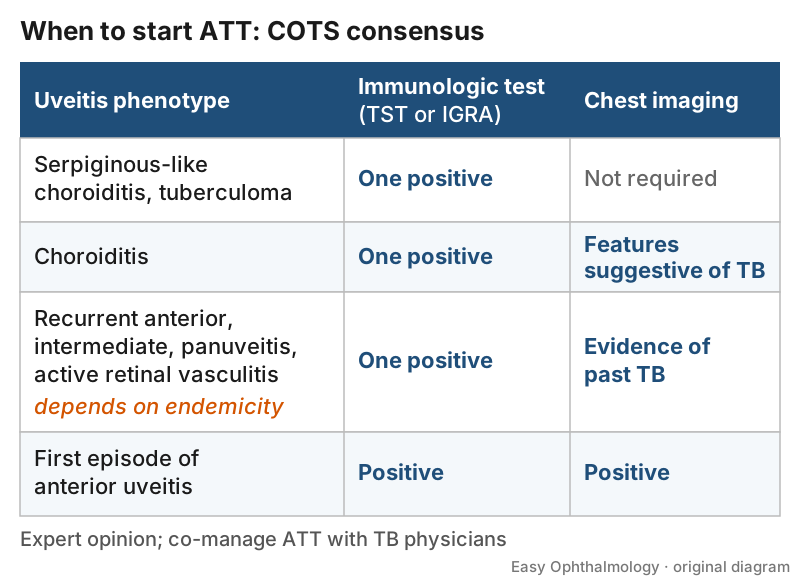
- Serpiginous-like choroiditis or tuberculoma. COTS considered one positive immunologic test sufficient to recommend ATT, even without radiologic features of TB [S3].
- HIV co-infection. Findings are mostly posterior segment and infective (tubercles, chorioretinitis, abscess), largely in the context of pulmonary or disseminated TB [S5].
- Worsening on ATT. Consider a paradoxical reaction; prompt corticosteroids and immunosuppressants can restore vision [S2].
Recognise it
- Phenotypes considered by consensus: anterior uveitis, intermediate uveitis, panuveitis, retinal vasculitis [S4], serpiginous-like choroiditis, tuberculoma and focal or multifocal choroiditis [S3].
- In HIV infection: anterior uveitis (granulomatous or otherwise), choroidal granulomas or tubercles, chorioretinitis, subretinal abscess, panophthalmitis, retinal detachment and vasculitis [S5].
- Setting: prevalence is higher in high-burden countries and sub-Saharan Africa [S7].
Confirm it
- Immunologic tests. The tuberculin skin test and interferon-gamma release assays (IGRAs) support a clinical diagnosis; IGRAs need a single visit and are not affected by prior BCG vaccination [S9].
- Chest imaging. Radiologic evidence of TB, combined with immunologic results, drives the COTS decisions [S3] [S4].
- Ocular PCR. Sensitivity 88%, specificity 71% against ATT response; not accurate enough to be the benchmark, but a negative result may help avoid unnecessary ATT [S6].
- In HIV: systemic imaging (CT, MRI, PET/CT) and molecular tests such as GeneXpert MTB/RIF are increasingly important [S5].
Manage it
Before acting on this section, check the national and local guidelines, product information and regulatory approvals that apply where you practise. See the medical disclaimer.
Tier A (primary care / no specialist)
- In a patient with known or treated TB who develops eye redness or reduced vision, refer to an eye clinic (timing in the table below).
- Work with the national TB programme: COTS recommends that specific types of TBU be added to the conditions treated as tuberculosis [S4].
Tier B (general eye clinic)
- Phenotype the uveitis and order a tuberculin skin test or IGRA and chest imaging [S3] [S4] [S9].
- When to start ATT (COTS consensus, expert opinion): - Choroiditis: one positive immunologic test plus radiologic features suggestive of TB [S3]. - Serpiginous-like choroiditis and tuberculoma: one positive immunologic test is enough [S3]. - Recurrent anterior uveitis, intermediate uveitis, panuveitis and active retinal vasculitis: depends on endemicity, with one positive immunologic test plus radiologic evidence of past TB [S4]. - First episode of anterior uveitis: both immunologic and radiologic tests positive [S4].
- Comanage ATT with TB or chest physicians, following the BTS clinical statement where applicable [S8]. Drug doses are not covered by these abstracts: follow the national TB programme.
Tier C (specialist centre)
- Expected outcomes. Pooled data: inflammation resolved completely in 83% and vision improved in 65% on ATT with or without corticosteroids, with recurrence in 13%; corticosteroids could be tapered below 10 mg/day in 91% [S10]. An earlier meta-analysis found non-recurrence in 84%, with little difference between ATT alone (85%) and ATT with systemic corticosteroid (82%) [S1].
- Duration. Six months was non-inferior to 9 months (non-recurrence 0.85 vs 0.94 at 1 year after ATT); subgroups suggested retinal vasculitis may do well with 6 months and serpiginous-like choroiditis may favour 9 months [S12]. Systemic corticosteroids were mandatory for serpiginous-like choroiditis in that trial [S12].
- Adjunctive immunosuppression was used alongside ATT in 9% of patients in pooled data [S10]. COTS developed 10 consensus statements on adjunctive therapy in choroiditis [S3].
- HIV. Start ATT according to clinical staging; antiretroviral therapy can be started soon after ATT [S5].
- Paradoxical reactions. Treat with corticosteroids and immunosuppressants; altering or stopping ATT may not be indicated [S2].
Refer when
| Situation | Urgency |
|---|---|
| Choroiditis, serpiginous-like lesions or vasculitis in a TB-endemic setting or a patient with TB, or posterior segment inflammation in a person with HIV | Urgent to a uveitis service (with HIV care where relevant); timing per your local service or specialist advice [S3] [S4] [S5] |
| Vision worsening after starting ATT | Same-day review for possible paradoxical reaction [EIC expert opinion] [S2] |
Pitfalls
- Treating a positive IGRA alone as proof of ocular TB; tests support rather than confirm the diagnosis [S9].
- Relying on ocular PCR as a definitive test [S6].
- Stopping ATT when inflammation worsens early in treatment [S2].
- Overstating ATT efficacy; the evidence has multiple biases and lacks control for confounding [S11].
Evidence notes
| Source | Date | Design |
|---|---|---|
| [S1] | 2016 | Meta-analysis, 28 studies, no control-group analysis |
| [S2] | 2019 | Narrative review (India) |
| [S3] | 2021 | International Delphi consensus (COTS report 1) |
| [S4] | 2021 | International Delphi consensus (COTS report 2) |
| [S5] | 2020 | Narrative review |
| [S6] | 2021 | Diagnostic meta-analysis (Indonesian authors) |
| [S7] | 2022 | Meta-analysis, 70 prevalence studies (South African authors) |
| [S8] | 2022 | British Thoracic Society clinical statement |
| [S9] | 2022 | Narrative review (Thailand) |
| [S10] | 2023 | Meta-analysis, 49 studies, 4,017 patients |
| [S11] | 2025 | Systematic review, 55 studies, narrative synthesis |
| [S12] | 2026 | Open-label non-inferiority RCT, 64 patients, India, Myanmar, Thailand |
- The ATT evidence is almost entirely observational; one review found multiple systemic biases and no control for confounding [S11], while meta-analyses report high response rates [S1] [S10].
- The prevalence meta-analysis describes clinical outcome as poor despite an 82.0% pooled response [S7].
- The BTS statement notes that high-quality evidence is lacking [S8].
- Not covered by these sources: ATT drug regimens and doses, drug-resistant TB, hepatotoxicity and optic neuropathy from ATT, and paediatric TBU.
Related articles
References
See the numbered source list below. Each marker [S#] links to its PubMed and DOI record.
Sources
- [S1] Kee AR, Gonzalez-Lopez JJ, Al-Hity A, Gupta B, Lee CS, Gunasekeran DV, et al. Anti-tubercular therapy for intraocular tuberculosis: A systematic review and meta-analysis. Survey of ophthalmology. (2016). PubMed 26970263 · doi:10.1016/j.survophthal.2016.03.001
- [S2] Ganesh SK, Abraham S, Sudharshan S Paradoxical reactions in ocular tuberculosis. Journal of ophthalmic inflammation and infection. (2019). PubMed 31493128 · doi:10.1186/s12348-019-0183-x
- [S3] Agrawal R, Testi I, Mahajan S, Yuen YS, Agarwal A, Kon OM, et al. Collaborative Ocular Tuberculosis Study Consensus Guidelines on the Management of Tubercular Uveitis-Report 1: Guidelines for Initiating Antitubercular Therapy in Tubercular Choroiditis. Ophthalmology. (2021). PubMed 32115264 · doi:10.1016/j.ophtha.2020.01.008
- [S4] Agrawal R, Testi I, Bodaghi B, Barisani-Asenbauer T, McCluskey P, Agarwal A, et al. Collaborative Ocular Tuberculosis Study Consensus Guidelines on the Management of Tubercular Uveitis-Report 2: Guidelines for Initiating Antitubercular Therapy in Anterior Uveitis, Intermediate Uveitis, Panuveitis, and Retinal Vasculitis. Ophthalmology. (2021). PubMed 32603726 · doi:10.1016/j.ophtha.2020.06.052
- [S5] Mehta S, Peters RP, Smit DP, Gupta V Ocular Tuberculosis in HIV-infected Individuals. Ocular immunology and inflammation. (2020). PubMed 32809898 · doi:10.1080/09273948.2020.1776882
- [S6] La Distia Nora R, Putera I, Khalisha DF, Septiana I, Sitompul R The diagnostic value of polymerase chain reaction for ocular tuberculosis diagnosis in relation to antitubercular therapy response: a meta-analysis. International journal of infectious diseases : IJID : official publication of the International Society for Infectious Diseases. (2021). PubMed 34364996 · doi:10.1016/j.ijid.2021.07.075
- [S7] Alli HD, Ally N, Mayet I, Dangor Z, Madhi SA Global prevalence and clinical outcomes of tubercular uveitis: a systematic review and meta-analysis. Survey of ophthalmology. (2022). PubMed 34626620 · doi:10.1016/j.survophthal.2021.10.001
- [S8] Kon OM, Beare N, Connell D, Damato E, Gorsuch T, Hagan G, et al. BTS clinical statement for the diagnosis and management of ocular tuberculosis. BMJ open respiratory research. (2022). PubMed 35379660 · doi:10.1136/bmjresp-2022-001225
- [S9] Tungsattayathitthan U, Boonsopon S, Tesavibul N, Dharakul T, Choopong P Interferon-gamma release assays in tuberculous uveitis: a comprehensive review. International journal of ophthalmology. (2022). PubMed 36124199 · doi:10.18240/ijo.2022.09.16
- [S10] Betzler BK, Putera I, Testi I, La Distia Nora R, Kempen J, Kon OM, et al. Anti-tubercular therapy in the treatment of tubercular uveitis: A systematic review and meta-analysis. Survey of ophthalmology. (2023). PubMed 36272559 · doi:10.1016/j.survophthal.2022.10.001
- [S11] Taylor JW, Wright GEL, Lim LL, Denholm JT A systemic review of the utility of antituberculosis therapy for presumed tuberculous uveitis. BMC infectious diseases. (2025). PubMed 39856576 · doi:10.1186/s12879-024-10288-1
- [S12] Ronnie Abhishek T, Ali MH, Aung Win MZ, Sukavatcharin S, Kelgaonkar A, Basu S Six-Month Versus Nine-Month Anti-Tubercular Therapy for Tubercular Posterior Uveitis: A Multicenter, Randomized Controlled Trial. Seminars in ophthalmology. (2026). PubMed 41363883 · doi:10.1080/08820538.2025.2599224