Educational content only. Not personalised medical advice. Clinical decisions remain the responsibility of the treating clinician.
Minimally Invasive Glaucoma Surgery (MIGS)
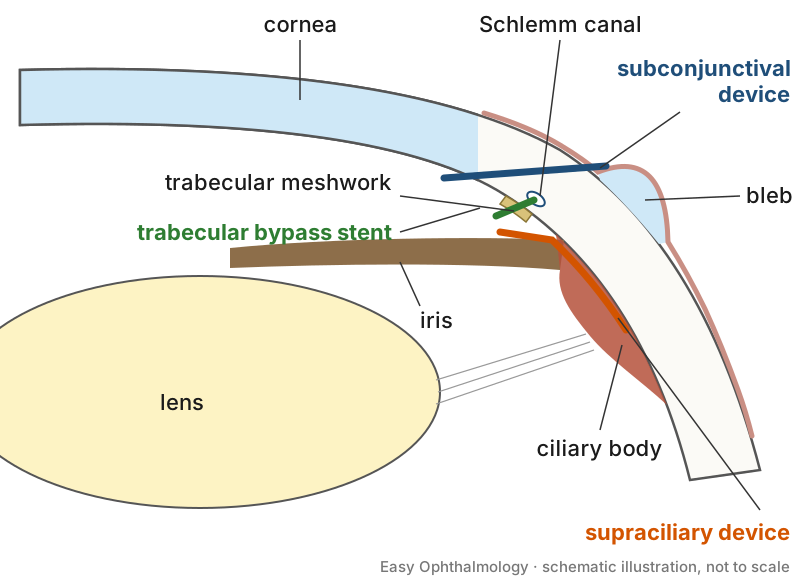
Minimally invasive glaucoma surgery (MIGS) covers trabecular bypass stents (iStent, Hydrus), ab interno trabeculotomy and goniotomy, and subconjunctival or supraciliary drainage devices [S5]. Added to cataract surgery, some MIGS give more patients drop-free control than cataract surgery alone, but effect sizes are small [S5], and bleb-forming devices lower IOP less than trabeculectomy [S12].
Key points - Adding a Hydrus microstent to cataract surgery raised the proportion of medication-free patients from about half to more than three quarters (moderate certainty) [S4]; at 5 years, 66% vs 46% were medication free [S7]. - Adding an iStent improved drop-free control (RR 1.38), but the evidence is very low certainty and all trials were funded by the manufacturer [S2]; its IOP-lowering effect was not sustained [S5]. - CyPass improved drop-free control but was associated with vision loss [S5] and endothelial cell loss with complications [S9]. - Gonioscopy-assisted transluminal trabeculotomy (GATT) with a suture is low cost, described as suited to developing nations, in a systematic review [S8]. - The PreserFlo MicroShunt lowered IOP by 26% vs 45% with trabeculectomy at 5 years, with less hypotony [S12].
Evidence last checked: 2026-10-17 (PubMed abstracts).
Red flags
- Corneal endothelial loss: more eyes lost endothelial cells after Hydrus (20.8% vs 10.6%) and CyPass (27.2% vs 10.0%) than controls; 7 CyPass eyes developed endothelial complications [S9].
- Device erosion or exposure: 4 MicroShunt eyes had erosion through the conjunctiva over 5 years [S12]; XEN exposure occurred in 1% [S6].
- Hypotony after bleb-forming devices: numerical hypotony in 39% after standalone XEN, usually transient [S6].
- Sight-threatening events occurred in 2% of MicroShunt eyes over 5 years [S12].
Recognise it: who is suitable
- Mild to moderate open-angle glaucoma with visually significant cataract: Hydrus trials enrolled mean deviation between -3.6 and -8.4 dB [S4].
- Patients who want fewer drops; difficulty managing medication led patients to explore bleb-based MIGS [S10].
- Moderate to severe primary or secondary open-angle glaucoma in adults and children for GATT [S8].
Confirm it: outcomes to expect
- Hydrus with cataract surgery lowered unmedicated IOP by 2 mmHg more than cataract surgery alone [S4].
- Standalone Hydrus achieved higher complete success and 0.6 fewer medications than two iStents at 12 months [S3].
- Goniotomy with the Kahook Dual Blade plus phacoemulsification gave higher success than iStent plus phacoemulsification; iStent inject gave similar IOP reduction to the blade [S11].
- Standalone XEN lowered IOP by 7.44 mmHg at 24 months, but 38% of eyes needed needling [S6].
Manage it
Before acting on this section, check the national and local guidelines, product information and regulatory approvals that apply where you practise. See the medical disclaimer.
Tier A (primary care / no specialist)
- Not applicable for performing surgery. Patients after MIGS with pain, redness or reduced vision should go to the eye unit the same day [G1].
Tier B (general eye clinic)
- Follow up for raised IOP needing treatment, which was more frequent after MicroShunt than trabeculectomy (26% vs 8%) [S12].
- Check corneal clarity over time in eyes with angle devices [S9].
Tier C (specialist centre)
- With cataract surgery. Hydrus has the strongest evidence for drop-free control and IOP lowering among trabecular bypass devices, with small effect sizes [S5]. Hydrus reduced the need for secondary glaucoma surgery (2.4% vs 6.2% at 5 years) without adverse long-term endothelial effect in HORIZON [S7].
- iStent. iStent with cataract surgery gave a small reduction in drops (0.42) [S2]; iStent inject showed no excess endothelial loss at 5 years [S9].
- Angle surgery where devices are unaffordable. Suture GATT is cost-effective, ab interno, with safety and efficacy described as comparable to trabeculectomy [S8]. This review gives no pooled numbers in its abstract [S8].
- Bleb-forming MIGS. A health technology assessment found MIBS may be safer than trabeculectomy with fewer follow-up visits, but whether outcomes match trabeculectomy is uncertain and cost-effectiveness is highly uncertain [S10]. A 2018 Cochrane review found no completed RCTs of subconjunctival devices [S1]; the later MicroShunt RCT showed less IOP lowering than trabeculectomy [S12].
Refer when
| Situation | Urgency |
|---|---|
| Red, painful eye or exposed device after MIGS | Immediate, same-day [G1] |
| Raised IOP or corneal oedema after MIGS | Urgent to the operating surgeon [S9] [S12]; timing per your local service or specialist advice |
| Mild to moderate glaucoma with cataract, wishing to reduce drops | Routine to a centre offering combined surgery [S4]; timing per your local service or specialist advice |
Pitfalls
- Offering MIGS for advanced glaucoma needing low target pressure; bleb MIGS lowered IOP less than trabeculectomy [S12] and trials of angle MIGS enrolled mild to moderate disease [S4].
- Overstating benefit: effects over cataract surgery alone are small [S5].
- Ignoring endothelial safety differences between devices [S9].
- Forgetting needling and follow-up burden after XEN [S6].
Evidence notes
| Source | Date | Design |
|---|---|---|
| [S1] | 2018 | Cochrane review, no completed RCTs |
| [S2] | 2019 | Cochrane review, 7 RCTs, all industry funded |
| [S3] | 2020 | RCT, 152 subjects, Hydrus vs 2 iStents |
| [S4] | 2020 | Cochrane review, 3 RCTs, manufacturer sponsored |
| [S5] | 2021 | Overview of 6 Cochrane reviews with network meta-analysis |
| [S6] | 2022 | Meta-analysis, 14 mainly observational studies |
| [S7] | 2022 | RCT (HORIZON), 5 years |
| [S8] | 2023 | Systematic review |
| [S9] | 2024 | Analysis of RCT endothelial data, 5 years |
| [S10] | 2024 | Health technology assessment, 2 RCTs and 39 observational studies |
| [S11] | 2025 | Meta-analysis, 14 studies |
| [S12] | 2026 | Multicentre RCT, 5-year safety; commercial disclosures noted |
- Most device trials were funded by manufacturers [S2] [S4]; evidence for XEN and goniotomy is mainly observational [S6] [S11].
- The GATT review is qualitative in its abstract and its "boon to developing nations" claim rests on cost reasoning rather than trial data [S8].
- Not covered by these sources: MIGS in angle closure, device prices, training and learning curves for low-resource programmes, and long-term visual field outcomes.
Related articles
References
See the numbered source list below. Each marker [S#] links to its PubMed and DOI record.
Sources
- [S1] King AJ, Shah A, Nikita E, Hu K, Mulvaney CA, Stead R, et al. Subconjunctival draining minimally-invasive glaucoma devices for medically uncontrolled glaucoma. The Cochrane database of systematic reviews. (2018). PubMed 30554418 · doi:10.1002/14651858.cd012742.pub2
- [S2] Le JT, Bicket AK, Wang L, Li T Ab interno trabecular bypass surgery with iStent for open-angle glaucoma. The Cochrane database of systematic reviews. (2019). PubMed 30919929 · doi:10.1002/14651858.cd012743.pub2
- [S3] Ahmed IIK, Fea A, Au L, Ang RE, Harasymowycz P, Jampel HD, et al. A Prospective Randomized Trial Comparing Hydrus and iStent Microinvasive Glaucoma Surgery Implants for Standalone Treatment of Open-Angle Glaucoma: The COMPARE Study. Ophthalmology. (2020). PubMed 31034856 · doi:10.1016/j.ophtha.2019.04.034
- [S4] Otarola F, Virgili G, Shah A, Hu K, Bunce C, Gazzard G Ab interno trabecular bypass surgery with Schlemm´s canal microstent (Hydrus) for open angle glaucoma. The Cochrane database of systematic reviews. (2020). PubMed 32147807 · doi:10.1002/14651858.cd012740.pub2
- [S5] Bicket AK, Le JT, Azuara-Blanco A, Gazzard G, Wormald R, Bunce C, et al. Minimally Invasive Glaucoma Surgical Techniques for Open-Angle Glaucoma: An Overview of Cochrane Systematic Reviews and Network Meta-analysis. JAMA ophthalmology. (2021). PubMed 34264292 · doi:10.1001/jamaophthalmol.2021.2351
- [S6] Lim SY, Betzler BK, Yip LWL, Dorairaj S, Ang BCH Standalone XEN45 Gel Stent implantation in the treatment of open-angle glaucoma: A systematic review and meta-analysis. Survey of ophthalmology. (2022). PubMed 35081414 · doi:10.1016/j.survophthal.2022.01.003
- [S7] Ahmed IIK, De Francesco T, Rhee D, McCabe C, Flowers B, Gazzard G, et al. Long-term Outcomes from the HORIZON Randomized Trial for a Schlemm's Canal Microstent in Combination Cataract and Glaucoma Surgery. Ophthalmology. (2022). PubMed 35218867 · doi:10.1016/j.ophtha.2022.02.021
- [S8] Velamala IP, Bharathi M Gonioscopy Assisted Transluminal Trabeculotomy:A Boon to Developing Nations-A Systematic Review. Seminars in ophthalmology. (2023). PubMed 35776682 · doi:10.1080/08820538.2022.2094715
- [S9] Ahmed IIK, Sheybani A, De Francesco T, Samuelson TW Corneal endothelial safety profile in minimally invasive glaucoma surgery. Journal of cataract and refractive surgery. (2024). PubMed 37988037 · doi:10.1097/j.jcrs.0000000000001365
- [S10] Ontario Health Minimally Invasive Bleb Surgery for Glaucoma: A Health Technology Assessment. Ontario health technology assessment series. (2024). PubMed 38332948
- [S11] Guedes J, Amaral DC, de Oliveira Caneca K, Cassins Aguiar EH, de Oliveira LN, Mora-Paez DJ, et al. Kahook Dual Blade Goniotomy Versus iStent Implantation Combined With Phacoemulsification: A Systematic Review and Meta-Analysis. Journal of glaucoma. (2025). PubMed 39641580 · doi:10.1097/ijg.0000000000002522
- [S12] Panarelli JF, Moster MR, Garcia-Feijoo J, Flowers BE, Baker ND, Barnebey HS, et al. Ab-Externo MicroShunt vs. Trabeculectomy in Primary Open-Angle Glaucoma: 5-Year Safety Results from a Randomized, Multicenter Study. Ophthalmology. Glaucoma. (2026). PubMed 40912402 · doi:10.1016/j.ogla.2025.08.009
Guidelines
- [G1] NHS Scotland (Community Eyecare Guidelines, eyes.nhs.scot). 7.4 Endophthalmitis, Post-Operative, (Exogenous Endophthalmitis) (2026). https://www.eyes.nhs.scot/eyecare-guidelines/section-7-uvea/74-endophthalmitis-post-operative-exogenous-endophthalmitis/