Educational content only. Not personalised medical advice. Clinical decisions remain the responsibility of the treating clinician.
Laser refractive surgery: LASIK, SMILE and PRK
Laser refractive surgery reshapes the cornea to correct myopia and astigmatism, by surface ablation (PRK, LASEK, transepithelial PRK), by a flap and excimer ablation (LASIK), or by lenticule extraction through a small incision (SMILE, also called KLEx) [S1] [S10]. Randomised evidence shows broadly similar efficacy and safety across the main techniques [S2] [S7]. For eye-care workers outside refractive centres, the key tasks are appropriate referral and recognising complications after surgery [S8] [S10].
Key points - A network meta-analysis of 48 RCTs found no significant differences in efficacy, safety or visual quality between the main laser techniques for myopia; femtosecond LASIK had the best predictability [S2]. - SMILE and LASIK gave comparable safety and efficacy in a meta-analysis of 11 RCTs; LASIK was more predictable and SMILE induced less spherical aberration [S7]. - Wavefront-guided or wavefront-optimised ablation showed no important difference from conventional ablation at 12 months (low-certainty evidence) [S6]. - LASIK significantly reduced tear production and tear break-up time; reductions after SMILE and PRK were not significant [S4]. - A 2025 international guideline on lenticule extraction emphasises screening for keratoconus and managing infection and intraoperative complications [S10].
Evidence last checked: 2026-10-17 (PubMed abstracts).
Red flags
- Pain, redness or reduced vision after surgery. Perioperative infection is a complication requiring management strategies in the KLEx guideline [S10]. Treat as an emergency.
- Blurred vision with raised intraocular pressure after LASIK. Interface fluid syndrome is a fluid pocket in the stroma that reduces visual acuity; 33.3% of reported patients needed surgery [S8].
- Undiagnosed keratoconus before surgery. Preoperative screening for keratoconus is a key recommendation [S10].
Recognise it: who is a candidate
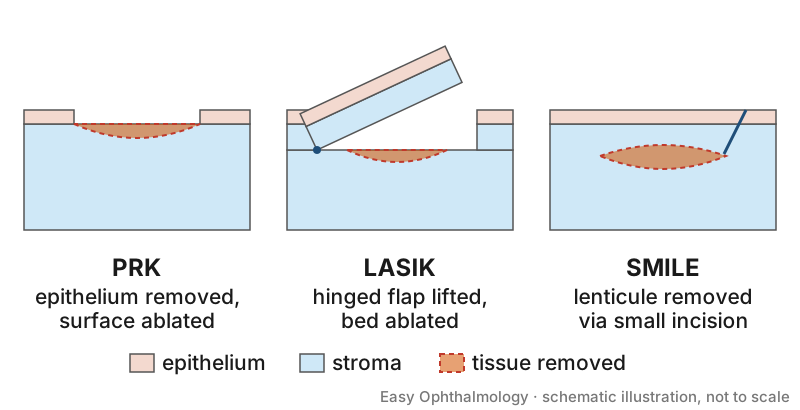
- Cochrane trials included adults aged 18 to 60 years with myopia up to 12 D [S1]; the Cochrane wavefront review included adults aged 18 or over [S6].
- Refractive accuracy depends on corneal thickness, degree of myopia, nomogram and optical zone [S10].
- PRK is used for myopia, astigmatism and hyperopia; a very small percentage have corneal haze or regression [S5].
Confirm it: preoperative assessment
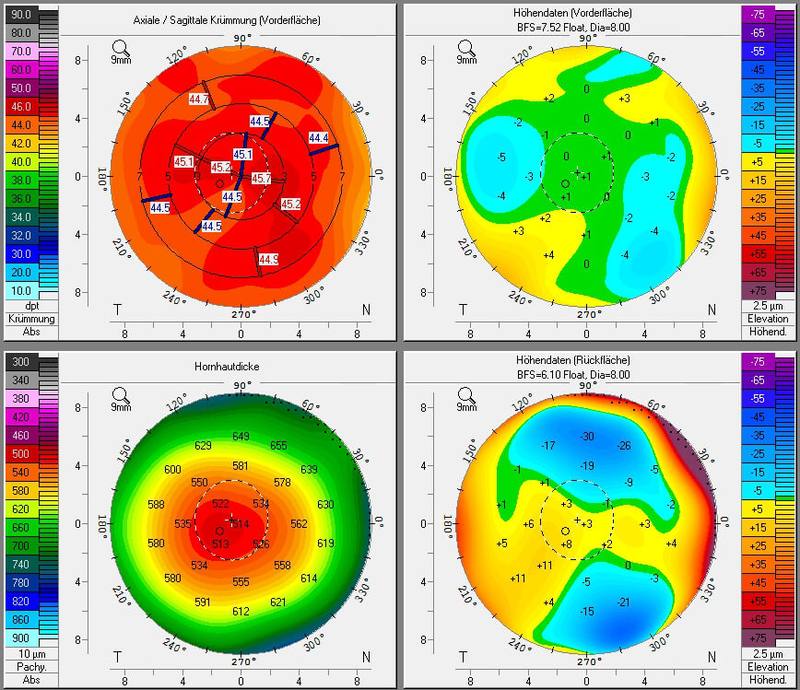
- The KLEx guideline gives recommendations for preoperative screening, candidate selection, intraoperative quality control, postoperative monitoring and complication management [S10].
- Corneal biomechanical measures may improve safety and predictability but need further validation [S10].
Manage it
Before acting on this section, check the national and local guidelines, product information and regulatory approvals that apply where you practise. See the medical disclaimer.
Tier A (primary care / no specialist)
- Laser refractive surgery is not available or needed at this level. Spectacles and contact lenses remain alternatives [S1].
- After someone has had refractive surgery, ask about pain, redness and reduced vision and refer as below.
Tier B (general eye clinic)
- Counselling. Explain that outcomes are similar between techniques [S2], and that LASIK carries more dry-eye signs than SMILE or PRK [S4].
- Post-operative review. Measure intraocular pressure in a LASIK patient with blurred vision: higher presenting IOP and duration of 1 month or less were associated with better final acuity in interface fluid syndrome [S8].
Tier C (specialist centre)
- Choice of technique. - In a paired-eye RCT of 70 Asian patients (mean -5.3 D), SMILE and femtosecond LASIK achieved 85% vs 83% uncorrected acuity of 20/20 or better and 99% vs 99% within ±1.0 D at 12 months [S3]. - Pooled RCTs: LASIK more often within ±0.5 D (RR 0.91 favouring LASIK) [S7]. - LASEK vs LASIK: uncertain difference in uncorrected acuity; regression was reported only after LASEK (8 of 37 eyes) and flap striae and over-correction only after LASIK (5 of 39 eyes), very low to low certainty [S1].
- Surface ablation. Transepithelial PRK and mechanical or alcohol-assisted PRK showed no significant differences in efficacy or safety in 20 studies (10 204 eyes); conventional PRK remains reliable where advanced technology is not affordable [S11].
- Ablation profile. Wavefront-optimised LASIK may slightly improve mean spherical equivalent versus wavefront-guided LASIK (MD -0.14 D, low certainty) [S6].
- Prophylactic crosslinking. Adding CXL reduced central corneal thickness and safety and efficacy indices, with no difference in 20/20 uncorrected acuity at 12 months or more [S9]. Routine use is not supported by these sources [S9].
- Complication protocols. Have strategies for wrong-plane dissection, difficult lenticule removal, suction loss and infection [S10].
Refer when
| Situation | Urgency |
|---|---|
| Pain, redness, discharge or reduced vision in the days after laser surgery | Immediate, same-day [G1] |
| Blurred vision after LASIK with raised intraocular pressure | Same-day [S8] |
| Adult seeking surgery for stable refractive error | Routine, to a refractive centre; timing per your local service or specialist advice |
Pitfalls
- Promising a specific technique is superior: differences in efficacy and safety are not significant [S2] [S7].
- Missing interface fluid syndrome in a LASIK patient with blurred vision and raised pressure [S8].
- Assuming prophylactic CXL adds safety [S9].
- Ignoring dry eye after LASIK [S4].
Evidence notes
| Source | Date | Design |
|---|---|---|
| [S1] | 2017 | Cochrane systematic review, 4 RCTs (LASEK vs LASIK) |
| [S2] | 2017 | Network meta-analysis, 48 RCTs |
| [S3] | 2020 | Paired-eye RCT, 70 patients, Singapore |
| [S4] | 2020 | Meta-analysis, 14 studies (dry eye) |
| [S5] | 2020 | Preferred practice pattern (India), expert review |
| [S6] | 2020 | Cochrane systematic review, 33 RCTs (wavefront) |
| [S7] | 2023 | Meta-analysis, 11 RCTs (SMILE vs LASIK) |
| [S8] | 2023 | Systematic review of 33 case reports (interface fluid syndrome) |
| [S9] | 2024 | Meta-analysis, 28 studies (prophylactic CXL) |
| [S10] | 2025 | International evidence-based guideline (KLEx), Delphi of 44 experts |
| [S11] | 2025 | Meta-analysis, 20 studies (transPRK vs PRK) |
- Many trials had unclear risk of bias and did not account for paired eyes [S1] [S6].
- The interface fluid syndrome data come from a small pooled case series [S8].
- The PRK practice pattern abstract gives no quantitative data [S5].
- The search returned many off-topic records (dental "smile" aesthetics and others), which were excluded.
- Not covered by these sources: rates of ectasia and infectious keratitis, hyperopic outcomes, cost and access in low-income settings.
Related articles
References
See the numbered source list below. Each marker [S#] links to its PubMed and DOI record.
Sources
- [S1] Kuryan J, Cheema A, Chuck RS Laser-assisted subepithelial keratectomy (LASEK) versus laser-assisted in-situ keratomileusis (LASIK) for correcting myopia. The Cochrane database of systematic reviews. (2017). PubMed 28197998 · doi:10.1002/14651858.cd011080.pub2
- [S2] Wen D, McAlinden C, Flitcroft I, Tu R, Wang Q, Alió J, et al. Postoperative Efficacy, Predictability, Safety, and Visual Quality of Laser Corneal Refractive Surgery: A Network Meta-analysis. American journal of ophthalmology. (2017). PubMed 28336402 · doi:10.1016/j.ajo.2017.03.013
- [S3] Ang M, Farook M, Htoon HM, Mehta JS Randomized Clinical Trial Comparing Femtosecond LASIK and Small-Incision Lenticule Extraction. Ophthalmology. (2020). PubMed 31619358 · doi:10.1016/j.ophtha.2019.09.006
- [S4] Sambhi RS, Sambhi GDS, Mather R, Malvankar-Mehta MS Dry eye after refractive surgery: a meta-analysis. Canadian journal of ophthalmology. Journal canadien d'ophtalmologie. (2020). PubMed 31712000 · doi:10.1016/j.jcjo.2019.07.005
- [S5] Fogla R, Luthra G, Chhabra A, Gupta K, Dalal R, Khamar P Preferred practice patterns for photorefractive keratectomy surgery. Indian journal of ophthalmology. (2020). PubMed 33229660 · doi:10.4103/ijo.ijo_2178_20
- [S6] Li SM, Kang MT, Wang NL, Abariga SA Wavefront excimer laser refractive surgery for adults with refractive errors. The Cochrane database of systematic reviews. (2020). PubMed 33336797 · doi:10.1002/14651858.cd012687.pub2
- [S7] Yao L, Zhang M, Wang D, Zhao Q, Wang S, Bai H Small Incision Lenticule Extraction (SMILE) and Laser in Situ Keratomileusis (LASIK) Used to Treat Myopia and Myopic Astigmatism: A Systematic Review and Meta-analysis of Randomized Clinical Trials. Seminars in ophthalmology. (2023). PubMed 35912896 · doi:10.1080/08820538.2022.2107399
- [S8] Ravipati A, Pradeep T, Donaldson KE Interface fluid syndrome after LASIK surgery: retrospective pooled analysis and systematic review. Journal of cataract and refractive surgery. (2023). PubMed 37144645 · doi:10.1097/j.jcrs.0000000000001214
- [S9] Hira S, Klein Heffel K, Mehmood F, Sehgal K, Felix De Farias Santos AC, Steuernagel Del Valle G Comparison of refractive surgeries (SMILE, LASIK, and PRK) with and without corneal crosslinking: systematic review and meta-analysis. Journal of cataract and refractive surgery. (2024). PubMed 38288954 · doi:10.1097/j.jcrs.0000000000001405
- [S10] Wang Y, Xie L, Yao K, Sekundo W, Alió JL, Mehta JS, et al. Evidence-Based Guidelines for Keratorefractive Lenticule Extraction Surgery. Ophthalmology. (2025). PubMed 39577672 · doi:10.1016/j.ophtha.2024.11.016
- [S11] Serfözö A, Martin C, Munteanu C, Seitz B, Daas L Efficacy, safety, and predictability of transepithelial vs mechanical or alcohol-assisted photorefractive keratectomy: meta-analysis. Journal of cataract and refractive surgery. (2025). PubMed 40929568 · doi:10.1097/j.jcrs.0000000000001749
Guidelines
- [G1] College of Optometrists (Guidance for Professional Practice). Annex 4 Urgency of referrals table (n.d.). https://www.college-optometrists.org/clinical-guidance/guidance/guidance-annexes/annex-4-urgency-of-referrals-table