Educational content only. Not personalised medical advice. Clinical decisions remain the responsibility of the treating clinician.
Ocular adverse events of immune checkpoint inhibitors and targeted cancer drugs
Immune checkpoint inhibitors (ICIs) and targeted cancer drugs, including MEK and BRAF inhibitors and antibody-drug conjugates (ADCs), have improved cancer survival but cause characteristic ocular adverse events [S5] [S11]. These range from dry eye and keratopathy to uveitis, retinopathy and orbital inflammation, and are probably under-reported [S4] [S7]. Early recognition and coordinated care between ophthalmology and oncology protect vision while keeping cancer treatment on track [S9] [S11].
Key points - The commonest ICI ocular toxicities are uveitis, inflammatory orbital disease and ocular surface changes; ocular toxicity is underestimated in ICI trials [S4]. - ICI-associated uveitis began a median of 9 weeks after starting treatment, and 83.6% of cases occurred within 6 months; most patients recovered to within one line of baseline vision with steroids and drug cessation [S3]. - MEK inhibitors cause ocular adverse events in up to 90% of patients, including transient serous retinopathy that is usually mild and self-limited [S1] [S6]. - ADCs such as belantamab mafodotin cause keratopathy and blurred vision; in DREAMM-7, ocular events occurred in 79% vs 29% with the comparator, were managed with dose modification, and worsening acuity mostly resolved [S8]. - ICI-induced sicca may affect 5 to 24% of treated patients [S12].
Evidence last checked: 2026-10-18 (PubMed abstracts).
Red flags
- Reduced vision, red painful eye or floaters on ICI or BRAF/MEK therapy: possible uveitis, which can cause vision loss from macular oedema, subretinal fluid or optic nerve inflammation [S11].
- Vogt-Koyanagi-Harada-like disease or panuveitis on immunotherapy [S6] [S11].
- Retinal vein occlusion or vascular occlusion on MEK inhibitors or interferon α [S1] [S6].
- Orbital inflammation on ICIs [S4].
- Severe keratopathy with vision loss on an ADC [S2] [S8].
Recognise it: patterns by drug class
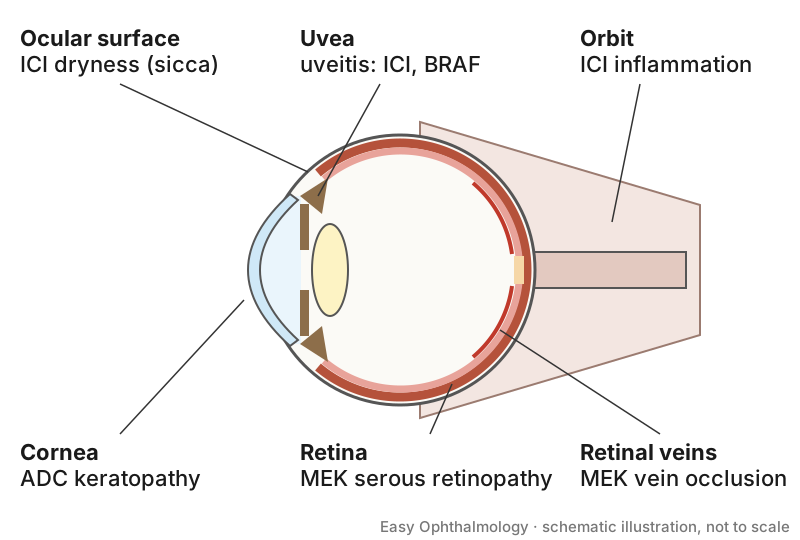
- Checkpoint inhibitors. Anterior, intermediate, posterior uveitis and panuveitis have all been reported [S3]. Most immunotherapy uveitis manifests as iritis, intermediate uveitis or VKH-like disease [S11]. Sicca (ocular and oral dryness) differs from Sjögren disease in its pathophysiology [S12].
- BRAF inhibitors have the highest percentage of uveitis among these drug classes [S11].
- MEK inhibitors. A transient neurosensory detachment is seen in almost all patients [S6]. Other effects include visual disturbance, dry eye, adnexal changes, field defects, panuveitis and retinal vein occlusion [S1].
- Antibody-drug conjugates. Symptoms include blurred vision and foreign-body sensation; signs include corneal staining, corneal pseudomicrocysts and conjunctivitis [S9]. In DREAMM-2, grade 3 to 4 keratopathy occurred in 27% and 21% of the two dose cohorts [S2].
- Other drugs. Tamoxifen can cause crystalline retinopathy and taxanes a macular oedema with angiographic silence [S6].
Confirm it
- Take a full systemic drug history: diagnosing drug-induced uveitis requires a high index of suspicion and temporal correlation, after excluding infectious and autoimmune causes [S10].
- Use OCT to detect MEK-associated subretinal fluid and tamoxifen-related changes, which may be present in asymptomatic patients [S6].
- Examine the cornea with fluorescein in patients on ADCs [S9].
Manage it
Before acting on this section, check the national and local guidelines, product information and regulatory approvals that apply where you practise. See the medical disclaimer.
Tier A (primary care / oncology clinic, no eye specialist)
- Ask patients on ICIs, BRAF/MEK inhibitors or ADCs about blurred vision, pain, redness, dryness and floaters, and teach home symptom monitoring [S11].
- For dry eye symptoms, artificial tears are part of a graded symptomatic approach [S12] [S9].
- Do not stop cancer treatment without the oncologist; most ophthalmic adverse effects can be treated without discontinuing it [S5].
Tier B (general eye clinic)
- Uveitis. Treat with topical, intravitreal or oral corticosteroids according to severity [S11]; prompt recognition and steroid treatment are critical [S3].
- ADC keratopathy. Dose delay or reduction appears beneficial and most events are reversible; the benefit of cool compresses, artificial tears, vasoconstrictors and topical steroids is unclear [S9].
- MEK retinopathy may subside with continued use over weeks or months or after discontinuation, with some exceptions [S1].
- Doses of anticancer drugs and steroids are not covered here: follow oncology protocols and local formularies.
Tier C (specialist centre)
- Agree with the oncologist on dose holds or modifications; cessation of immunotherapy is a last-line measure [S11].
- Identify the vision-threatening and life-threatening situations that require stopping therapy jointly with the oncologist [S5].
- Plan baseline and follow-up examinations with oncology for drugs with frequent ocular toxicity [S11] [S9].
Refer when
| Situation | Urgency |
|---|---|
| Reduced vision, eye pain or floaters on ICI or BRAF/MEK therapy | Urgent to an eye clinic [S3] [S11]; timing per your local service or specialist advice |
| Sudden vision loss (possible vascular occlusion or severe uveitis) | Same-day [S1] [S6] |
| Dryness or blurred vision on an ADC or ICI without vision loss | Routine [S9] [S12]; timing per your local service or specialist advice |
Pitfalls
- Missing uveitis that starts weeks to months after starting an ICI [S3].
- Mistaking drug-induced uveitis for autoimmune or infectious disease, or the reverse [S10].
- Stopping cancer treatment for a manageable ocular event [S5] [S9].
- Overtreating mild MEK-associated serous retinopathy, which is usually self-limited [S1].
Evidence notes
| Source | Date | Design |
|---|---|---|
| [S1] | 2019 | Narrative review of trials and reviews |
| [S2] | 2020 | Randomised phase 2 trial (DREAMM-2), 196 patients |
| [S3] | 2021 | Review of 126 published cases |
| [S4] | 2021 | Review of phase 3 trials and 46 case reports |
| [S5] | 2021 | Narrative review |
| [S6] | 2022 | Narrative review |
| [S7] | 2024 | Narrative review |
| [S8] | 2024 | Phase 3 RCT (DREAMM-7), 494 patients, industry-funded |
| [S9] | 2024 | Narrative review |
| [S10] | 2025 | Narrative review |
| [S11] | 2025 | Narrative review |
| [S12] | 2026 | Narrative review |
- Evidence on ICI eye toxicity is mostly case reports and narrative reviews; incidence is not clearly defined [S4].
- DREAMM-2 and DREAMM-7 were funded by GlaxoSmithKline/GSK [S2] [S8].
- The search returned many oncology trials of ADCs (for example mirvetuximab and tisotumab) that were not used here.
- Not covered by these sources: grading scales for ocular toxicity, steroid regimens, screening intervals for specific drugs, and tebentafusp or bispecific antibodies.
Related articles
- Metastatic uveal melanoma and tebentafusp
- Drug-induced optic neuropathy: ethambutol, linezolid and amiodarone
References
See the numbered source list below. Each marker [S#] links to its PubMed and DOI record.
Sources
- [S1] Méndez-Martínez S, Calvo P, Ruiz-Moreno O, Pardiñas Barón N, Leciñena Bueno J, Gil Ruiz MDR, et al. OCULAR ADVERSE EVENTS ASSOCIATED WITH MEK INHIBITORS. Retina (Philadelphia, Pa.). (2019). PubMed 30681641 · doi:10.1097/iae.0000000000002451
- [S2] Lonial S, Lee HC, Badros A, Trudel S, Nooka AK, Chari A, et al. Belantamab mafodotin for relapsed or refractory multiple myeloma (DREAMM-2): a two-arm, randomised, open-label, phase 2 study. The Lancet. Oncology. (2020). PubMed 31859245 · doi:10.1016/s1470-2045(19)30788-0
- [S3] Dow ER, Yung M, Tsui E Immune Checkpoint Inhibitor-associated Uveitis: Review of Treatments and Outcomes. Ocular immunology and inflammation. (2021). PubMed 32815757 · doi:10.1080/09273948.2020.1781902
- [S4] Alba-Linero C, Alba E Ocular side effects of checkpoint inhibitors. Survey of ophthalmology. (2021). PubMed 33440195 · doi:10.1016/j.survophthal.2021.01.001
- [S5] Fortes BH, Tailor PD, Dalvin LA Ocular Toxicity of Targeted Anticancer Agents. Drugs. (2021). PubMed 33788182 · doi:10.1007/s40265-021-01507-z
- [S6] Arora S, Surakiatchanukul T, Arora T, Errera MH, Agrawal H, Lupidi M, et al. Retinal toxicities of systemic anticancer drugs. Survey of ophthalmology. (2022). PubMed 34048859 · doi:10.1016/j.survophthal.2021.05.007
- [S7] Boucher R, Haigh O, Barreau E, Champiat S, Lambotte O, Adam C, et al. Ocular surface toxicities associated with modern anticancer therapies. Survey of ophthalmology. (2024). PubMed 37806566 · doi:10.1016/j.survophthal.2023.10.002
- [S8] Hungria V, Robak P, Hus M, Zherebtsova V, Ward C, Ho PJ, et al. Belantamab Mafodotin, Bortezomib, and Dexamethasone for Multiple Myeloma. The New England journal of medicine. (2024). PubMed 38828933 · doi:10.1056/nejmoa2405090
- [S9] Dy GK, Farooq AV, Kang JJ Ocular adverse events associated with antibody-drug conjugates for cancer: evidence and management strategies. The oncologist. (2024). PubMed 39046895 · doi:10.1093/oncolo/oyae177
- [S10] Lu LM, Wilkinson VMT, Niederer RL Drug-Induced Uveitis: Patterns, Pathogenesis and Clinical Implications. Clinical optometry. (2025). PubMed 40589424 · doi:10.2147/opto.s492202
- [S11] Warszawski N, Feng M, Bhuyan A, Fonollosa A, Sobrin L, Berkenstock MK Immunotherapy and Direct Acting Anti-Cancer Agent Associated-Uveitis. Ocular immunology and inflammation. (2025). PubMed 41231847 · doi:10.1080/09273948.2025.2584913
- [S12] Belkhir R, Gosset M, Rousseau A, Bitoun S, Lazure T, Mariette X, et al. Sicca induced by immune checkpoint inhibitors. Presse medicale (Paris, France : 1983). (2026). PubMed 41285240 · doi:10.1016/j.lpm.2025.104331