Educational content only. Not personalised medical advice. Clinical decisions remain the responsibility of the treating clinician.
Herpes zoster ophthalmicus
Herpes zoster ophthalmicus (HZO) is reactivation of varicella zoster virus in the ophthalmic division of the trigeminal nerve, affecting about 4 to 20% of people with zoster [S6] [S12]. About half of patients with HZO develop ocular disease, and up to 25% of those have chronic or recurrent disease [S6]. Prompt antiviral therapy moderates vision-threatening complications, and vaccination prevents HZO [S6] [S12].
Key points - Start oral antivirals early: oral acyclovir was superior to placebo for preventing ocular manifestations, and famciclovir and valacyclovir gave comparable results [S2]. - Hutchinson's sign (nasociliary involvement) raises the odds of eye involvement about six-fold, but its absence does not exclude it [S9]. - Ocular involvement needs urgent ophthalmic consultation [S6]. - In the ZEDS RCT, one year of low-dose suppressive valacyclovir did not meet its primary end point but reduced events at 18 months [S7]. - The recombinant zoster vaccine was superior to the live vaccine and to placebo for preventing zoster [S3].
Evidence last checked: 2026-10-17 (PubMed abstracts).
Red flags
- Any eye involvement with an HZO rash requires urgent ophthalmic consultation [S6].
- Hutchinson's sign. Ocular involvement occurred in 78% of patients with the sign versus 34% without (OR 6.51, 95% CI 4.09 to 10.34) [S9].
- Double vision or a drooping lid. Up to a third of patients with HZO may develop ophthalmoplegia [S5].
- Vision loss from optic neuropathy or retinitis, which are uncommon [S6]; optic neuritis caused irreversible vision loss in some children [S4].
- Reduced corneal sensation. Neurotrophic keratopathy risk increases with recurrences of HZO [S10].
Recognise it
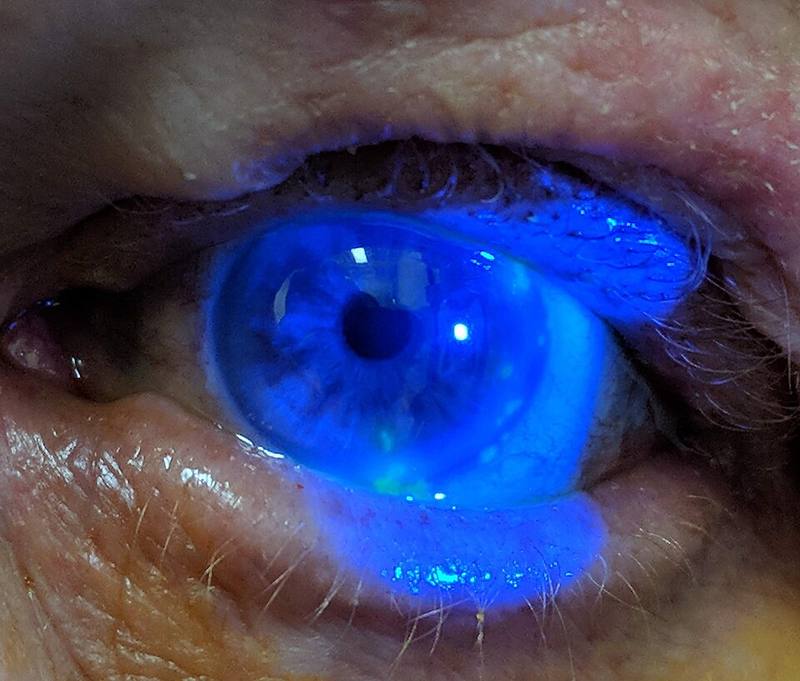
- Who is at risk. Increasing age and immunosuppression are the major risk factors [S6]. Incidence in the UK reaches 12.2 per 1000 population in people over 85 years [S12].
- Children. HZO occurs in healthy and immunocompromised children; major risk factors are intrauterine varicella exposure or varicella at a young age, and it has occurred after varicella vaccination [S4].
- Ocular manifestations. Common: conjunctivitis, keratitis and uveitis; uncommon: optic neuropathy and retinitis [S6]. In ZEDS, endpoints were stromal keratitis, endothelial keratitis, iritis and dendriform epithelial keratitis [S7].
Confirm it
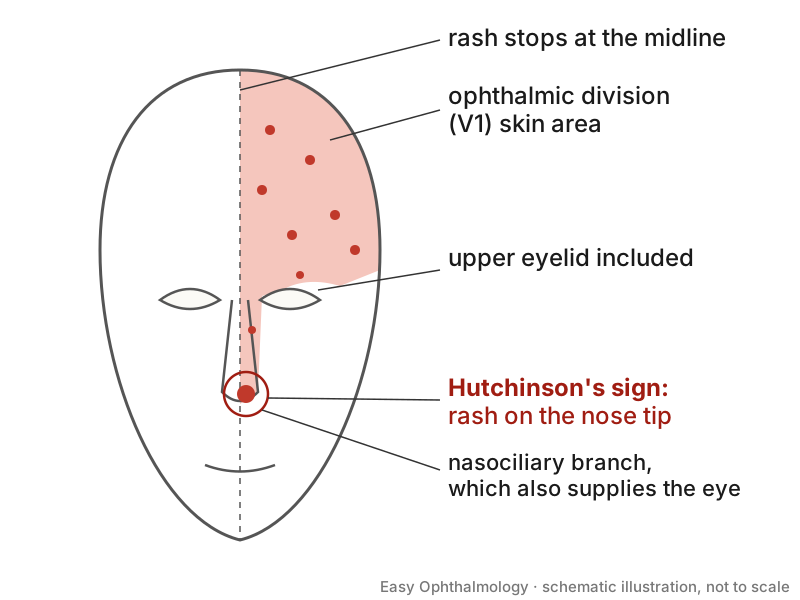
- Diagnosis is primarily clinical [S4].
- Hutchinson's sign has high specificity (89.2%) and positive predictive value (88.5%) but moderate sensitivity (52.6%) for ocular involvement, on low to very low certainty evidence [S9]. Examine every patient with HZO for eye involvement whether or not the sign is present [S9].
Manage it
Before acting on this section, check the national and local guidelines, product information and regulatory approvals that apply where you practise. See the medical disclaimer.
Tier A (primary care / no specialist)
- Start oral antivirals promptly; early treatment may prevent ocular complications [S6].
- Regimens reported in a systematic review of 3 RCTs (as reported in [S2]): acyclovir 800 mg 5 times daily for 7 or 10 days, famciclovir 500 mg 3 times daily for 7 days, or valacyclovir 1000 mg 3 times daily for 7 days. Famciclovir and valacyclovir have simpler dosing [S2]. Otherwise follow local formularies.
- Refer any patient with eye symptoms or signs (see "Refer when").
Tier B (general eye clinic)
- Antiviral choice. A Cochrane review found only one poorly reported RCT (110 patients) comparing valacyclovir and acyclovir, with very low-certainty evidence and no clear difference [S1]. A 2026 review highlights valacyclovir's better bioavailability and simpler dosing [S12].
- Stromal keratitis. In ZEDS, 20% of 527 participants developed new, recurrent or worsening stromal keratitis; most kept very good vision when monitored closely and treated, usually with topical steroids, and only 10% received open-label oral antivirals [S11]. The authors suggest considering low-potency topical steroids for treatment and ongoing suppression [S11].
- Ophthalmoplegia. Complete recovery was similar with antivirals alone or antivirals plus oral steroids in a case series and review of 76 cases; age predicted recovery [S5].
Tier C (specialist centre)
- Suppressive valacyclovir (ZEDS, 2025). Immunocompetent adults with HZO and keratitis or iritis within the previous year received valacyclovir 1000 mg daily or placebo for 12 months, as reported in [S7]. The primary end point at 12 months was not met (28% vs 33%; HR 0.77, 95% CI 0.56 to 1.05); at 18 months events were fewer (32% vs 40%; HR 0.73, 95% CI 0.55 to 0.97) [S7]. The authors support considering 1 year of suppression [S7]; an independent review calls the evidence for suppression weak [S12].
- Postherpetic neuralgia. Suppressive valacyclovir did not reduce its prevalence at 12 months but was associated with lower doses of neuropathic pain medication and shorter pain duration at 18 months [S8].
- Neurotrophic keratopathy. Vaccination and suppressive valacyclovir are recommended to reduce recurrences and NK risk, in an expert review [S10].
- Prevention. In a network meta-analysis, the adjuvanted recombinant vaccine was superior to the live vaccine (vaccine efficacy 85%) and placebo (94%) but caused more injection-site and systemic adverse events [S3]. Its effectiveness against HZO is reported as 67 to 93% [S12]. Data on preventing recurrence in people who already had HZO are limited, but vaccination is recommended [S6].
Refer when
| Situation | Urgency |
|---|---|
| HZO rash with red eye, reduced vision, pain in the eye or Hutchinson's sign | Same-day ophthalmic review [EIC expert opinion] [S6] |
| Double vision, sudden vision loss or suspected optic neuritis | Immediate to an eye or neuro-ophthalmology service |
| Recurrent keratitis or iritis after HZO | Urgent to an eye clinic; timing per your local service or specialist advice |
Pitfalls
- Reassuring a patient because Hutchinson's sign is absent [S9].
- Stopping topical steroids abruptly; 38% of those without steroids at stromal keratitis recurrence had stopped them in the prior 3 months [S11].
- Forgetting HZO in children, including vaccinated children [S4].
- Not offering zoster vaccination [S6].
Evidence notes
| Source | Date | Design |
|---|---|---|
| [S1] | 2016 | Cochrane systematic review, 1 RCT |
| [S2] | 2018 | Systematic review of 3 RCTs with cost comparison |
| [S3] | 2018 | Systematic review and network meta-analysis, 27 studies |
| [S4] | 2023 | Systematic review of 130 paediatric cases |
| [S5] | 2024 | Case series and case-report systematic review |
| [S6] | 2024 | Narrative review |
| [S7] | 2025 | Multicentre double-masked RCT (ZEDS), 527 participants |
| [S8] | 2025 | ZEDS secondary analysis, postherpetic neuralgia |
| [S9] | 2026 | Systematic review and meta-analysis, 14 observational studies |
| [S10] | 2026 | Expert review |
| [S11] | 2026 | ZEDS secondary analysis, stromal keratitis |
| [S12] | 2026 | Narrative review |
- ZEDS benefits are on secondary end points only [S7] [S8]; sources disagree on how strongly to recommend suppression [S7] [S12].
- ZEDS was run in Canada, New Zealand and the US [S8]; vaccine effectiveness data are largely for zoster rather than HZO [S6].
- Antiviral trials are few, small and dated [S1] [S2].
- Not covered by these sources: management of immunocompromised patients and HIV, acute retinal necrosis, and antiviral dosing in kidney disease.
Related articles
References
See the numbered source list below. Each marker [S#] links to its PubMed and DOI record.
Sources
- [S1] Schuster AK, Harder BC, Schlichtenbrede FC, Jarczok MN, Tesarz J Valacyclovir versus acyclovir for the treatment of herpes zoster ophthalmicus in immunocompetent patients. The Cochrane database of systematic reviews. (2016). PubMed 27841441 · doi:10.1002/14651858.cd011503.pub2
- [S2] Fan S, Stojanovic D, Malvankar-Mehta MS, Hutnik C Treatment of herpes zoster ophthalmicus: a systematic review and Canadian cost-comparison. Canadian journal of ophthalmology. Journal canadien d'ophtalmologie. (2018). PubMed 29631821 · doi:10.1016/j.jcjo.2017.08.005
- [S3] Tricco AC, Zarin W, Cardoso R, Veroniki AA, Khan PA, Nincic V, et al. Efficacy, effectiveness, and safety of herpes zoster vaccines in adults aged 50 and older: systematic review and network meta-analysis. BMJ (Clinical research ed.). (2018). PubMed 30361202 · doi:10.1136/bmj.k4029
- [S4] Hakim FE, Riaz K, Farooq A Pediatric herpes zoster ophthalmicus: a systematic review. Graefe's archive for clinical and experimental ophthalmology = Albrecht von Graefes Archiv fur klinische und experimentelle Ophthalmologie. (2023). PubMed 36949170 · doi:10.1007/s00417-023-06033-0
- [S5] Sverdlichenko I, Tayeb S, Zaslavsky K, Micieli JA, Margolin EA Antivirals vs Antivirals and Steroids for Treatment of Herpes Zoster-Related Ophthalmoplegia: A Case Series and Systematic Review. Journal of neuro-ophthalmology : the official journal of the North American Neuro-Ophthalmology Society. (2024). PubMed 37307095 · doi:10.1097/wno.0000000000001901
- [S6] Litt J, Cunningham AL, Arnalich-Montiel F, Parikh R Herpes Zoster Ophthalmicus: Presentation, Complications, Treatment, and Prevention. Infectious diseases and therapy. (2024). PubMed 38834857 · doi:10.1007/s40121-024-00990-7
- [S7] Cohen EJ, Troxel AB, Liu M, Hochman JS, Baratz KH, Mian SI, et al. Low-Dose Valacyclovir in Herpes Zoster Ophthalmicus: The Zoster Eye Disease Randomized Clinical Trial. JAMA ophthalmology. (2025). PubMed 40048183 · doi:10.1001/jamaophthalmol.2024.6114
- [S8] Warner DB, Jeng BH, Kim J, Liu M, Troxel AB, Hochman JS, et al. Low-Dose Valacyclovir for Postherpetic Neuralgia in the Zoster Eye Disease Study: A Randomized Clinical Trial. JAMA ophthalmology. (2025). PubMed 40048191 · doi:10.1001/jamaophthalmol.2024.6113
- [S9] Mihalache A, Yu P, Tao BK, Xie JS, Margolin EA, Micieli JA Hutchinson's Sign in Herpes Zoster Ophthalmicus: A Systematic Review and Meta-Analysis. Ophthalmology. (2026). PubMed 41223901 · doi:10.1016/j.ophtha.2025.10.019
- [S10] Jeng BH Neurotrophic Keratopathy in Herpes Zoster Ophthalmicus. Eye & contact lens. (2026). PubMed 41430591 · doi:10.1097/icl.0000000000001252
- [S11] Jacobs DS, Lee T, Asbell P, Shen J, Choulakian M, Holland GN, et al. Stromal Keratitis in the Zoster Eye Disease Study: Lessons Learned. American journal of ophthalmology. (2026). PubMed 41655829 · doi:10.1016/j.ajo.2026.01.034
- [S12] Milligan AL, Larkin F Update on treatment and prophylaxis of herpes zoster ophthalmicus. The British journal of ophthalmology. (2026). PubMed 42270293 · doi:10.1136/bjo-2025-328899