Educational content only. Not personalised medical advice. Clinical decisions remain the responsibility of the treating clinician.
Glaucoma Medications: Choices, Adherence and Side Effects
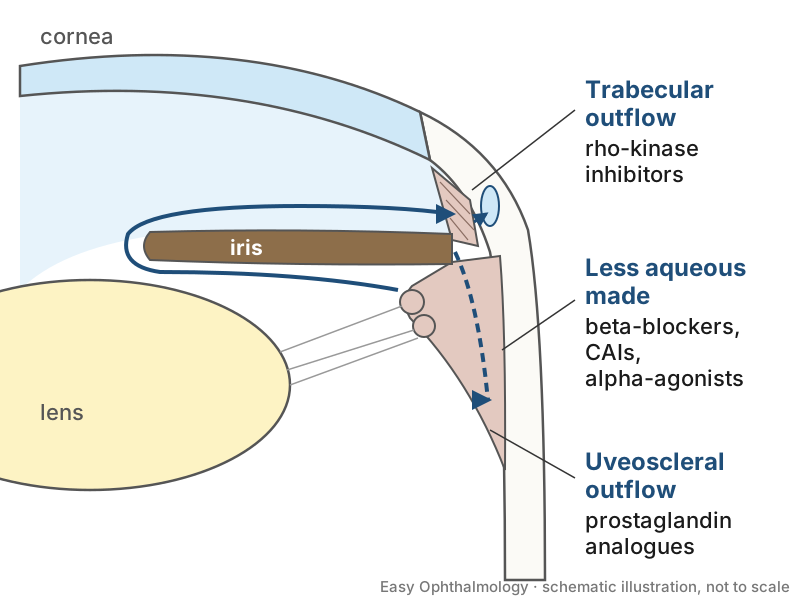
Topical medication is the most common first-line treatment for glaucoma, yet adherence is notably low [S10]. Prostaglandin analogues lower intraocular pressure (IOP) the most among single drugs [S1] [S11], but under half of patients on them are adherent at one year [S9], so drug choice, side effects and the patient's ability to use drops all matter.
Key points - Prostaglandin F2α analogues (PGFAs) lowered IOP by 4.75 mmHg in a 166-trial network meta-analysis; alpha-agonists, beta-blockers and rho-kinase inhibitors lowered it by about 3.2 to 3.4 mmHg [S11]. - PGFA plus carbonic anhydrase inhibitor (CAI) was the strongest combination and showed synergy; PGFA plus beta-blocker and PGFA plus rho-kinase inhibitor showed antagonism [S11]. - Bimatoprost lowered IOP slightly more than latanoprost but caused more conjunctival hyperaemia; latanoprost and tafluprost were better tolerated [S12]. - Only 44% of patients on prostaglandin analogues were adherent at year 1 [S9]; in Ethiopia, adherence was 49.46%, and paying for drops oneself cut the odds of adherence [S8].
Evidence last checked: 2026-10-17 (PubMed abstracts).
Red flags
- Systemic beta-blocker effects: timolol significantly reduced heart rate at all visits in a phase 3 trial [S3]. Check pulse and cardiorespiratory history before prescribing [EIC expert opinion].
- Falling adherence over time: persistence on prostaglandin analogues fell from 75% at 6 months to 31% at 3 years [S9]. Progression on "maximal therapy" may be non-adherence.
- Drops not reaching the eye: 25% of patients reading below high-school level failed to instil the drop into the eye [S5].
Recognise it: side effects by class
| Class | Side effects reported in these sources |
|---|---|
| Prostaglandin analogues | Conjunctival hyperaemia, highest with bimatoprost (OR 3.3 vs latanoprost) [S12]; periocular skin hyperpigmentation and eyelash changes [S2] |
| Beta-blockers | Reduced heart rate [S3]; preserved drops gave worse tear break-up time and Schirmer results than preservative-free [S6] |
| Carbonic anhydrase inhibitors | Taste abnormality with brinzolamide and dorzolamide; blurred vision with brinzolamide; ocular discomfort with dorzolamide [S4] |
| Alpha-agonists | Ocular hyperaemia with brimonidine [S4] |
| Rho-kinase inhibitors | Conjunctival hyperaemia (19% to 65%), conjunctival haemorrhage (6% to 20%), cornea verticillata (13% to 26%) [S7] |
Confirm it: is the treatment working?
- Measure IOP response against baseline; in trials, efficacy was mean IOP reduction at fixed times of day [S3] [S4].
- Ask about and observe drop technique: instilling the drop, dispensing one drop and avoiding bottle contamination were the criteria used in [S5].
- Ask who pays for drops and where the patient lives; urban residence and good vision were linked to adherence [S8].
Manage it
Before acting on this section, check the national and local guidelines, product information and regulatory approvals that apply where you practise. See the medical disclaimer.
Tier A (primary care / no specialist)
- Do not stop prescribed glaucoma drops without the eye service; check that the patient can obtain and instil them [S5] [S8] [EIC expert opinion].
- Dosing is not covered in detail by these sources beyond the trial regimens below; follow local formularies.
Tier B (general eye clinic)
- First line. Any active first-line drug lowers IOP compared with placebo; bimatoprost, latanoprost and travoprost are among the most effective, but within-class differences are small and cost, adverse effects and preference should guide the choice [S1]. Latanoprost or tafluprost suit patients with mild disease because of better tolerability [S12].
- Adding a second drug. PGFA plus CAI ranked highest of combinations [S11]. Brinzolamide added to a prostaglandin analogue or beta-blocker lowered IOP, with effect similar to timolol or dorzolamide as add-on [S4].
- Non-PGFA options. A triple combination of alpha-agonist, beta-blocker and CAI lowered IOP by 7.22 mmHg, similar to the best PGFA-based combinations (low certainty) [S11]; useful where prostaglandins are unavailable or not tolerated.
- Adherence support. Multifaceted behavioural interventions may increase the proportion of adherent patients (RR 1.18), but the evidence is very uncertain and IOP or field benefits were not shown [S10]. Health education and subsidised medication were recommended in Ethiopia [S8].
- Instillation technique. Eyelid closure after instillation did not change IOP reduction (moderate certainty), and wiping excess fluid may reduce periocular pigmentation (low certainty) [S2].
Tier C (specialist centre)
- Rho-kinase inhibitors. Netarsudil 0.02% once daily (as reported in [S3]) was non-inferior to timolol 0.5% twice daily, with conjunctival hyperaemia in 47.9% [S3]. Across trials, rho-kinase inhibitors were non-inferior to timolol and effective as add-on [S7].
- Preservative-free drops. Preservative-free beta-blockers lowered IOP similarly to preserved drops, with some ocular surface measures favouring preservative-free; evidence is low certainty [S6].
- When drops fail through adherence, procedural treatments that do not depend on daily drops may have value [S9].
Refer when
| Situation | Urgency |
|---|---|
| Patient on glaucoma drops with sudden pain, redness and reduced vision | Same-day to an eye service [G1] |
| IOP not controlled or field worsening despite two or more drugs | Urgent to a glaucoma service; timing per your local service or specialist advice |
| Patient cannot afford, obtain or instil drops | Routine to discuss laser or surgery [S8] [S9]; timing per your local service or specialist advice |
Pitfalls
- Adding timolol to a prostaglandin by reflex, despite antagonism in the component analysis [S11].
- Switching between prostaglandin analogues expecting large gains: differences are small [S1] [S12].
- Escalating therapy without checking technique or adherence [S5] [S9].
- Ignoring cost: paying out of pocket strongly reduced adherence [S8].
Evidence notes
| Source | Date | Design |
|---|---|---|
| [S1] | 2016 | Network meta-analysis, 114 RCTs |
| [S2] | 2017 | Cochrane review, 2 small trials |
| [S3] | 2019 | Phase 3 RCT (ROCKET-4) |
| [S4] | 2019 | Meta-analysis, 26 RCTs |
| [S5] | 2022 | Substudy of a single-site RCT, US veterans |
| [S6] | 2022 | Systematic review, 7 RCTs |
| [S7] | 2022 | Meta-analysis, 10 prospective RCTs |
| [S8] | 2024 | Meta-analysis, 6 Ethiopian studies |
| [S9] | 2025 | Meta-analysis of 47 observational studies |
| [S10] | 2025 | Cochrane review, 17 RCTs |
| [S11] | 2025 | Component network meta-analysis, 166 RCTs |
| [S12] | 2025 | Bayesian network meta-analysis, 25 RCTs |
- Most efficacy evidence is short term (weeks to months) [S1] [S7] [S3].
- The adherence meta-analysis [S9] concludes in favour of procedural treatment; its funding is not stated in the abstract. The Cochrane review found that all but one adherence trial had multiple funding sources [S10].
- Rankings across network meta-analyses agree on prostaglandin superiority but differ in certainty [S1] [S11] [S12].
- Not covered by these sources: contraindications in asthma and heart block, pregnancy and breastfeeding, oral acetazolamide, generic drug quality, and availability of drugs in low-income settings.
Related articles
- Primary Open-Angle Glaucoma: Diagnosis and Treatment Targets
- Selective Laser Trabeculoplasty as First-Line Treatment
- Mydriatics, cycloplegics and their risks
References
See the numbered source list below. Each marker [S#] links to its PubMed and DOI record.
Sources
- [S1] Li T, Lindsley K, Rouse B, Hong H, Shi Q, Friedman DS, et al. Comparative Effectiveness of First-Line Medications for Primary Open-Angle Glaucoma: A Systematic Review and Network Meta-analysis. Ophthalmology. (2016). PubMed 26526633 · doi:10.1016/j.ophtha.2015.09.005
- [S2] Xu L, Wang X, Wu M Topical medication instillation techniques for glaucoma. The Cochrane database of systematic reviews. (2017). PubMed 28218404 · doi:10.1002/14651858.cd010520.pub2
- [S3] Khouri AS, Serle JB, Bacharach J, Usner DW, Lewis RA, Braswell P, et al. Once-Daily Netarsudil Versus Twice-Daily Timolol in Patients With Elevated Intraocular Pressure: The Randomized Phase 3 ROCKET-4 Study. American journal of ophthalmology. (2019). PubMed 30862500 · doi:10.1016/j.ajo.2019.03.002
- [S4] Liu Y, Zhao J, Zhong X, Wei Q, Huang Y Efficacy and Safety of Brinzolamide as Add-On to Prostaglandin Analogues or β-Blocker for Glaucoma and Ocular Hypertension: A Systematic Review and Meta-Analysis. Frontiers in pharmacology. (2019). PubMed 31293419 · doi:10.3389/fphar.2019.00679
- [S5] Kang JM, Chatterjee A, Rosdahl JA, Bosworth HB, Woolson S, Olsen M, et al. Health Literacy and Success with Glaucoma Drop Administration. Ophthalmology. Glaucoma. (2022). PubMed 34052458 · doi:10.1016/j.ogla.2021.05.004
- [S6] Skov AG, Rives AS, Freiberg J, Virgili G, Azuara-Blanco A, Kolko M Comparative efficacy and safety of preserved versus preservative-free beta-blockers in patients with glaucoma or ocular hypertension: a systematic review. Acta ophthalmologica. (2022). PubMed 34128326 · doi:10.1111/aos.14926
- [S7] Wu JH, Chang SN, Nishida T, Kuo BI, Lin JW Intraocular pressure-lowering efficacy and ocular safety of Rho-kinase inhibitor in glaucoma: a meta-analysis and systematic review of prospective randomized trials. Graefe's archive for clinical and experimental ophthalmology = Albrecht von Graefes Archiv fur klinische und experimentelle Ophthalmologie. (2022). PubMed 34491427 · doi:10.1007/s00417-021-05379-7
- [S8] Abore KW, Fole EB, Abebe MT, Tekle NF, Tilahun RB, Chinkey FD, et al. Adherence and factors influencing adherence to glaucoma medications among adult glaucoma patients in Ethiopia: A systematic review and meta-analysis. PloS one. (2024). PubMed 38478513 · doi:10.1371/journal.pone.0293047
- [S9] Baudouin C, Myers JS, Van Tassel SH, Goyal NA, Martinez-de-la-Casa J, Ng A, et al. Adherence and Persistence on Prostaglandin Analogues for Glaucoma: A Systematic Review and Meta-Analysis. American journal of ophthalmology. (2025). PubMed 40113120 · doi:10.1016/j.ajo.2025.03.025
- [S10] Kruoch Z, Amin P, Shelton E, Zimmerman AB, Stephey E, Hunter M, et al. Multifaceted behavioral interventions to improve topical glaucoma therapy adherence in adults. The Cochrane database of systematic reviews. (2025). PubMed 40497459 · doi:10.1002/14651858.cd015788.pub2
- [S11] Hsia Y, Wang C, Su CC, Huang JY, Wang TH, Tu YK Efficacy and Drug Interactions of Glaucoma Medications: A Systematic Review and Component Network Meta-analysis. Ophthalmology. (2025). PubMed 40701331 · doi:10.1016/j.ophtha.2025.07.009
- [S12] Peng J, Huang W, Duan J Efficacy and safety of prostaglandin drugs for elevated intraocular pressure: a Bayesian network meta-analysis. Frontiers in medicine. (2025). PubMed 40861241 · doi:10.3389/fmed.2025.1642986
Guidelines
- [G1] NHS Scotland Community Eyecare Guidelines. 6.4 Glaucoma, Acute Angle Closure (n.d.). https://www.eyes.nhs.scot/eyecare-guidelines/section-6-glaucoma/64-glaucoma-acute-angle-closure/