Educational content only. Not personalised medical advice. Clinical decisions remain the responsibility of the treating clinician.
Fungal keratitis
Fungal keratitis is a severe corneal infection that often results in blindness and eye loss, most prevalent in tropical and subtropical climates and frequently affecting young agricultural workers of low socioeconomic status [S3]. It probably affects over a million people each year, and 8 to 11% of patients in three case series lost the eye [S3]. Early diagnosis and treatment can preserve vision [S3].
Key points - The minimum estimated annual incidence is 1 051 787 cases, highest in Asia and Africa [S3]. - Corneal scraping for microscopy and culture is the standard for diagnosis [S4] [S6]. - Topical natamycin is first-line for filamentous fungal keratitis; in a Cochrane review it reduced perforation or therapeutic keratoplasty compared with voriconazole (high-quality evidence) [S1] [S7]. - Inappropriate corticosteroid drops, ineffective antibacterial therapy and diagnostic delay contribute to poor outcomes in low-resource settings [S6]. - Severe or non-responding cases may need intrastromal or intracameral antifungals or therapeutic keratoplasty [S7] [S9].
Evidence last checked: 2026-10-17 (PubMed abstracts).
Red flags
- Corneal ulcer after trauma, especially with vegetable matter or in a farmer. Antecedent trauma is a significant predisposing factor [S4].
- Ulcer on steroid drops or not responding to antibiotics. Inappropriate steroid drops and ineffective antibacterial treatment worsen outcomes [S6].
- Delayed diagnosis. Correct identification of fungal infection is often delayed up to 2 to 3 weeks after presentation [S9].
- Thinning or perforation. Fungal infections have a higher rate of perforation requiring surgery than other infectious causes [S9].
- Contact lens wear. Contact lens use was implicated in nearly half of reported Fusarium keratitis cases [S10].
Recognise it
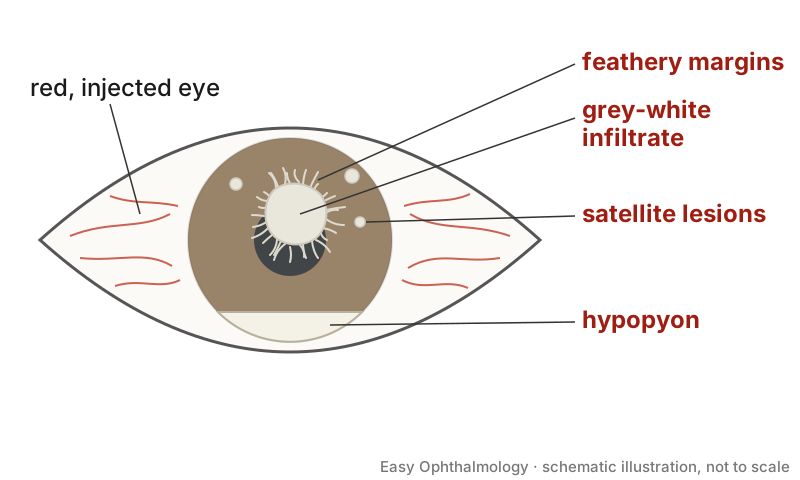
- Who is at risk. Agricultural workers in tropical and subtropical climates [S3]; people with trauma [S4]; contact lens wearers and patients with diabetes or immunosuppression [S11].
- Organisms. Aspergillus and Fusarium are the most common causes [S4]; yeasts, particularly Candida, also occur [S11]. The Fusarium solani species complex predominated in a review of 163 Fusarium cases [S10].
- Signs. Clinical signs are often non-specific [S11].
- Mimic: Pythium. Pythium insidiosum closely resembles fungal keratitis clinically and on smear; reticular dots, tentacular projections, peripheral furrowing and early limbal spread suggest it [S5].
Confirm it
- Corneal scraping with direct microscopy and fungal culture is required for diagnosis [S6] and is the standard of care [S4].
- Other tools include in vivo confocal microscopy, histopathology [S11], PCR and molecular identification, which is especially useful for rare species [S4] [S9].
- Pythium grows on blood agar or other nutritional agar, which is the gold standard; it shows hyphae on 10% KOH and Gram stain like a fungus [S5].
Manage it
Before acting on this section, check the national and local guidelines, product information and regulatory approvals that apply where you practise. See the medical disclaimer.
Tier A (primary care / no specialist)
- Do not start corticosteroid drops on a corneal ulcer: inappropriate steroids contribute to blindness in low-resource settings [S6].
- Refer every suspected infectious corneal ulcer for scraping and antifungal treatment (see "Refer when").
Tier B (general eye clinic)
- Scrape for direct microscopy and culture [S6].
- Topical natamycin first-line [S4] [S7]. In a Cochrane review of 12 trials (10 in India), topical 5% natamycin versus topical 1% voriconazole (as reported in [S1]) gave: - fewer perforations or therapeutic keratoplasties (RR 0.61, 95% CI 0.40 to 0.94; 434 participants; high-quality evidence) [S1]; - more microbiological cure at six days in one trial (RR 1.64, 95% CI 1.38 to 1.94; 299 participants) [S1]; - probably better visual acuity, although the confidence interval included no difference [S1] [S2].
- Alternatives when natamycin is unavailable include voriconazole, chlorhexidine, amphotericin B and econazole [S7]. Voriconazole is described as the best alternative, especially for non-Fusarium cases [S4].
- Treatment is intensive and often prolonged; topical drugs are often unavailable and not always effective [S6] [S7]. Dosing frequency is not covered by these abstracts: follow local formularies.
Tier C (specialist centre)
- Intrastromal or intracameral antifungal injection may be used [S7]; cases not responding to topical therapy need more invasive treatment [S9].
- Therapeutic penetrating keratoplasty may be required for severe cases or perforation [S7]; early surgery is advised in refractory cases [S11]. Recurrence after keratoplasty is high [S4].
- Cross-linking. Evidence for safety and efficacy of cross-linking in fungal keratitis is inconclusive [S8].
- Photodynamic therapy is being tried for non-responsive cases before a therapeutic graft [S4].
- Pythium. Antibacterials (0.2% linezolid and 1% azithromycin, as reported in [S5]) have been suggested as first-line on in vitro evidence, with early therapeutic keratoplasty in non-resolving cases [S5].
Refer when
| Situation | Urgency |
|---|---|
| Any suspected fungal ulcer where scraping or natamycin is unavailable | Same-day to an eye clinic [G1] |
| Deep or enlarging infiltrate, hypopyon, thinning or perforation | Immediate to a cornea service |
| No improvement on topical antifungal treatment | Emergency referral to a cornea service [EIC expert opinion] |
Pitfalls
- Treating a fungal ulcer with steroid or antibiotic drops alone [S6].
- Waiting weeks for a diagnosis: identification is often delayed 2 to 3 weeks [S9].
- Missing Pythium, which looks fungal but is treated differently [S5].
- Assuming contact lens keratitis is bacterial: lens wear was implicated in nearly half of Fusarium cases [S10].
Evidence notes
| Source | Date | Design |
|---|---|---|
| [S1] | 2015 | Cochrane systematic review, 12 RCTs |
| [S2] | 2018 | Summary of systematic reviews, 3 RCTs, GRADE |
| [S3] | 2021 | Systematic review of incidence and diagnosis |
| [S4] | 2022 | Narrative review |
| [S5] | 2022 | Narrative review (Pythium) |
| [S6] | 2022 | Narrative review and advocacy |
| [S7] | 2022 | Narrative review, low-resource focus |
| [S8] | 2023 | Systematic literature review (cross-linking) |
| [S9] | 2024 | Narrative review |
| [S10] | 2024 | Systematic review of 163 case reports |
| [S11] | 2025 | Narrative review |
- Thin primary evidence on this sheet. The fungal-keratitis PubMed sheet contains no primary RCTs with abstracts; the landmark trials (for example the Mycotic Ulcer Treatment Trials) are on the microbial-keratitis sheet and are not cited here. Most sources are narrative reviews (expert opinion).
- The Cochrane trials were of variable quality and generally underpowered; most comparisons rested on one small trial [S1].
- The Fusarium review is based on published case reports, with most cases from the United States, suggesting underreporting from tropical regions [S10].
- Modern detailed guidelines on fungal keratitis diagnosis and management are lacking [S6].
- Not covered by these sources: dosing schedules, duration of therapy, oral antifungals, and prevention after agricultural injury.
Related articles
References
See the numbered source list below. Each marker [S#] links to its PubMed and DOI record.
Sources
- [S1] FlorCruz NV, Evans JR Medical interventions for fungal keratitis. The Cochrane database of systematic reviews. (2015). PubMed 25855311 · doi:10.1002/14651858.cd004241.pub4
- [S2] Retamal J, Ordenes-Cavieres G, Grau-Diez A Natamycin versus voriconazole for fungal keratitis. Medwave. (2018). PubMed 30562337 · doi:10.5867/medwave.2018.08.7387
- [S3] Brown L, Leck AK, Gichangi M, Burton MJ, Denning DW The global incidence and diagnosis of fungal keratitis. The Lancet. Infectious diseases. (2021). PubMed 33645500 · doi:10.1016/s1473-3099(20)30448-5
- [S4] Sharma N, Bagga B, Singhal D, Nagpal R, Kate A, Saluja G, et al. Fungal keratitis: A review of clinical presentations, treatment strategies and outcomes. The ocular surface. (2022). PubMed 34915188 · doi:10.1016/j.jtos.2021.12.001
- [S5] Gurnani B, Kaur K, Venugopal A, Srinivasan B, Bagga B, Iyer G, et al. Pythium insidiosum keratitis - A review. Indian journal of ophthalmology. (2022). PubMed 35325996 · doi:10.4103/ijo.ijo_1534_21
- [S6] Brown L, Kamwiziku G, Oladele RO, Burton MJ, Prajna NV, Leitman TM, et al. The Case for Fungal Keratitis to Be Accepted as a Neglected Tropical Disease. Journal of fungi (Basel, Switzerland). (2022). PubMed 36294612 · doi:10.3390/jof8101047
- [S7] Hoffman JJ, Arunga S, Mohamed Ahmed AHA, Hu VH, Burton MJ Management of Filamentous Fungal Keratitis: A Pragmatic Approach. Journal of fungi (Basel, Switzerland). (2022). PubMed 36294633 · doi:10.3390/jof8101067
- [S8] Manns RPC, Achiron A, Knyazer B, Elhaddad O, Darcy K, Yahalomi T, et al. Use of corneal cross-linking beyond keratoconus: a systemic literature review. Graefe's archive for clinical and experimental ophthalmology = Albrecht von Graefes Archiv fur klinische und experimentelle Ophthalmologie. (2023). PubMed 36881260 · doi:10.1007/s00417-023-05994-6
- [S9] Arboleda A, Ta CN Overview of Mycotic Keratitis. Cornea. (2024). PubMed 39102310 · doi:10.1097/ico.0000000000003559
- [S10] Cintra MEC, da Silva Dantas M, Al-Hatmi AMS, Bastos RW, Rossato L Fusarium Keratitis: A Systematic Review (1969 to 2023). Mycopathologia. (2024). PubMed 39107598 · doi:10.1007/s11046-024-00874-x
- [S11] Bock R, Roth M, Geerling G Mycotic Keratitis - Signs, Diagnosis, Therapy. Klinische Monatsblatter fur Augenheilkunde. (2025). PubMed 40306694 · doi:10.1055/a-2598-5668
Guidelines
- [G1] NHS Scotland (Community Eyecare Guidelines, eyes.nhs.scot). 5.13 Keratitis, Microbial, Fungal (2026). https://www.eyes.nhs.scot/eyecare-guidelines/section-5-corneal/513-keratitis-microbial-fungal/