Educational content only. Not personalised medical advice. Clinical decisions remain the responsibility of the treating clinician.
The eye care workforce and task sharing
Too few eye-care workers, unevenly distributed, is a central reason why avoidable blindness persists, especially in rural areas [S8] [S10]. WHO names both task shifting and more human resources for eye health as tools to improve access [S8]. Task shifting works when it comes with training, supervision, clear roles and a supportive policy environment [S3] [S5] [S11].
Key points - Sierra Leone had only 6 ophthalmologists for the whole country, while 91.5% of its blindness was estimated to be avoidable [S3]. - In a randomised non-inferiority trial, nurse-administered intravitreal injections gave visual outcomes non-inferior to physician injections at one year [S2]. - Trained non-ophthalmologists and general physicians using portable cameras showed good agreement with reference standards for diabetic retinopathy screening [S9]. - Enhanced, skills-based supervision improved primary eye care knowledge and vision-testing skills compared with routine supervision [S1]. - Incentives, financial and non-financial, help start task shifting and improve rural recruitment and retention, particularly of mid-level eye-care professionals [S8].
Evidence last checked: 2026-10-18 (PubMed abstracts).
Red flags: signs that need urgent action
- A new cadre without a post: in Sierra Leone, unimplemented policy left ophthalmic community health officers posted at the wrong level, dissatisfied with certification and without career paths [S3].
- High staff attrition: 24% of Tanzanian primary health workers were lost within a year, 44% among clinical officers [S1].
- Task shifting without referral capacity: a community health worker programme in India tripled referrals but did not detectably reduce corneal ulcers [S4].
- No competency framework or incentives for community workers [S11].
- Uneven workforce distribution and inadequate funding in national frameworks [S10].
Recognise it: workforce gaps and cadres
- Rural and underserved areas have the greatest burden of blindness and the least access [S8].
- Restricted scope of practice: in Kenya only optometrists, ophthalmologists and ophthalmic clinical officers may refract [S7].
- Cadres used for task sharing include ophthalmic community health officers [S3], nurses [S2], community and allied health workers [S11], community cadres [S6], community health workers [S4] and primary health workers [S1].
- Tasks shifted successfully include health education, visual acuity screening, portable fundus photography, referral navigation and digital data management [S11].
Confirm it: is task shifting working?
- Measure outcomes, not only activity: nurse injections were tested against a three-letter non-inferiority margin, with 2077 injections and 3 ocular adverse events recorded [S2].
- Measure skills directly, for example the ability to describe and demonstrate vision testing [S1].
- Track the downstream effect: referrals rose (incidence rate ratio 3.57) without a detectable change in corneal ulcer incidence [S4].
- Track uptake: cadres motivated people to attend diabetic eye screening, with examination rates about six times higher than before [S6].
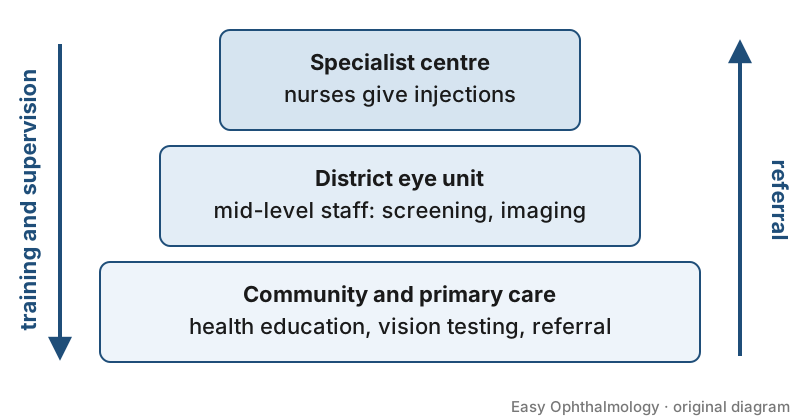
Manage it: building the workforce at each resource tier
Before acting on this section, check the national and local guidelines, product information and regulatory approvals that apply where you practise. See the medical disclaimer.
Tier A (community and primary care)
- Train community health workers and primary care staff in health education, vision testing and referral [S6] [S10] [S11].
- Recruit community workers from the communities they serve; cultural familiarity helped overcome distrust, mobility and language barriers [S11].
- Use job aids and supportive supervision [S5].
Tier B (district eye unit)
- Supervise primary workers with skills-based methods rather than routine visits [S1].
- Use mid-level and allied staff for screening and imaging under supervision [S9] [S11].
- Link non-eye health workers to optometrists by telemedicine for refraction, as proposed by Kenyan opinion leaders [S7].
Tier C (specialist centre and national planners)
- Delegate high-volume procedures where evidence supports it; task shifting injections to nurses can relieve the burden on ophthalmology departments [S2].
- Create posts, career paths and certification before training a new cadre [S3].
- Use in-service training, on-site clinical supervision and mentoring, periodic supportive supervision, job aids and pre-service education [S5].
- Combine task shifting with recruitment and retention incentives tailored to local motivation [S8].
- Include human resources among national strategic pillars; Indian experts reached consensus on task shifting, quality indicators and better referral systems [S12].
Refer when
| Situation | Urgency |
|---|---|
| A community or primary worker sees sudden vision loss, a painful red eye or an eye injury | Same-day to the nearest eye unit |
| Corneal abrasion seen by a community health worker | Within hours to a vision centre or eye clinic |
| Reduced vision found at screening | Routine to an eye clinic; timing per your local service or specialist advice |
Pitfalls
- Training a cadre without policy, posts or advancement [S3].
- Expecting referrals alone to change disease outcomes [S4].
- Neglecting supervision and retention [S1] [S8].
- Assuming results from high-income settings transfer directly; the nurse injection trial was in Norway [S2].
- Leaving community workers without digital tools or integrated referral systems [S11].
Evidence notes
| Source | Date | Design |
|---|---|---|
| [S1] | 2014 | Quasi-experimental cluster randomised study, 36 dispensaries, Tanzania |
| [S2] | 2020 | Randomised non-inferiority trial, 342 patients, Norway |
| [S3] | 2021 | Qualitative study, 42 participants, Sierra Leone |
| [S4] | 2022 | Cluster RCT, 42 communities, India |
| [S5] | 2024 | Scoping review, 38 studies, Africa |
| [S6] | 2024 | Scoping review, LMICs |
| [S7] | 2024 | Delphi study with scoping review, Kenya |
| [S8] | 2024 | Structured literature review, 23 studies |
| [S9] | 2025 | Systematic review and meta-analysis, 25 studies |
| [S10] | 2026 | Narrative review of 14 frameworks |
| [S11] | 2026 | Narrative review, 22 studies |
| [S12] | 2026 | Expert consensus, India |
- Thin evidence: only two randomised trials on task shifting itself [S2] [S4], one from a high-income setting; most sources are reviews, qualitative work or expert opinion.
- The search returned no global workforce density data, so numbers of ophthalmologists or optometrists per population are not given.
- Task shifting of cataract or trichiasis surgery is not covered by these sources.
- Not covered by these sources: workforce ratios and targets, training curricula and licensing.
Related articles
References
See the numbered source list below. Each marker [S#] links to its PubMed and DOI record.
Sources
- [S1] Okwen M, Lewallen S, Courtright P Primary eye care skills scores for health workers in routine and enhanced supervision settings. Public health. (2014). PubMed 24359760 · doi:10.1016/j.puhe.2013.10.007
- [S2] Bolme S, Morken TS, Follestad T, Sørensen TL, Austeng D Task shifting of intraocular injections from physicians to nurses: a randomized single-masked noninferiority study. Acta ophthalmologica. (2020). PubMed 31267688 · doi:10.1111/aos.14184
- [S3] Pente V, Bechange S, Jolley E, Tobi P, Roca A, Ruddock A, et al. Task-shifting eye care to ophthalmic community health officers (OCHO) in Sierra Leone: A qualitative study. Journal of global health. (2021). PubMed 33763216 · doi:10.7189/jogh.11.07001
- [S4] Srinivasan M, Ravilla T, Vijayakumar V, Yesunesan D, Mani I, Whitcher JP, et al. Community Health Workers for Prevention of Corneal Ulcers in South India: A Cluster-Randomized Trial. American journal of ophthalmology. (2022). PubMed 34942106 · doi:10.1016/j.ajo.2021.12.010
- [S5] Okoroafor SC, Dela Christmals C Health Professions Education Strategies for Enhancing Capacity for Task-Shifting and Task-Sharing Implementation in Africa: A Scoping Review. The Journal of continuing education in the health professions. (2024). PubMed 37341562 · doi:10.1097/ceh.0000000000000517
- [S6] Sadikin IS, Lestari YD, Victor AA The role of cadre in the community on diabetic retinopathy management and its challenges in low-middle income countries: a scoping review. BMC public health. (2024). PubMed 38225623 · doi:10.1186/s12889-024-17652-5
- [S7] Muma S, Naidoo KS, Hansraj R Proposed task shifting integrated with telemedicine to address uncorrected refractive error in Kenya: Delphi study. BMC health services research. (2024). PubMed 38254104 · doi:10.1186/s12913-024-10618-8
- [S8] Somerville JG, Strang NC, Jonuscheit S Topical review: Task shifting and the recruitment and retention of eye health workers in underserved areas. Optometry and vision science : official publication of the American Academy of Optometry. (2024). PubMed 38546755 · doi:10.1097/opx.0000000000002118
- [S9] Yudistira Y, Hendrawan KA, Andayani A, Suryathi NMA, Ernawati T, Gunawan ACV, et al. Diabetic Retinopathy Screening Approaches in Developing Countries: A Systematic Review and Meta-Analysis. Turkish journal of ophthalmology. (2025). PubMed 41142633 · doi:10.4274/tjo.galenos.2025.32916
- [S10] Ahuja N, Taghaddos D Global eye care frameworks: a review of strategies, gaps, and recommendations for equitable access. Canadian journal of ophthalmology. Journal canadien d'ophtalmologie. (2026). PubMed 41418819 · doi:10.1016/j.jcjo.2025.11.018
- [S11] Mohan S, Kumaramanickavel G, Stevens F, Scherpbier A Reaching the unreached: Task-shifting diabetic retinopathy screening in urban slums of low- and middle-income countries. Oman journal of ophthalmology. (2026). PubMed 42516341 · doi:10.4103/ojo.ojo_264_25
- [S12] Das T, Khanna R, Krishnan R, Mathur U, Murthy S, Nicholson M, et al. Strategies for strengthening eye care in India: a consensus-based recommendations. The Lancet regional health. Southeast Asia. (2026). PubMed 42609562 · doi:10.1016/j.lansea.2026.100791