Educational content only. Not personalised medical advice. Clinical decisions remain the responsibility of the treating clinician.
Contact lens complications and safe wear
Contact lens wear is the most important risk factor for microbial keratitis, an infection that presents with pain, redness and vision loss and can permanently damage sight [S2] [S11]. The annual incidence of contact lens-associated keratitis is 2 to 4 per 10 000 wearers, and permanent visual damage is very rare (0.6 per 10 000 wearers per year) [S9]. Most of the risk is modifiable: overnight wear, poor hand hygiene and poor storage case hygiene carry the highest attributable risk [S5].
Key points - About 90% of contact lens-associated keratitis is bacterial; Acanthamoeba and fungi are much less common but harder to treat [S8] [S9]. - Any overnight wear, not washing and drying hands before handling lenses, and poor storage case hygiene are the key modifiable risk factors [S5]. - The risk of severe disease is lowest with daily disposable and rigid gas permeable lenses [S5]. - Emergency corneal transplantation is needed in 20% to 30% of fungal and Acanthamoeba infections [S9]. - Orthokeratology wearers had up to 3.79 times the odds of an adverse event compared with conventional contact lens wearers [S10].
Evidence last checked: 2026-10-17 (PubMed abstracts).
Red flags
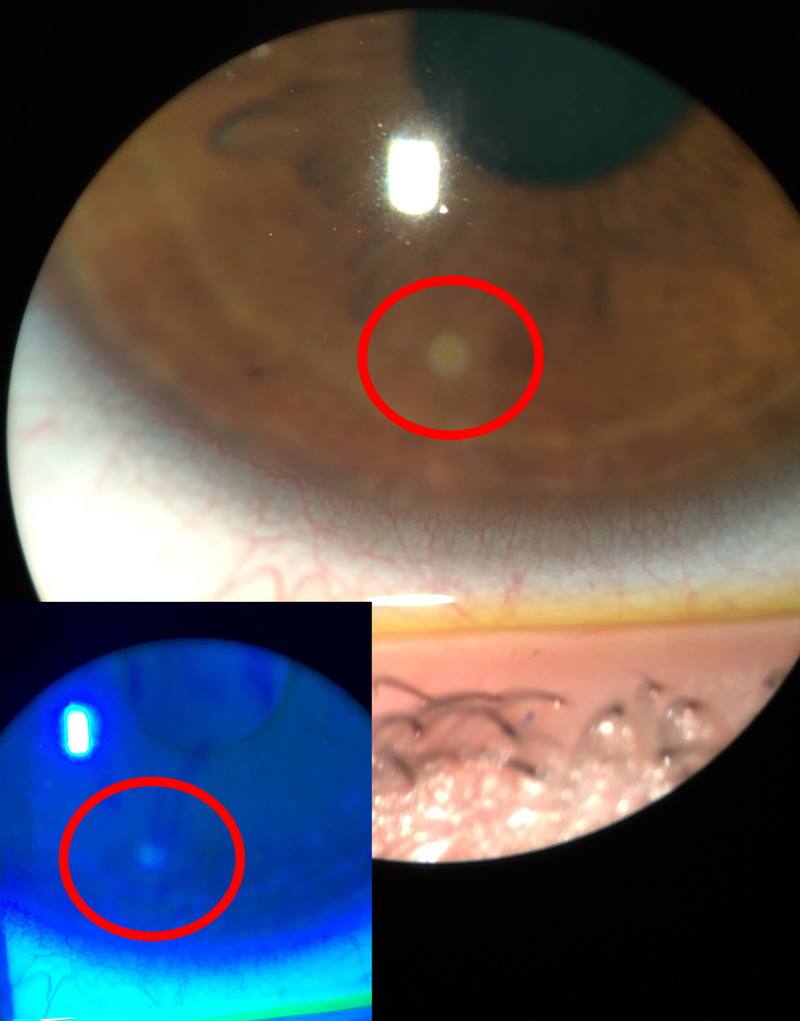
- Contact lens wearer with a painful red eye and reduced vision. This is the typical presentation of microbial keratitis [S11]. Contact lens keratitis usually has a highly acute presentation [S9].
- Corneal infiltrate or ulcer. Advanced bacterial infection usually requires intense topical antibiotic treatment [S9].
- Slow response to antibiotics. Fungal and Acanthamoeba infection are harder to treat [S8].
- Cosmetic or decorative lenses. Their infection risk is an emerging concern, particularly in Asia [S5].
Recognise it: who is at risk
- Compared with keratitis in non-wearers, contact lens keratitis occurs at a younger age and is more often caused by Pseudomonas aeruginosa and Acanthamoeba [S5].
- Overnight wear is the leading risk factor for contact lens-related bacterial infection [S2].
- Children in myopia control: modelling estimated that between 38 and 945 patients need 5 years of lens wear to produce 5 years of vision loss, assuming an incidence of 1 to 25 per 10 000 patient-years [S7].
- 23% to 94% of wearers report lens-related discomfort and eye problems [S9].
Confirm it
- Broad-spectrum topical antimicrobial treatment is the mainstay for infectious keratitis [S6]. Specific presenting signs vary with the organism [S11].
- Corneal scrapes, culture and organism-specific testing are not described in these abstracts; follow local protocols.
Manage it
Before acting on this section, check the national and local guidelines, product information and regulatory approvals that apply where you practise. See the medical disclaimer.
Tier A (primary care / no specialist)
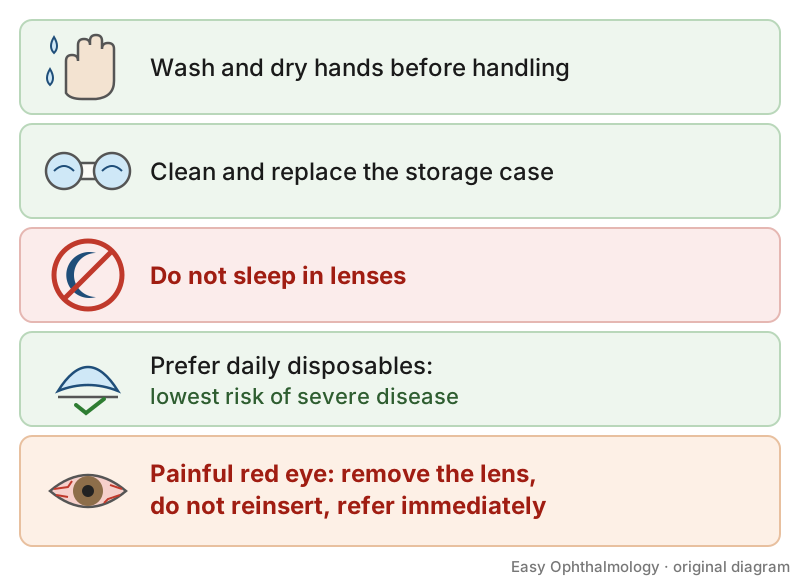
- Prevention advice for every wearer [S5] [S11]: - do not sleep in lenses; - wash and dry hands before handling lenses; - clean and replace the storage case.
- Prefer daily disposables where affordable, as they carry the lowest risk of severe disease [S5]; silicone hydrogel daily disposables may offer health and compliance benefits (narrative review) [S4].
- Painful red eye in a wearer: remove the lens, do not reinsert, and refer immediately (see below).
Tier B (general eye clinic)
- Small, peripheral bacterial ulcers. Fluoroquinolones may be used as monotherapy [S8]. Antibiotic resistance is a persistent problem [S8]; Gram-positive resistance to fourth-generation fluoroquinolones may be increasing [S2], although resistance in contact lens-related isolates was infrequent in Australia [S5].
- Early-diagnosed corneal infiltration is often self-limited [S9], but refer any case that is large, central or not improving.
- Dosing is not covered here; follow local formularies.
Tier C (specialist centre)
- Fungal keratitis. Less responsive to topical medication; adjunct oral or intrastromal antifungals may help [S8].
- Acanthamoeba keratitis. A Cochrane review found only one RCT: chlorhexidine 0.02% and PHMB 0.02% (as reported in [S1]) had similar resolution (86% vs 78%); the evidence is insufficient to judge relative effectiveness [S1].
- Surgery. Reserved for severe recalcitrant cases [S11]; emergency keratoplasty in 20% to 30% of fungal and Acanthamoeba infections [S9].
- Myopia control lenses. No serious ocular adverse events occurred in a 3-year daily disposable myopia control trial, although four asymptomatic corneal infiltrative events were seen [S3]. Ortho-K safety evidence is underdeveloped [S10].
Refer when
| Situation | Urgency |
|---|---|
| Contact lens wearer with painful red eye, photophobia or reduced vision | Immediate, same-day [S11] |
| Corneal ulcer not improving on antibiotics, or suspected fungal or Acanthamoeba keratitis | Immediate, same-day, to a cornea service [S8] [G1] |
| Persistent lens discomfort without red flags | Routine; timing per your local service or specialist advice |
Pitfalls
- Treating a contact lens red eye as simple conjunctivitis [S11].
- Advising extended or overnight wear [S2] [S5].
- Assuming all ulcers are bacterial and will respond to fluoroquinolones [S8].
- Ignoring case hygiene: storage case contamination is strongly linked to keratitis [S5].
Evidence notes
| Source | Date | Design |
|---|---|---|
| [S1] | 2015 | Cochrane systematic review, 1 RCT (Acanthamoeba) |
| [S2] | 2016 | Narrative review |
| [S3] | 2019 | Multicentre RCT, 3 years (myopia control lens) |
| [S4] | 2020 | Narrative review (silicone hydrogel daily disposables) |
| [S5] | 2020 | Narrative review (Australia) |
| [S6] | 2021 | Narrative review (infectious keratitis) |
| [S7] | 2021 | Review with risk modelling |
| [S8] | 2022 | Narrative review (therapy) |
| [S9] | 2022 | Narrative review (Germany) |
| [S10] | 2024 | Systematic review and meta-analysis (orthokeratology) |
| [S11] | 2024 | Narrative review |
- Thin evidence: most sources are narrative reviews; only [S1] and [S10] are systematic reviews, and [S3] is the only RCT.
- Sources conflict on trends: one review reports rising contact lens keratitis and antibiotic resistance [S2], another a stable incidence and infrequent resistance [S5].
- Not covered by these sources: water exposure, lens solutions, corneal scraping technique, antimicrobial doses (apart from [S1]) and data from low-income countries.
Related articles
- Acanthamoeba keratitis
- Bacterial keratitis
- Optical myopia control: spectacle lenses, contact lenses and orthokeratology
References
See the numbered source list below. Each marker [S#] links to its PubMed and DOI record.
Sources
- [S1] Alkharashi M, Lindsley K, Law HA, Sikder S Medical interventions for acanthamoeba keratitis. The Cochrane database of systematic reviews. (2015). PubMed 25710134 · doi:10.1002/14651858.cd010792.pub2
- [S2] Cheung N, Nagra P, Hammersmith K Emerging trends in contact lens-related infections. Current opinion in ophthalmology. (2016). PubMed 27176217 · doi:10.1097/icu.0000000000000280
- [S3] Chamberlain P, Peixoto-de-Matos SC, Logan NS, Ngo C, Jones D, Young G A 3-year Randomized Clinical Trial of MiSight Lenses for Myopia Control. Optometry and vision science : official publication of the American Academy of Optometry. (2019). PubMed 31343513 · doi:10.1097/opx.0000000000001410
- [S4] Sulley A, Dumbleton K Silicone hydrogel daily disposable benefits: The evidence. Contact lens & anterior eye : the journal of the British Contact Lens Association. (2020). PubMed 32098715 · doi:10.1016/j.clae.2020.02.001
- [S5] Stapleton F Contact lens-related corneal infection in Australia. Clinical & experimental optometry. (2020). PubMed 32363626 · doi:10.1111/cxo.13082
- [S6] Ting DSJ, Ho CS, Deshmukh R, Said DG, Dua HS Infectious keratitis: an update on epidemiology, causative microorganisms, risk factors, and antimicrobial resistance. Eye (London, England). (2021). PubMed 33414529 · doi:10.1038/s41433-020-01339-3
- [S7] Bullimore MA, Ritchey ER, Shah S, Leveziel N, Bourne RRA, Flitcroft DI The Risks and Benefits of Myopia Control. Ophthalmology. (2021). PubMed 33961969 · doi:10.1016/j.ophtha.2021.04.032
- [S8] Jeang L, Tuli SS Therapy for contact lens-related ulcers. Current opinion in ophthalmology. (2022). PubMed 35779052 · doi:10.1097/icu.0000000000000861
- [S9] Maier P, Betancor PK, Reinhard T Contact Lens–Associated Keratitis—an Often Underestimated Risk. Deutsches Arzteblatt international. (2022). PubMed 35912449 · doi:10.3238/arztebl.m2022.0281
- [S10] Sartor L, Hunter DS, Vo ML, Samarawickrama C Benefits and risks of orthokeratology treatment: a systematic review and meta-analysis. International ophthalmology. (2024). PubMed 38904856 · doi:10.1007/s10792-024-03175-w
- [S11] Linaburg TJ, Hammersmith KM Contact Lens-Related Corneal Infections. Infectious disease clinics of North America. (2024). PubMed 39271302 · doi:10.1016/j.idc.2024.07.010
Guidelines
- [G1] NHS Scotland (Community Eyecare Guidelines, eyes.nhs.scot). 5.13 Keratitis, Microbial, Fungal (2026). https://www.eyes.nhs.scot/eyecare-guidelines/section-5-corneal/513-keratitis-microbial-fungal/